
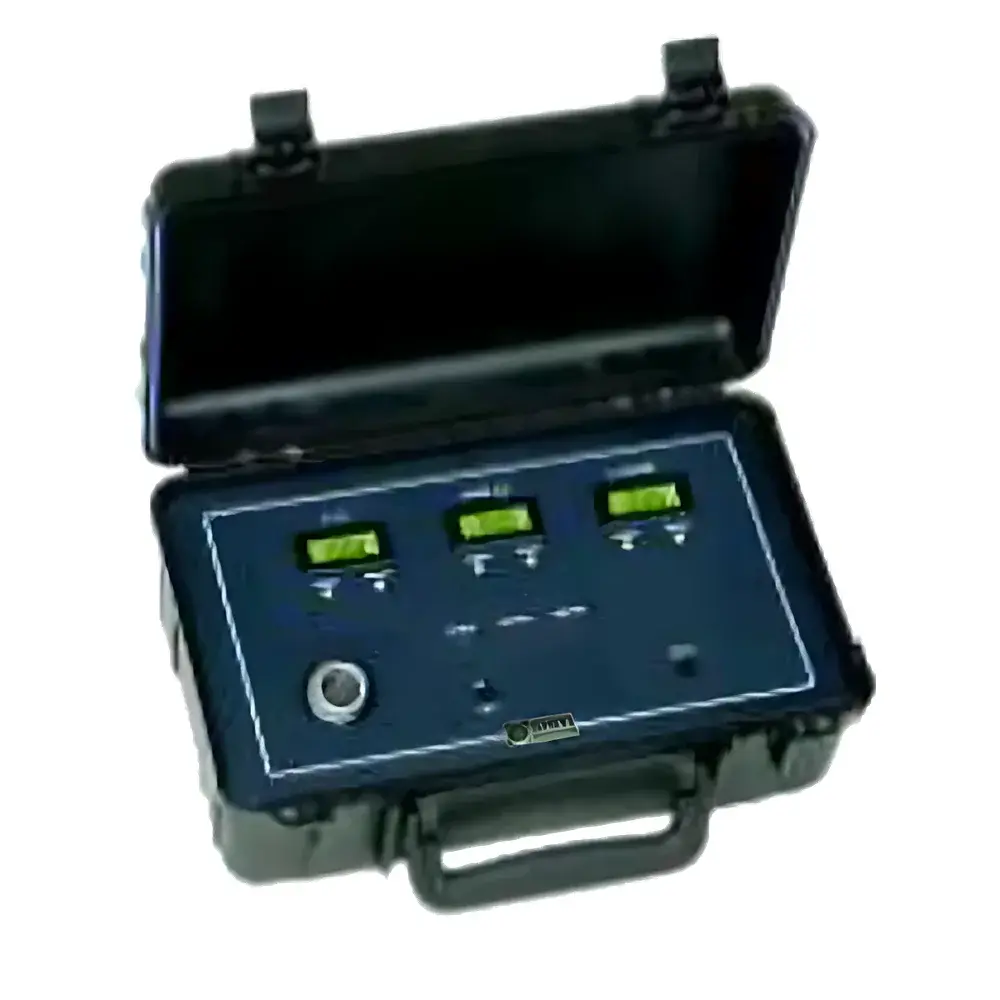
LESHI SE305 Portable Flue Gas Analyzer
| Brand | LESHI |
|---|---|
| Origin | Beijing, China |
| Model | SE305 |
| Type | Portable Flue Gas Analyzer |
| Detection Principles | Electrochemical (O₂, CO, NO, NO₂, SO₂) and Catalytic/Thermal Conversion (NO₂ → NO for NOx calculation) |
| Compliance | HJ 692–2014 (Determination of Nitrogen Oxides in Exhaust Gas from Stationary Sources — Potentiostatic Electrolysis Method) |
| Display | Backlit LCD with Single- or Multi-parameter View (O₂, CO, SO₂, NO, NO₂, NOₓ) |
| Sampling System | Integrated diaphragm pump, stainless-steel probe (with 12 ft PTFE-lined sampling hose), condenser, dual-stage particulate filter, mass flow meter, and onboard NO₂-to-NO converter |
| Optional Accessories | Continuous condensate drain module, external cooling/drying unit |
| Enclosure Rating | IP54 (dust-protected, splash-resistant) |
| Operating Temperature Range | 0–40 °C |
| Power Supply | Rechargeable Li-ion battery (≥6 h continuous operation) |
| Data Logging | Internal memory (≥10,000 records), USB export |
Overview
The LESHI SE305 Portable Flue Gas Analyzer is an engineered field instrument designed for real-time, on-site measurement of key combustion exhaust gases—including oxygen (O₂), carbon monoxide (CO), sulfur dioxide (SO₂), nitrogen monoxide (NO), nitrogen dioxide (NO₂), and total nitrogen oxides (NOₓ)—in stationary source emissions. It employs a hybrid sensing architecture: electrochemical sensors for O₂, CO, SO₂, NO, and NO₂, combined with a thermally controlled catalytic converter that quantitatively reduces NO₂ to NO prior to detection—enabling accurate, stoichiometric NOₓ calculation (NOₓ = NO + NO₂). This configuration aligns with the analytical methodology specified in HJ 692–2014, the Chinese national standard for nitrogen oxide determination in fixed-source flue gas using potentiostatic electrolysis. The system features a fully integrated sampling train: a stainless-steel probe draws sample gas through a 12-ft chemically resistant hose into a thermoelectric condenser, followed by dual-stage particulate filtration and precise mass flow regulation before reaching the sensor array. All measurements are processed in real time and rendered on a high-contrast, backlit LCD interface—supporting both individual gas concentration display and consolidated NOₓ summary views.
Key Features
- Simultaneous real-time measurement of six parameters: O₂, CO, SO₂, NO, NO₂, and calculated NOₓ
- Ruggedized, IP54-rated housing with ergonomic design for extended field deployment
- Backlit graphical LCD display enabling clear visibility under low-light or outdoor conditions
- Modular sensor and filtration architecture—sensors, filters, and condenser modules are user-replaceable without tools
- Onboard sampling system includes a maintenance-free diaphragm pump, calibrated mass flow meter, and integrated NO₂ catalytic converter
- Continuous condensate management option available via external refrigerated dryer or internal drain port with auto-evacuation capability
- Fast sensor recovery upon NOₓ over-range exposure—electrochemical cells resume stable baseline within <60 seconds post-overload
- Rechargeable lithium-ion battery supporting ≥6 hours of continuous operation; USB-C charging and data export interface
Sample Compatibility & Compliance
The SE305 is validated for use across a broad range of flue gas matrices encountered in coal-, gas-, and biomass-fired boilers; waste incinerators; cement kilns; and industrial thermal oxidizers. Its electrochemical sensor stack is optimized for typical flue gas temperature ranges (0–180 °C at probe tip, with cooled sample stream <40 °C at sensor inlet) and moisture content up to 15 vol% (when used with optional condensation control). The analyzer meets the performance criteria outlined in HJ 692–2014 for NOₓ quantification accuracy (±5% of reading or ±2 ppm, whichever is greater), linearity (R² ≥ 0.999), and response time (T₉₀ < 30 s). While not certified to ISO 12039 or EN 15267, its operational methodology and calibration traceability (via NIST-traceable span gases) support compliance with GLP-aligned field monitoring protocols and routine QA/QC verification per CNAS-CL01:2018 requirements.
Software & Data Management
Data acquisition and reporting are managed via embedded firmware with non-volatile memory storage for ≥10,000 timestamped measurement records (including date/time, ambient temperature, pressure, and all six gas concentrations). Export is supported via USB 2.0 to standard CSV format—compatible with Microsoft Excel, LabChart, or custom LIMS ingestion scripts. No proprietary software installation is required. The device supports manual zero/span calibration using certified reference gases (e.g., 0% O₂ in N₂, 100 ppm CO in air) and retains calibration history for audit purposes. Audit trails include operator ID (manually entered), calibration dates, gas cylinder lot numbers, and drift verification results—facilitating alignment with internal QA documentation and regulatory inspection readiness.
Applications
- Regulatory compliance monitoring at municipal and industrial emission stacks under China’s Ultra-Low Emission (ULE) policy framework
- Field validation of SCR/SNCR denitrification system performance—measuring pre- and post-catalyst NOₓ, NH₃ slip (indirectly via NO/NO₂ ratio shifts), and SO₂ removal efficiency
- Mobile ambient air quality surveys conducted by provincial ecological environment monitoring centers
- Teaching and research applications in environmental engineering labs—e.g., combustion optimization studies, catalyst aging experiments, and flue gas desulfurization (FGD) pilot trials
- Pre-commissioning and periodic performance audits of CEMS (Continuous Emission Monitoring Systems) as a portable reference method
FAQ
What gas detection principles does the SE305 employ?
It uses electrochemical sensors for O₂, CO, SO₂, NO, and NO₂. NO₂ is also catalytically converted to NO upstream of the NO sensor to enable direct NOₓ calculation.
Is the SE305 compliant with international standards such as ISO or EN?
It conforms to HJ 692–2014 and supports field measurement practices aligned with ISO 5866 and ASTM D6522 where applicable—but it is not CE-marked or type-approved under EN 15267.
Can the instrument operate without external power in remote locations?
Yes—the built-in rechargeable Li-ion battery provides ≥6 hours of continuous operation, and battery status is displayed in real time on the LCD.
How often must the electrochemical sensors be replaced?
Typical service life is 18–24 months under normal field use; replacement intervals depend on cumulative exposure to high-concentration SO₂, H₂S, or acidic condensates.
Does the SE305 support data logging with GPS-tagged timestamps?
No—GPS functionality is not integrated; however, UTC timestamps are embedded in all logged records, and location metadata can be manually appended during data export.
Related Products







