
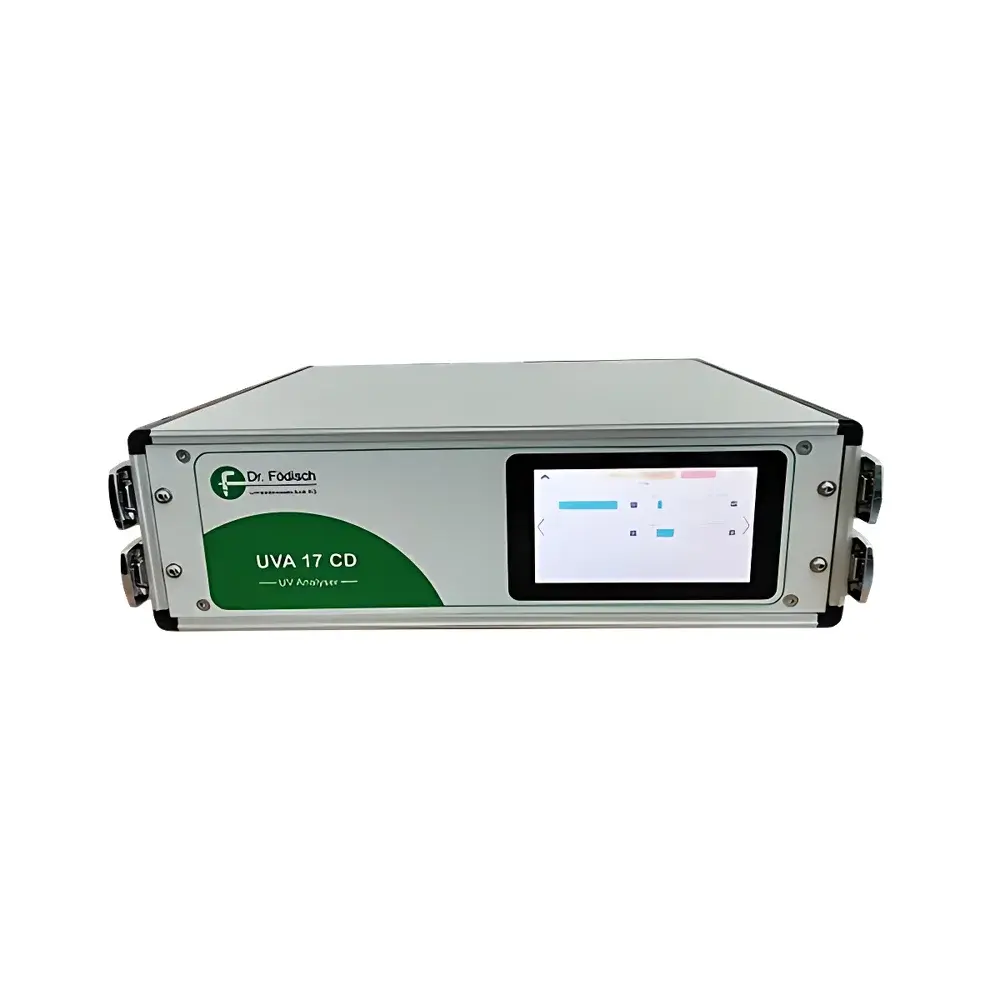
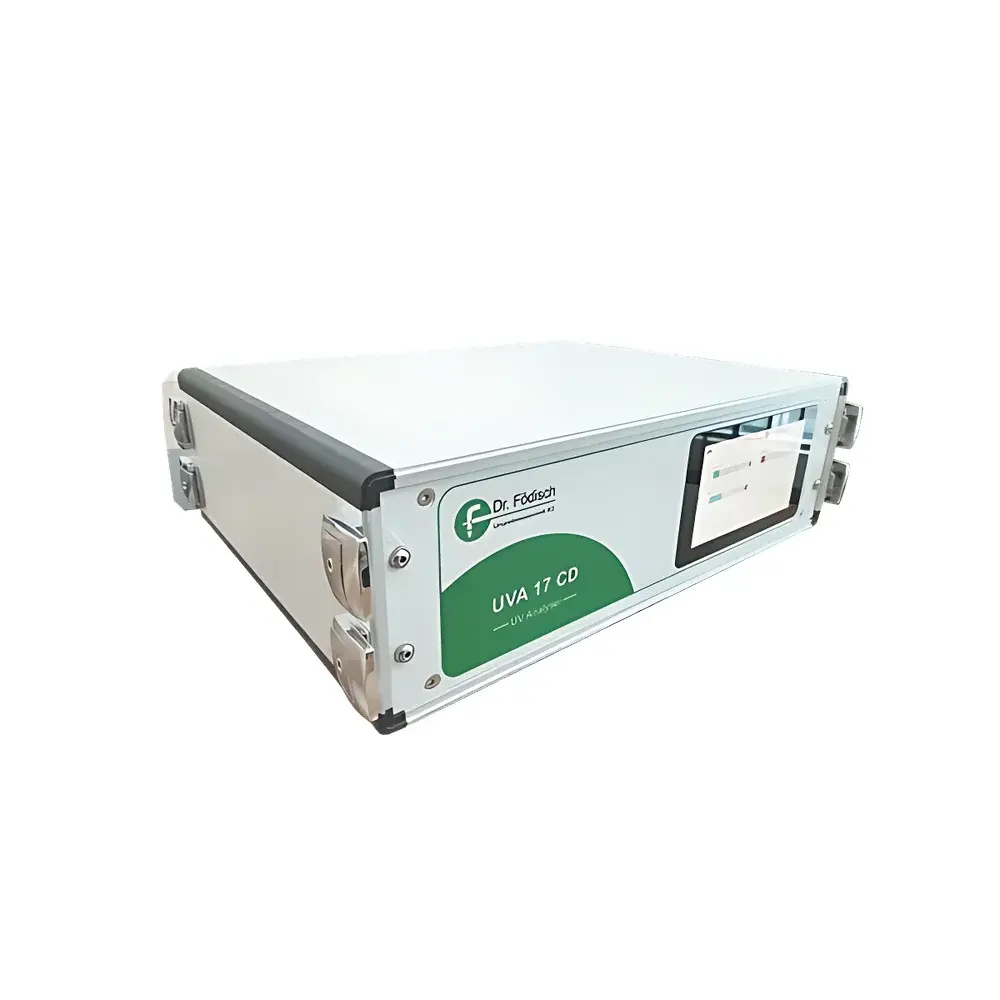
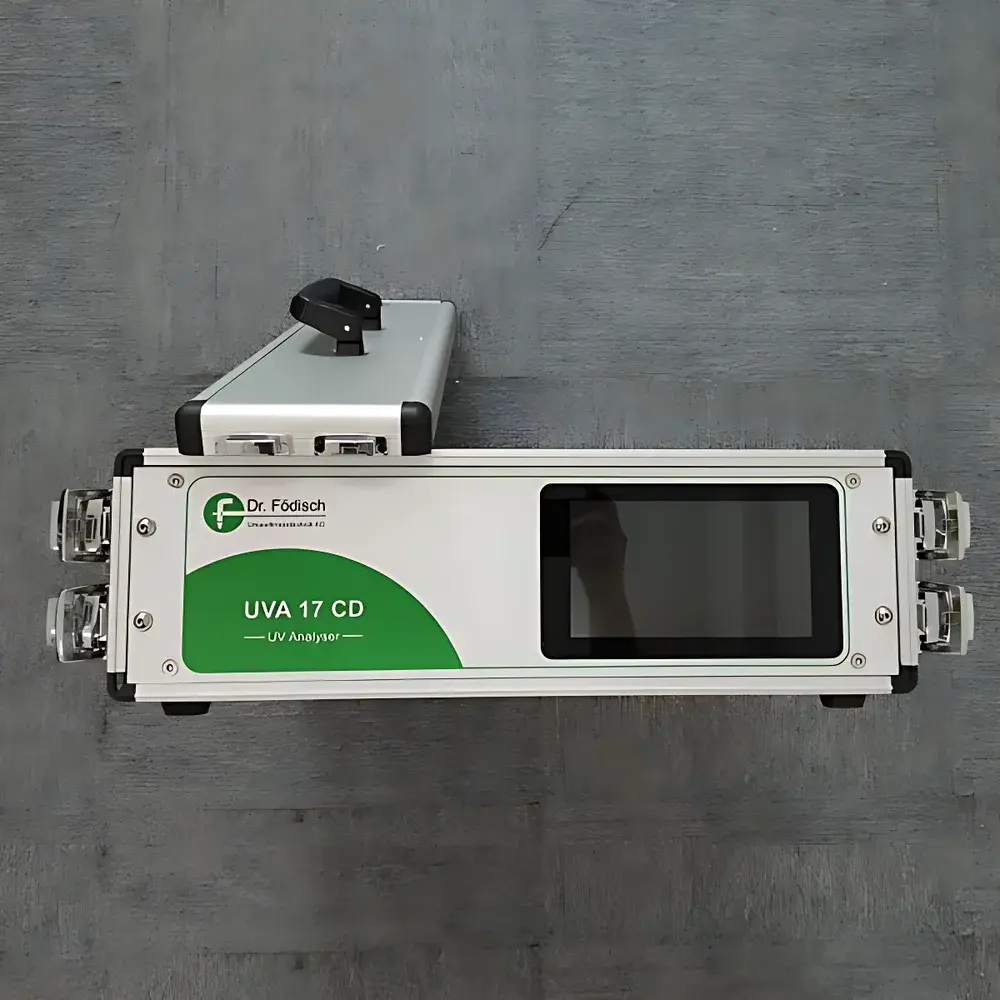
Foedisch UVA17m CD Portable UV Differential Absorption Flue Gas Analyzer
| Brand | Foedisch |
|---|---|
| Origin | Germany |
| Model | UVA17m CD |
| Instrument Type | Portable Flue Gas Analyzer |
| Measurement Principle | UV Differential Absorption Spectroscopy (UV-DOAS) for NO, NO₂, SO₂, NH₃, H₂S |
| Compliance | HJ 1131–2020, HJ 1132–2020, HJ/T 397–2007, JJG 968–2002, DB37/T 2704–2015, DB37/T 2705–2015, DB37/T 2641–2015 |
| Operating Environment | High-humidity, low-sulfur flue gas streams |
| Key Performance Attributes | Moisture-insensitive measurement, dual-range auto-switching, high-temperature sample path (180 °C), integrated thermal stabilization of optical components, sub-ppm detection limits, cross-interference compensation algorithm |
Overview
The Foedisch UVA17m CD is a portable, field-deployable flue gas analyzer engineered for regulatory-grade quantification of key combustion pollutants in stationary emission sources. At its core lies ultraviolet differential optical absorption spectroscopy (UV-DOAS), a physics-based, non-dispersive spectral technique that resolves trace gas concentrations by measuring wavelength-specific attenuation of broadband UV light across a precisely calibrated optical path. Unlike NDIR or electrochemical methods, UV-DOAS inherently rejects interference from water vapor and particulate scattering—critical for accurate measurements in wet, low-SO₂ industrial stacks (e.g., waste incineration, biomass boilers, and municipal heating plants). Complementing the UV module, a high-stability zirconia oxygen sensor provides independent, temperature-compensated O₂ measurement per ISO 14644-1 and EN 15267-3 requirements. The instrument’s full-path heated design (180 °C hot-wet sampling) eliminates condensation artifacts and preserves molecular integrity throughout transport and analysis.
Key Features
- True hot-wet measurement architecture: Integrated 180 °C heated sampling line, probe, filter, and optical cell—no dilution, no drying, no bias from phase change.
- Dual-range UV spectrometer with automatic range switching: Optimized sensitivity for both ambient background (e.g., 0–50 ppm NO) and high-emission scenarios (e.g., 0–1000 ppm SO₂), ensuring <±2% FS accuracy across full span per HJ 1131–2020.
- Thermally stabilized optical bench: Critical UV light source (deuterium lamp) and detector array maintained at constant temperature to minimize spectral drift and photometric noise over extended field deployments.
- Chemometric interference correction engine: Real-time multivariate algorithm compensates for overlapping absorption bands (e.g., NO₂/SO₂ cross-sensitivity, H₂S/NH₃ spectral overlap) using reference spectra validated against NIST-traceable gas standards.
- Ruggedized human-machine interface: 7-inch sunlight-readable industrial touchscreen with tactile keypad backup; supports glove-compatible operation and IP65-rated enclosure for outdoor stack access.
- Onboard data integrity framework: Automatic timestamping, audit trail logging, and electronic signature support compliant with GLP and EPA Method 205 requirements.
Sample Compatibility & Compliance
The UVA17m CD is validated for direct analysis of undiluted flue gases containing up to 25% vol. H₂O, ≤10 g/m³ total suspended particulates, and operating temperatures up to 200 °C at the probe tip. It meets all technical and metrological criteria defined in Chinese national standards HJ 1131–2020 (SO₂), HJ 1132–2020 (NOₓ), and DB37/T 2641–2015 (multi-gas UV systems), including linearity (<±1.5% R²), repeatability (<±1.0% RSD), and zero-drift (<0.5% FS/24 h). Its measurement uncertainty budget has been independently verified per ISO/IEC 17025:2017 Annex A.3 for environmental emission testing laboratories. While designed for China’s regulatory ecosystem, its UV-DOAS methodology aligns with EN 15267-3 Type Approval principles and supports equivalency assessments under EU IED monitoring protocols.
Software & Data Management
- Embedded firmware v4.2 includes configurable reporting templates aligned with HJ/T 397–2007 field log formats, with one-click export to CSV, PDF, and XML (for integration into provincial EMS platforms).
- PC-based Foedisch AnalyzeSuite™ (v3.1) enables advanced spectral review, baseline correction, and multi-point calibration validation using stored raw absorbance matrices.
- Optional LTE-M IoT module supports TLS 1.2-encrypted MQTT transmission to cloud dashboards, with configurable alarm thresholds and remote firmware updates—fully auditable under FDA 21 CFR Part 11 Annex 11 requirements.
- All measurement sessions generate immutable records including spectral snapshots, calibration history, flow/pressure logs, and operator ID—retained for ≥12 months on internal eMMC storage.
Applications
The UVA17m CD serves as a primary verification tool for CEMS compliance audits, periodic stack testing, and process optimization in energy-intensive sectors. Typical use cases include: continuous emission monitoring system (CEMS) performance evaluation per HJ 75–2017; combustion efficiency tuning via real-time O₂ + NOₓ co-monitoring; sulfur capture rate assessment in wet FGD units; fugitive emission screening during maintenance outages; and method validation for laboratory reference analyzers. Its immunity to moisture-induced quenching makes it especially suited for biogas-fired engines, sewage sludge incinerators, and marine auxiliary boiler exhaust—environments where conventional IR or chemiluminescence analyzers exhibit significant water vapor bias.
FAQ
Does the UVA17m CD require zero/span calibration before each test?
Per HJ/T 397–2007 Section 6.3.2, a single pre-test zero check (using certified N₂) and span verification (using traceable NO/SO₂/NH₃ mixtures) are mandatory; automated daily zero tracking reduces manual intervention frequency.
Can it measure ammonia (NH₃) without interference from NO₂ or H₂O?
Yes—the UV-DOAS spectral deconvolution algorithm applies constrained least-squares fitting using high-resolution reference spectra, achieving <3% relative interference from 100 ppm NO₂ in 200 ppm NH₃ measurements.
What is the typical response time (T90) for SO₂ at 50 ppm?
12 seconds under standard 1 L/min sampling flow, verified per HJ 1131–2020 Annex B using dynamic permeation tube calibrators.
Is the zirconia O₂ sensor replaceable in the field?
Yes—the O₂ module is a user-serviceable cartridge with factory pre-calibration; replacement requires no optical realignment or firmware reconfiguration.
How is data integrity ensured during power interruption?
Internal supercapacitor sustains memory and clock for >72 hours; all active measurements are checkpointed to non-volatile memory every 5 seconds.







