
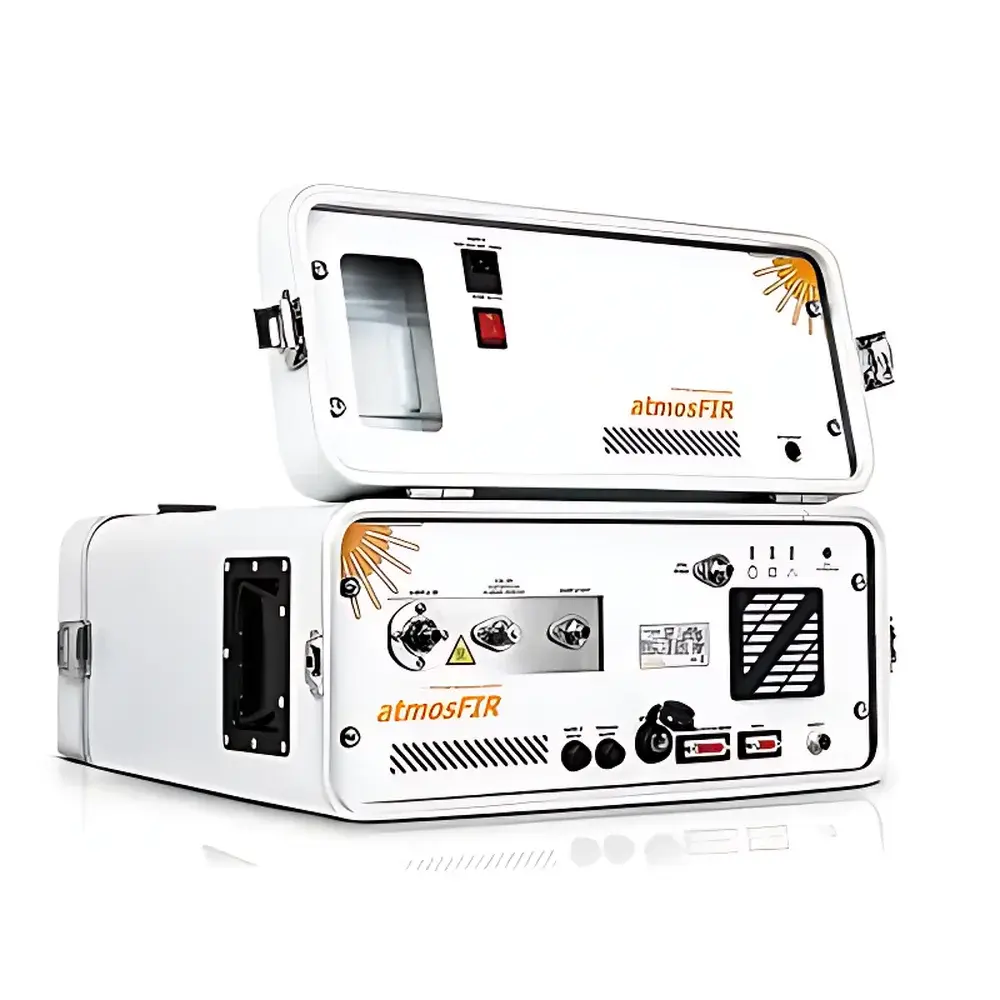
Protea AtmosFIR Portable Fourier Transform Infrared (FTIR) Gas Analyzer
| Brand | Protea |
|---|---|
| Origin | United Kingdom |
| Model | AtmosFIR (Fixed Emission Source Version) |
| Instrument Type | Portable Flue Gas Analyzer |
| Measurement Principle | Fourier Transform Infrared Spectroscopy (FTIR) |
| Detection Targets | CO₂, H₂O, CO, SO₂, NO, HF, CH₄, HCN, and up to 1000+ gases |
| Repeatability | ±1% of full scale |
| Response Time | 120 s (T₉₀) |
| Operating Temperature Range | Heated optical path up to 180 °C |
| Detector | Thermoelectrically cooled DTGS (Deuterated Triglycine Sulfate) |
| Certification | UK MCERTS, M22 (Flue Gas Monitoring), ISO 14001-compliant design |
| Enclosure Rating | IP65-rated rugged transport case |
| Weight | <18 kg (carbon-fiber reinforced composite chassis) |
| Power Supply | 24 V DC or universal AC adapter (100–240 V, 50/60 Hz) |
| Data Output | USB 3.0, Ethernet, optional 4–20 mA analog outputs |
| Software Platform | PAS (Protea Analysis Suite) with PLS multivariate calibration engine |
Overview
The Protea AtmosFIR Portable Fourier Transform Infrared (FTIR) Gas Analyzer is an engineered solution for real-time, multi-component quantitative analysis of hot, humid, and corrosive industrial exhaust streams—including flue gas, combustion emissions, and process off-gases. Based on high-resolution interferometric FTIR spectroscopy, the AtmosFIR captures full mid-infrared spectra (typically 600–4000 cm⁻¹) with spectral resolution configurable down to 0.5 cm⁻¹. Unlike filter-based or electrochemical sensors, FTIR enables simultaneous detection and quantification of dozens of analytes—including regulated pollutants (CO, NO, SO₂, HF), greenhouse gases (CO₂, CH₄, N₂O), moisture (H₂O), and volatile organic compounds (VOCs)—within a single measurement cycle. Its heated optical path (up to 180 °C), thermoelectrically cooled DTGS detector, and robust carbon-fiber chassis eliminate the need for cryogenic cooling or external conditioning units—making it uniquely suited for field-deployable compliance monitoring at fixed emission sources per EN 15267 and EPA Method 320.
Key Features
- Integrated heated sampling system: Built-in heated probe, heated sample line controller, and heated internal filter—fully synchronized with FTIR data acquisition to prevent condensation and adsorption losses.
- No pre-analyzer gas conditioning required: Eliminates external scrubbers, chillers, or dilution systems—reducing maintenance burden and calibration drift.
- Ruggedized portable architecture: Carbon-fiber composite housing, IP65-rated transport case, and <18 kg total mass enable rapid deployment across stack testing sites, landfill perimeter surveys, and mobile CEMS verification campaigns.
- Dual-sensor oxygen measurement: Integrated paramagnetic or electrochemical O₂ sensor provides stoichiometric reference for excess air correction and NOₓ conversion efficiency calculations.
- Modular flow control: Optional mass flow controller supports dynamic range extension for high-concentration analytes (e.g., CO >10% v/v) and automated linearity validation per EN 14181 QAL2.
- Field-configurable spectral library: PAS software includes certified calibration models traceable to NPL and BAM standards; users may add custom gases offline without hardware modification.
Sample Compatibility & Compliance
The AtmosFIR is validated for direct analysis of raw, unconditioned flue gas streams containing particulates ≤10 µm, moisture up to 40% v/v, and temperatures up to 200 °C at the probe tip. Its heated optical bench maintains dew point margin throughout the interferometer and detector path, ensuring long-term stability in high-humidity environments. The instrument meets UK MCERTS Performance Standards for Continuous Emission Monitoring Systems (CEMS) and carries formal M22 certification for periodic stack testing under the Environmental Permitting Regulations. Design and documentation support audit readiness for ISO 14001, ISO 9001, and GLP-compliant environmental laboratories. All firmware and PAS software versions maintain full traceability logs compliant with FDA 21 CFR Part 11 requirements for electronic records and signatures.
Software & Data Management
The Protea Analysis Suite (PAS) is a Windows-based platform delivering full spectral acquisition, chemometric modeling, and regulatory reporting in a single interface. It implements Partial Least Squares (PLS) regression with cross-validation and residual diagnostics to ensure robust multivariate quantification—even in overlapping spectral regions (e.g., NO/NO₂, HCN/HF). PAS automates mandatory QA/QC procedures including zero/span drift assessment, limit of detection (LOD) and limit of quantitation (LOQ) calculation per ISO 11843-2, and residual interference checks per EN 15267-3 Annex D. All raw interferograms and processed spectra are stored in HDF5 format with embedded metadata (time stamp, GPS coordinates, operator ID, calibration history), enabling retrospective re-analysis as new calibration models become available. Export options include CSV, XML (for EMIS integration), and PDF reports formatted to EPA 75, EN 14181, and China HJ 75–2017 templates.
Applications
- Regulatory stack testing: Routine and periodic compliance verification for thermal power plants, cement kilns, waste incinerators, and chemical reactors.
- CEMS performance audit: Independent validation of installed online analyzers using identical measurement physics and calibration traceability.
- VOC speciation and fugitive emission screening: Identification and quantification of halogenated hydrocarbons, aldehydes, ketones, and aromatic compounds in refinery flare gas or solvent recovery vents.
- Combustion optimization studies: Real-time feedback on equivalence ratio, flame temperature proxies (via H₂O/CO₂ ratio), and incomplete combustion markers (CO, unburnt hydrocarbons).
- Landfill and biogas monitoring: Simultaneous tracking of CH₄, CO₂, H₂S, NH₃, and siloxanes to assess gas quality and corrosion risk in energy recovery systems.
- Research-grade emission characterization: High-resolution spectral libraries support method development for emerging contaminants (e.g., PFAS precursors, fluorinated ethers) under EU REACH and US TSCA frameworks.
FAQ
Does the AtmosFIR require liquid nitrogen or external cooling?
No—the DTGS detector is thermoelectrically cooled and operates stably at ambient temperatures without cryogens.
Can it be used as a permanent CEMS component?
Yes—its 19-inch rack-mount option and IP65-rated enclosure support both mobile survey and fixed-site installation, meeting EN 14181 QAL1 requirements when deployed with certified calibration gases.
How is calibration traceability maintained?
All factory calibrations are performed using NPL- or BAM-certified standard gas mixtures; PAS stores full calibration certificate metadata and supports user-initiated span checks with audit-trail logging.
Is PAS software validated for 21 CFR Part 11 compliance?
Yes—PAS includes role-based access control, electronic signatures, audit trail generation, and data integrity safeguards aligned with FDA and EMA guidance for regulated environments.
What maintenance intervals are recommended?
Optical alignment and detector performance verification every 12 months; heated filter replacement every 3–6 months depending on particulate load—no consumables required for the FTIR core.







