
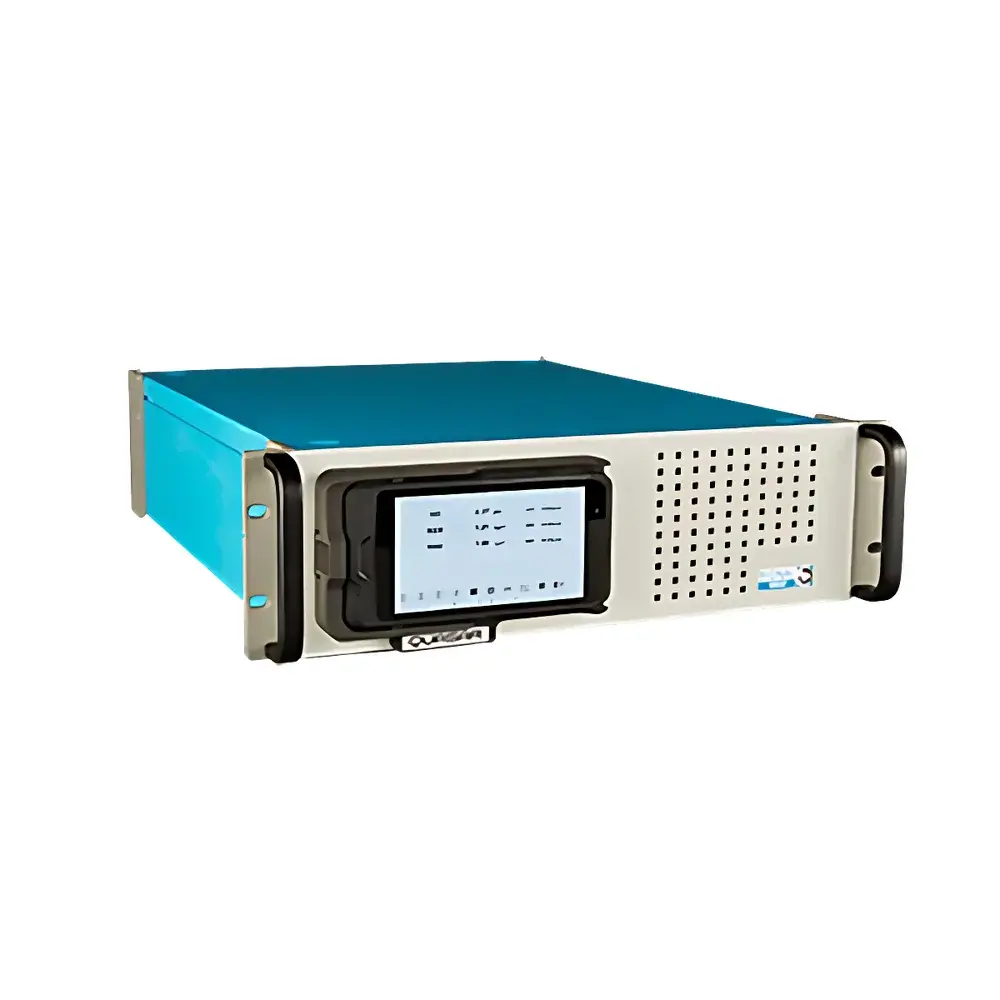
Signal QUASAR Online Chemiluminescence NOₓ Analyzer
| Brand | Signal |
|---|---|
| Origin | United Kingdom |
| Model | QUASAR |
| Detection Principle | Heated Vacuum Chemiluminescence |
| Measurement Targets | NO, NO₂, NOₓ (and optionally NH₃) |
| Operating Modes | Continuous Real-Time Monitoring |
| Compliance Standards | EN 14792, US EPA Method 7E |
| Vacuum System | Dry High-Vacuum Pump (standard) or Ambient-Pressure Option |
| Reaction Chamber | Heated (100–150 °C), Moisture-Tolerant |
| Detection Sensitivity | Sub-ppm (≤0.1 ppm) for NOₓ |
| Output | Simultaneous NO, NO₂, and NOₓ concentrations |
| Data Logging | Optional Integrated Color Touchscreen with Internal Storage |
| Software Interface | Windows-based Remote Control & Configuration (VB API Support) |
| Alarm Types | 10 Configurable Fault/Threshold Alarms (e.g., flow deviation, heater failure, EHT drift, calibration timeout, thermocouple fault) |
| Optional Ranges | Trace (0–10 ppm) and High-Range (0–10,000 ppm or 0–10% vol) |
| Sample Compatibility | Wet, hot, corrosive flue gases without pre-conditioning |
| Regulatory Context | Designed for GLP-compliant environmental monitoring and CEMS integration |
Overview
The Signal QUASAR Online Chemiluminescence NOx Analyzer is a reference-grade continuous emission monitoring system engineered for regulatory-compliant measurement of nitrogen oxides (NO, NO2, and total NOx) in industrial, combustion, and research environments. It employs heated vacuum chemiluminescence detection — the internationally recognized reference method for NOx quantification per EN 14792 and US EPA Method 7E. In this technique, nitric oxide (NO) reacts with ozone (O3) in a temperature-controlled, high-vacuum reaction chamber to generate light in the near-UV range (~600–3000 nm). The emitted photons are detected by a low-noise photomultiplier tube (PMT), delivering high signal-to-noise ratios and minimal quenching interference from CO2, H2O, and hydrocarbons. Unlike ambient-pressure CLD systems, the QUASAR’s vacuum environment enhances photon collection efficiency and eliminates pressure-dependent reaction kinetics, enabling stable sub-ppm detection limits even under variable sample matrix conditions.
Key Features
- Heated vacuum reaction chamber (operating at 100–150 °C) tolerant of wet, hot, and condensable sample streams — eliminating need for external gas conditioning or chiller-based drying.
- Dual-channel photometric detection architecture supporting simultaneous, real-time quantification of NO, NO2 (via catalytic converter), and total NOx with independent calibration traceability.
- Configurable operating modes: dry high-vacuum pump (standard) or ambient-pressure variant for applications where vacuum maintenance is operationally constrained.
- Thermal management options include both “hot” (fully heated sample path) and “cold” (ambient inlet + heated reaction zone) configurations to suit diverse stack or lab gas handling requirements.
- Integrated color touchscreen interface with onboard data logging (up to 30 days at 1-second resolution), time-stamped event logging, and user-accessible calibration history.
- Full remote operability via Windows-native software with Visual Basic API support — enabling seamless integration into SCADA, DCS, or custom LIMS environments.
- Comprehensive alarm architecture with ten programmable fault conditions, including sample flow deviation, heater temperature excursion, EHT supply instability, thermocouple failure, and calibration validity timeout.
Sample Compatibility & Compliance
The QUASAR is validated for direct analysis of untreated flue gases from combustion sources, engine exhausts, and process streams containing up to 25% water vapor and moderate particulate loading. Its heated sampling train prevents condensation-related adsorption losses and ensures quantitative recovery of reactive NO2. The analyzer meets the performance criteria specified in EN 14792 (Ambient Air Quality — Standard Method for Measurement of NO and NO2) and US EPA Method 7E (Determination of Nitrogen Oxides Emissions from Stationary Sources). It supports audit-ready operation under GLP and ISO/IEC 17025 frameworks, with configurable audit trails, electronic signatures, and calibration lockout features compatible with FDA 21 CFR Part 11 requirements when deployed in regulated pharmaceutical or medical gas manufacturing settings.
Software & Data Management
Signal’s QUASAR Control Suite provides full instrument configuration, diagnostics, calibration scheduling, and data export in CSV or XML formats. The software implements automated zero/span validation routines with configurable pass/fail thresholds and generates compliance reports aligned with EU IED and US Clean Air Act reporting templates. All calibration events, parameter changes, and alarm triggers are timestamped and stored with user ID attribution. For enterprise-level deployment, the VB API enables bidirectional communication with third-party platforms, supporting automated calibration log synchronization, alarm forwarding via SMTP/SNMP, and real-time data streaming to cloud-based analytics engines.
Applications
- Continuous emissions monitoring systems (CEMS) for thermal power plants, cement kilns, and waste incinerators.
- Engine development and certification testing — capturing transient NOx dynamics during WLTC, RDE, or ISO 8178 cycles.
- Combustion optimization studies in gas turbines, boilers, and aftertreatment systems (e.g., SCR, EGR).
- Process gas quality assurance in on-site NOx generation for semiconductor etching or medical nitric oxide therapy gas production.
- Research laboratories conducting atmospheric chemistry, catalyst deactivation, or low-temperature oxidation kinetics.
FAQ
Is the QUASAR suitable for measuring NO2 directly without conversion?
No — NO2 is quantified indirectly via catalytic reduction to NO in a molybdenum or stainless-steel converter; total NOx is calculated as the sum of measured NO and converter-derived NO.
Can the analyzer operate continuously in high-humidity exhaust streams?
Yes — the fully heated sample path (up to 180 °C) and vacuum reaction chamber eliminate condensation artifacts and ensure stable baseline performance across 0–100% relative humidity.
What calibration gases are required for routine operation?
Primary calibrants include certified NO-in-N2 (for NO channel), NO2-in-air (for converter efficiency verification), and zero air (synthetic or catalytically purified); ozone generator output is internally verified via UV absorption.
Does the system support automatic span validation with internal ozone generation?
Yes — integrated ozone generation allows dynamic span checks without external gas cylinders, reducing operational overhead and improving long-term measurement consistency.
How is data integrity maintained during power interruptions or network outages?
Onboard non-volatile memory retains all operational logs, calibration records, and 30+ days of second-resolution concentration data — synchronized to host systems upon recovery.
Related Products







