
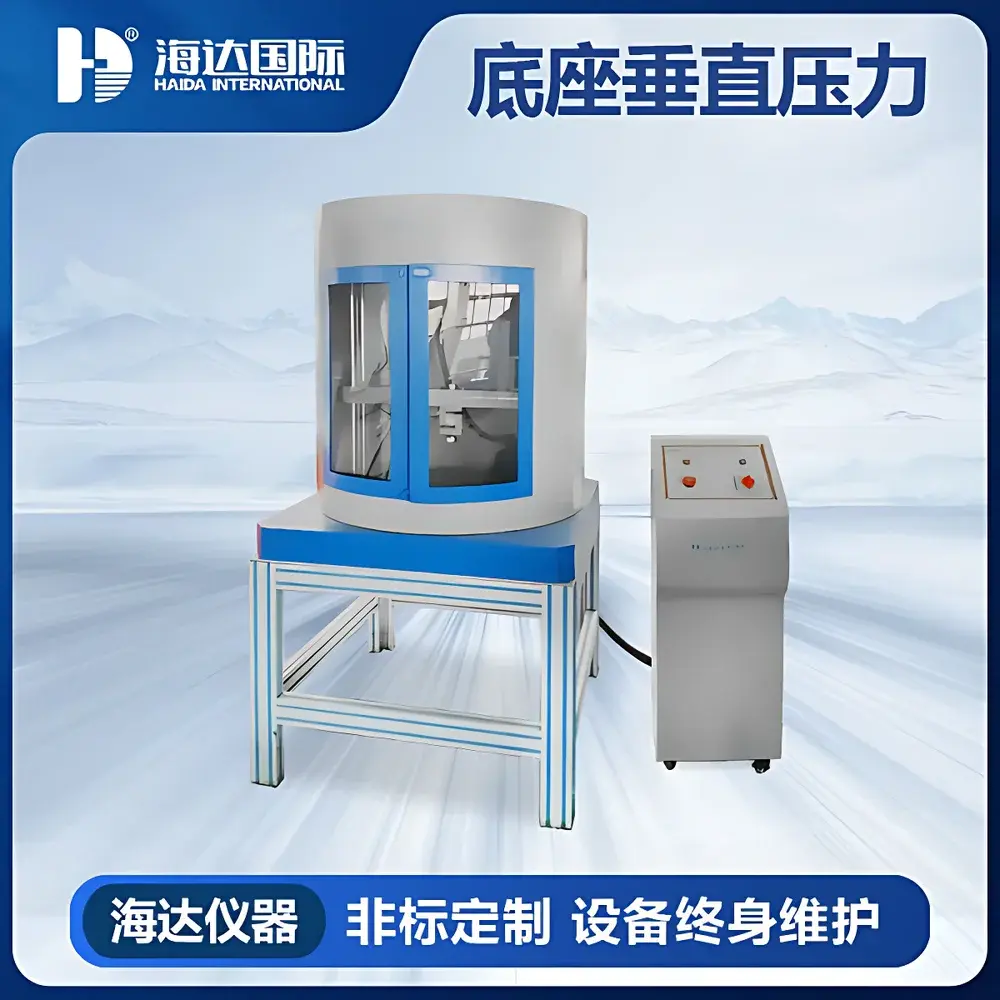
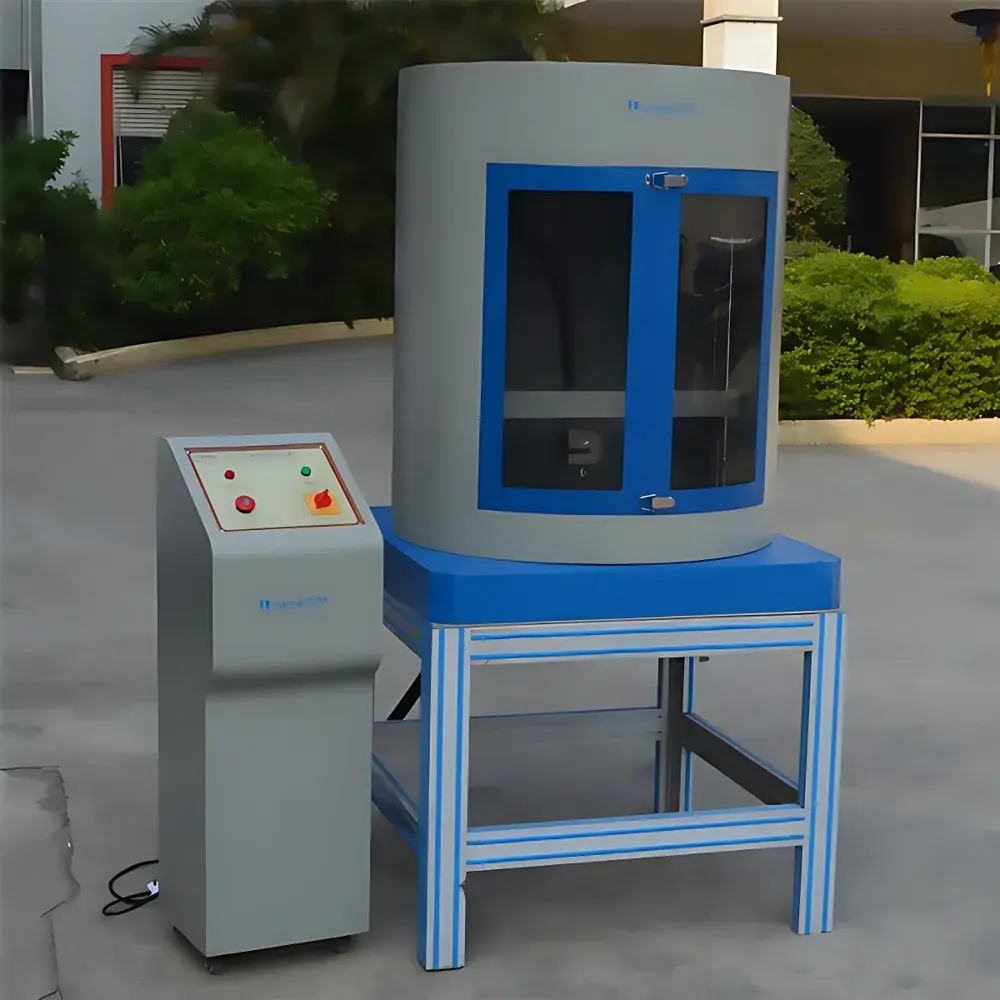
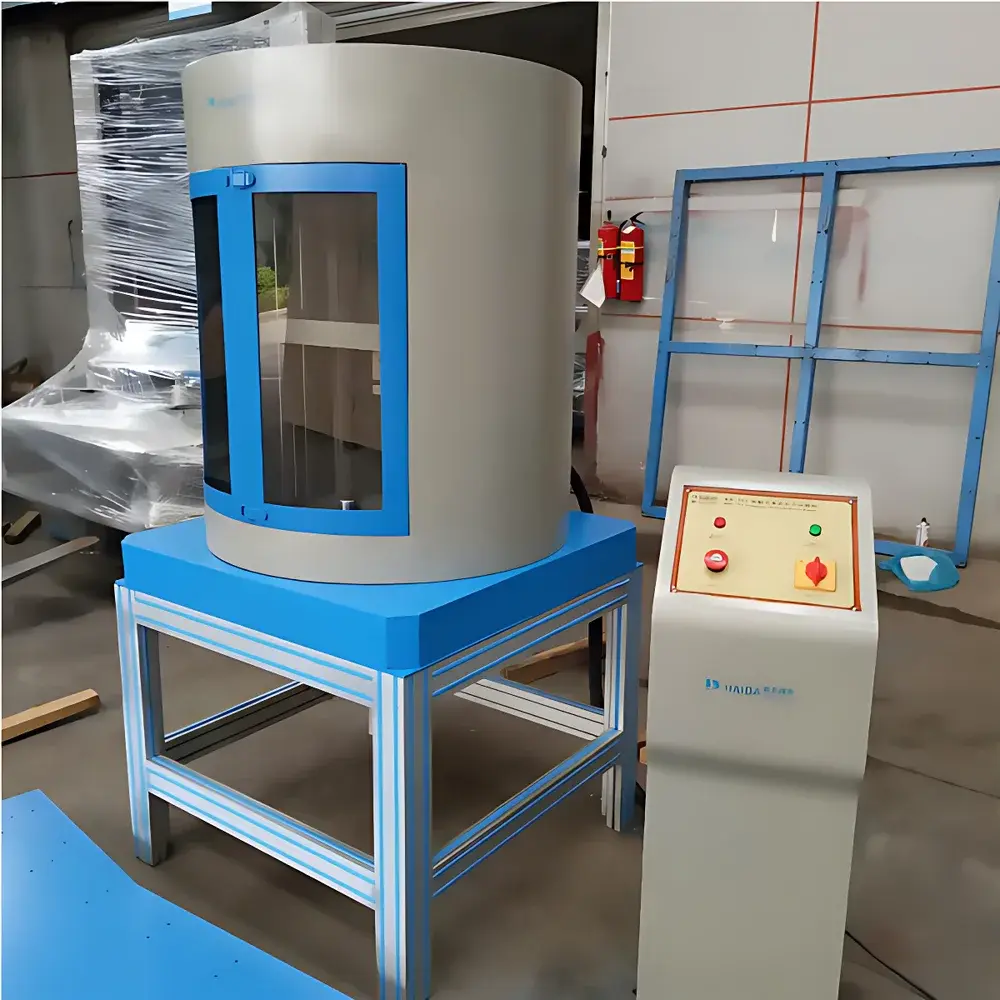
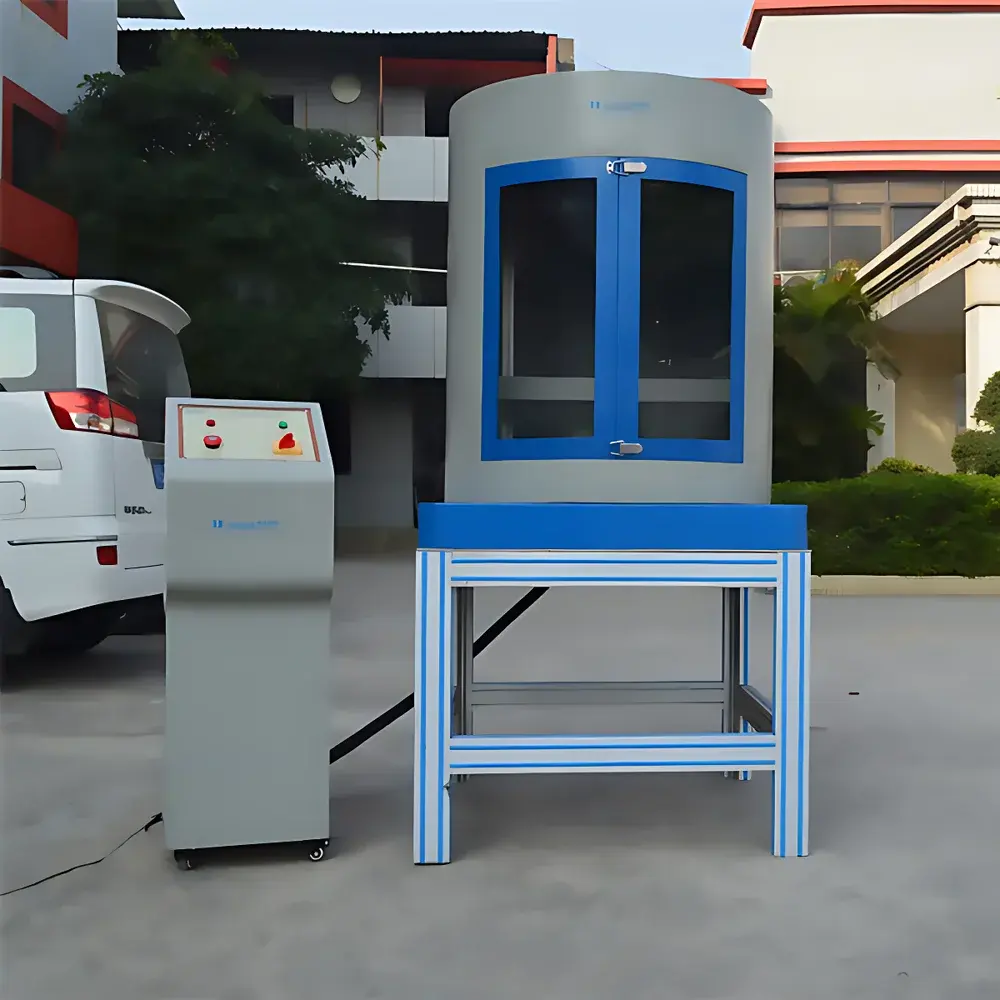
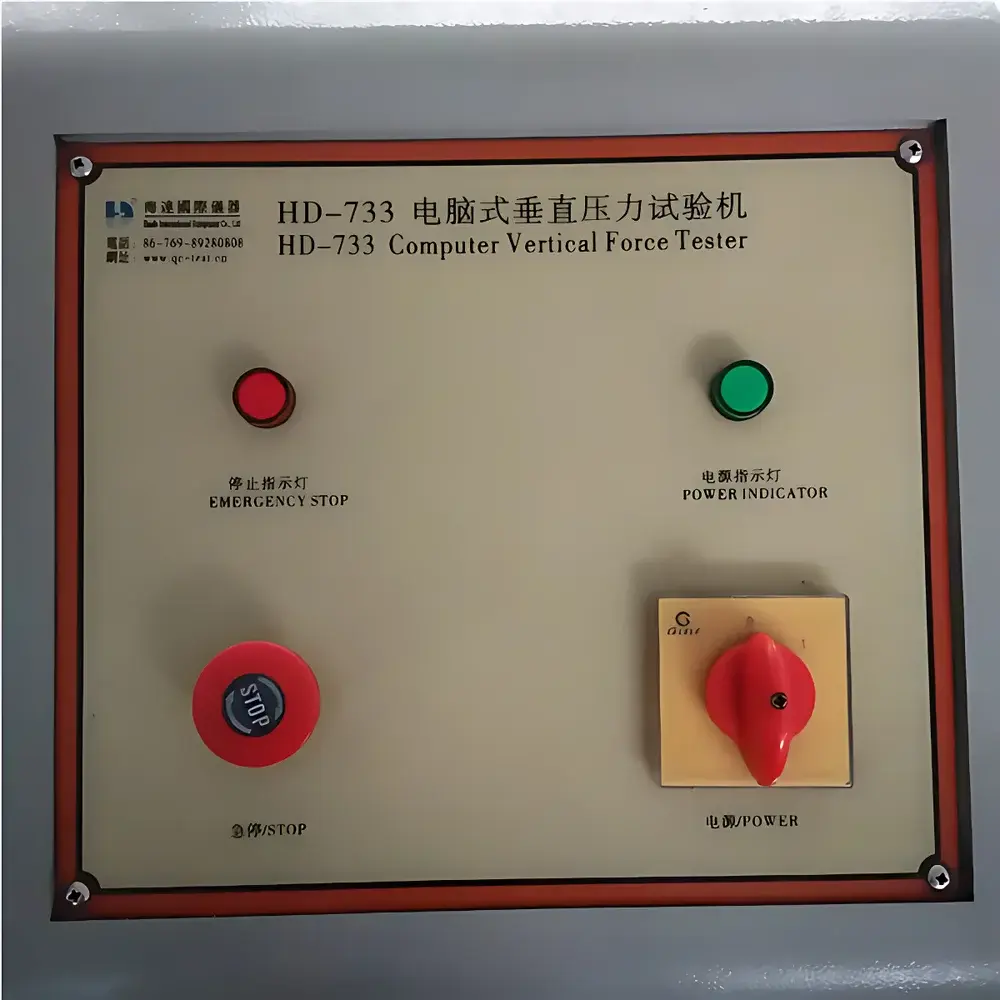
HAIDA HD-F733-1 Office Chair Base Vertical Load Tester
| Brand | HAIDA INTERNATIONAL |
|---|---|
| Origin | Guangdong, China |
| Manufacturer Type | Direct Manufacturer |
| Product Category | Domestic |
| Model | HAIDA HD-F733-1 Office Chair Base Vertical Load Tester |
| Max Test Force | 1–30 kN |
| Speed Range | 0.1–120 mm/min (adjustable) |
| Host Weight | ~300 kg |
Overview
The HAIDA HD-F733-1 Office Chair Base Vertical Load Tester is a precision-engineered static load testing system designed specifically for evaluating the structural integrity and compressive endurance of five-star chair bases under controlled vertical force application. Built upon a robust dual-column electromechanical architecture, it implements quasi-static loading protocols in strict accordance with internationally recognized furniture performance standards—including BIFMA X5.1 Appendix C (Vertical Load Test for Chair Bases) and QB/T 2280–2016 (Office Chair Standard, People’s Republic of China). The instrument applies calibrated axial force through a high-stiffness load train comprising a precision-ground ball screw, Panasonic servo motor (750 W), and a DIN-certified load cell—enabling repeatable, traceable, and GLP-compliant test execution. Its primary operational mode simulates real-world usage conditions: stepwise loading to specified force levels (e.g., 1,200 N or 2,500 N), 60-second dwell periods, unloading, and reapplication—capturing both elastic recovery and permanent deformation behavior of polyamide, aluminum alloy, and reinforced nylon base components.
Key Features
- High-accuracy load measurement: Integrated German-sourced load cell with ≤ ±0.5% full-scale accuracy and 1/200,000 internal resolution, supporting unit conversion across N, kN, kgf, lbf, and gf;
- Dual-column rigid frame constructed from A3 structural steel, CNC-bent and laser-cut, finished with electrostatic powder coating (gloss white + metallic blue);
- Panasonic 750 W servo motor and drive system paired with imported preloaded ball screws for smooth, backlash-free motion control and long-term mechanical stability;
- Direct PC-to-instrument communication via DB9 serial interface—eliminating network latency or USB hub interference for deterministic data acquisition;
- Wireless local operation capability via dedicated handheld controller, enabling standalone height adjustment and emergency stop without host PC dependency;
- Comprehensive safety architecture: programmable upper/lower mechanical limit switches, software-enforced overload cutoff, automatic return-to-home after test completion, and fail-safe power-off on sensor fault detection.
Sample Compatibility & Compliance
The HD-F733-1 accommodates chair bases up to 750 mm in maximum diameter and 650 mm effective test height (excluding fixtures). Its modular fixture set—including adjustable support columns, flat/curved contact platens, and centering alignment guides—ensures consistent load distribution across diverse base geometries (e.g., injection-molded nylon starbases, die-cast aluminum hubs, and hybrid composite assemblies). All test procedures are fully aligned with regulatory frameworks governing commercial furniture certification: BIFMA X5.1 (U.S.), EN 1335–1:2012 (Europe), ISO 7174–1:2015 (global ergonomics), and QB/T 2280–2016 (China). Data logs include timestamped force-displacement curves, peak load retention values, and post-test dimensional deviation metrics—structured to satisfy internal QA audits and third-party certification submissions under ISO/IEC 17025 requirements.
Software & Data Management
The proprietary HAIDA TestMaster™ software (v4.2+) runs natively on Windows OS and supports multilingual UI (English, Simplified Chinese, Traditional Chinese). It provides real-time graphical monitoring of load vs. displacement, configurable test sequences (single-step, multi-cycle, ramp-hold-ramp), and automated report generation compliant with GLP documentation standards. Audit trail functionality records all user actions—including parameter edits, calibration events, and manual overrides—with immutable timestamps. Export formats include CSV (for statistical analysis in Minitab or JMP), PDF (certification-ready reports), and XML (interoperability with LIMS platforms). The software enforces 21 CFR Part 11–compatible electronic signatures and role-based access control (admin/operator modes), ensuring data integrity throughout the product development and quality assurance lifecycle.
Applications
- Validation of five-star base fatigue resistance during new product introduction (NPI) for OEM office furniture manufacturers;
- Supplier qualification testing for casters, gas lifts, and base assemblies prior to final assembly;
- Root cause analysis of field failures related to base cracking, leg splay, or weld joint separation;
- Comparative benchmarking of material substitutions (e.g., PA66-GF30 vs. AlSi10Mg via die-casting) under identical loading profiles;
- Pre-compliance screening for BIFMA, ANSI/BIFMA, and CE-marking certification workflows;
- Internal R&D stress mapping to inform topology optimization of base rib structures using FEA correlation datasets.
FAQ
What standards does the HD-F733-1 directly support?
It is configured to execute BIFMA X5.1 Appendix C and QB/T 2280–2016 vertical load test protocols out-of-the-box, with customizable parameters for EN 1335–1 and ISO 7174–1 adaptations.
Is the system suitable for cyclic fatigue testing?
No—the HD-F733-1 is optimized for static and quasi-static load hold tests; for dynamic fatigue evaluation (e.g., 100,000-cycle endurance), HAIDA recommends the HD-F750 series electrodynamic fatigue testers.
Can test data be integrated into an existing MES or QMS platform?
Yes—via native CSV/XML export, OPC UA-compatible middleware integration, or direct database write-through using ODBC drivers included with the software suite.
What maintenance intervals are recommended for long-term accuracy?
Annual recalibration of the load cell per ISO 376:2011 is advised; mechanical inspection of ball screws and linear guides every 6 months under continuous operation.
Does the system include validation documentation for regulated environments?
Yes—factory-issued IQ/OQ documentation packages (including installation checklists, operational verification scripts, and traceable calibration certificates) are available as optional add-ons.



