
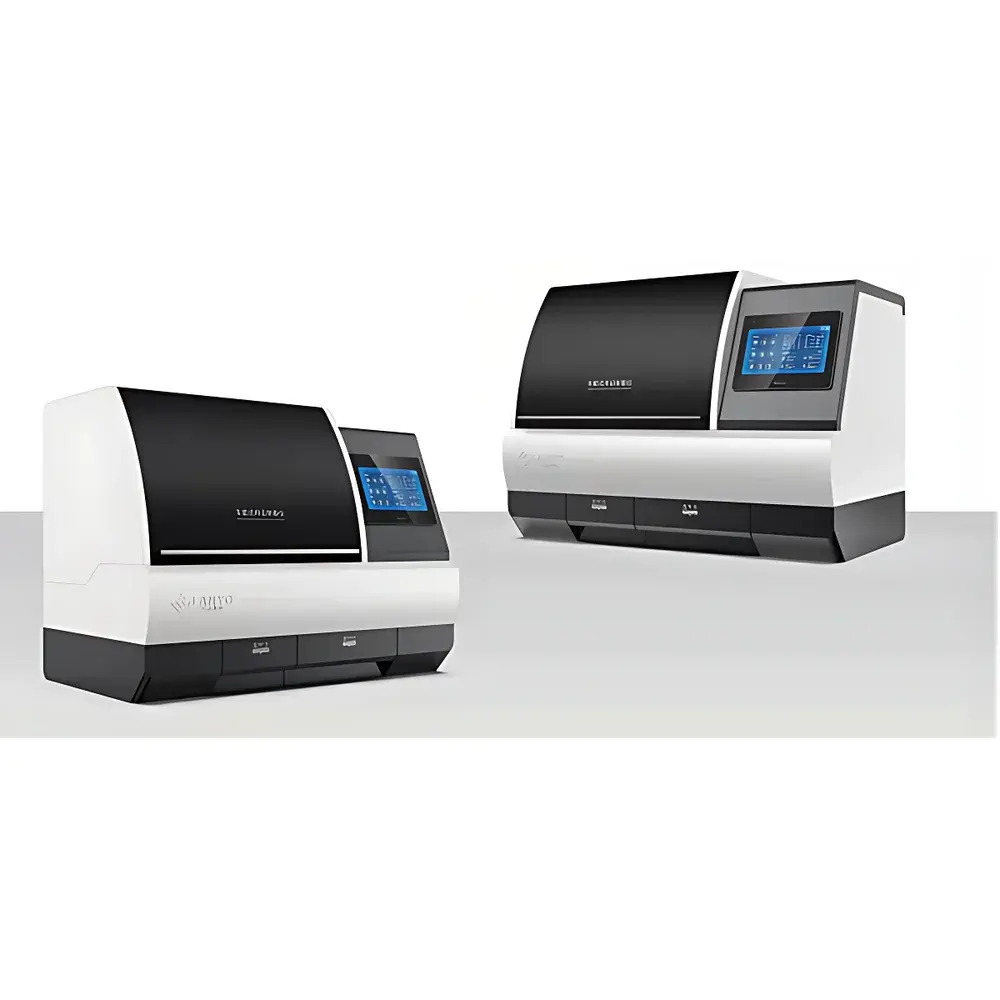
Lanyou FASP-M Fully Automated On-Vehicle Soil Sample Preparation System
| Origin | Beijing, China |
|---|---|
| Manufacturer Type | Distributor |
| Model | FASP-M |
| Pricing | Upon Request |
Overview
The Lanyou FASP-M Fully Automated On-Vehicle Soil Sample Preparation System is an engineered solution for field-deployable, standardized soil sample conditioning—designed specifically to support rapid elemental analysis (e.g., XRF, ICP-OES, AAS) in mobile environmental monitoring applications. Unlike conventional lab-based or manual preparation workflows, the FASP-M implements a closed-loop, contamination-controlled process grounded in low-temperature mechanical conditioning and non-metallic material handling. Its core operational principle integrates regulated thermal drying (<40 °C), directional impact grinding without metal contact, homogenization via inert-material agitators, gravimetric subsampling, and RFID/2D barcode-tracked vial loading—all executed autonomously within a single compact chassis. Developed under China’s National Key R&D Program (“Rapid Screening and Detection Technologies for Site Contaminants”), the system complies with fundamental metrological traceability requirements for field-prepared samples and bridges a critical gap between field sampling and laboratory-grade analytical readiness.
Key Features
- On-vehicle deployment architecture: Designed for integration into emergency response vehicles or dedicated soil survey mobile labs—meets automotive-grade constraints including shock/vibration damping, 12–24 V DC power compatibility, IP54-rated dust/moisture resistance, and <80 kg total mass.
- Dual-sample parallel processing: Simultaneous low-temperature drying of two fresh soil specimens (≤200 g each) at ≤40 °C, preserving redox-sensitive analytes such as Cr(VI) and volatile metals (e.g., Hg, As-species).
- Non-metallic material pathway: Grinding media, mixing blades, and sample-contact surfaces are fabricated exclusively from high-purity ceramic and food-grade polymer composites—eliminating exogenous metallic contamination risks during size reduction and homogenization.
- Intelligent cleaning protocol: Integrated electric brush scrubbing + negative-pressure vacuum suction + replaceable HEPA-grade filter cartridge ensures cross-contamination prevention between sequential samples.
- Traceable sample lifecycle management: Dual-encoding system—2D barcode printed on vial shoulder + embedded RF chip in vial base—enables unambiguous identification, automated logging, and full audit trail generation per sample batch.
- Embedded precision weighing: Integrated analytical balance (±0.001 g repeatability) supports automated subsampling, mass recording, and QC weight validation prior to vial sealing.
Sample Compatibility & Compliance
The FASP-M accommodates heterogeneous soil matrices—including clay-rich, organic-rich, gravelly, and slurry-like field-collected specimens—within defined moisture and particle size limits (≤30 wt% moisture; ≤20 mm initial fragment size). It adheres to procedural fidelity requirements outlined in multiple national technical standards: HJ/T 166–2004 (Soil Environmental Monitoring Technical Specification), NY/T 395–2012 (Farmland Soil Environmental Quality Monitoring), DZ/T 0130.4–2006 (Geological Laboratory Quality Management), and EJ 428–1989 (Radiation Monitoring Soil Sampling & Preparation). All process parameters—including drying time, grinding duration, mixing cycles, and cleaning sequence—are firmware-locked to match standard-compliant protocols, minimizing operator-dependent variability and supporting GLP-aligned field data integrity.
Software & Data Management
The onboard control interface runs deterministic real-time firmware with ISO/IEC 17025-aligned process logging. Each sample run generates a timestamped digital record containing: ambient temperature/humidity, chamber temperature profile, grinding energy input, final mass, vial ID, operator ID (if authenticated), and pass/fail status against predefined tolerance thresholds. Export formats include CSV and PDF reports compliant with internal QA documentation requirements. While not FDA 21 CFR Part 11-certified out-of-the-box, the system supports optional audit trail extension modules for regulated environments requiring electronic signature and change-control capabilities.
Applications
- Third National Soil Survey field operations requiring same-day elemental screening
- Contaminated site emergency response—rapid turnaround for Pb, Cd, As, Cr, Ni, Cu, Zn, and Hg quantification
- Agricultural land quality assessment campaigns (e.g., heavy metal accumulation mapping)
- Regulatory compliance monitoring under China’s Soil Pollution Prevention and Control Action Plan
- Method validation studies comparing field-prepared vs. lab-prepared samples for XRF calibration transfer
FAQ
Does the FASP-M require external compressed air or water supply?
No—operation is fully self-contained using only DC power input and ambient air for cooling and vacuum generation.
Can the system handle wet or frozen soil samples?
It accepts samples with up to 30 wt% moisture content but does not include freezing/thawing capability; pre-thawing is required for frozen specimens.
Is method validation data available for regulatory submission?
Yes—validation reports covering precision (RSD ≤3.5%), recovery (85–115% for target elements), and inter-laboratory reproducibility are provided upon request for qualified users.
What maintenance intervals are recommended?
Brush wear inspection every 200 cycles; HEPA filter replacement every 500 cycles; ceramic grinder media replacement every 1,000 cycles—or per visual wear assessment.
Can the FASP-M be integrated with third-party LIMS or cloud platforms?
Standard RS-232 and Ethernet interfaces support custom API integration; middleware development kits are available under NDA for enterprise-level interoperability.
Related Products





