
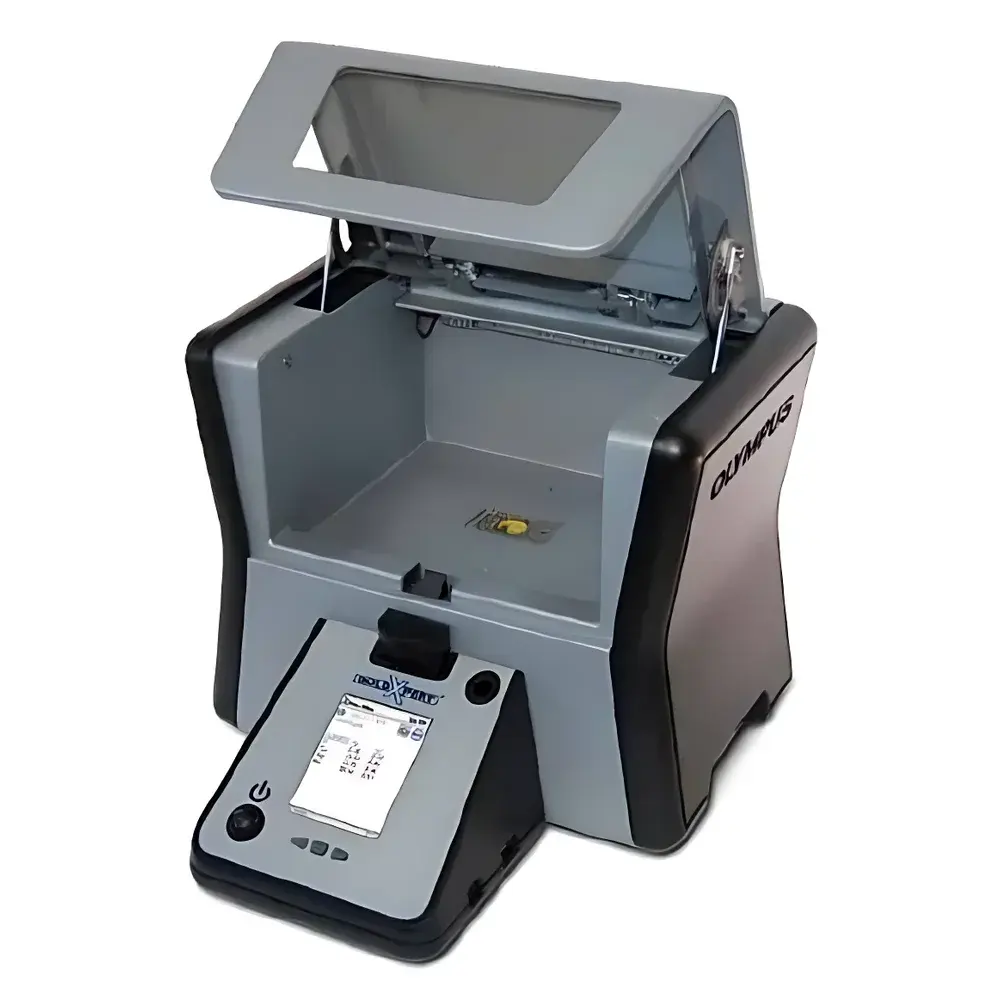
Olympus GoldXpert Energy Dispersive X-Ray Fluorescence Spectrometer
| Brand | Olympus |
|---|---|
| Origin | USA |
| Model | GoldXpert |
| Form Factor | Benchtop/Floor-standing |
| Industry Application | Non-ferrous Metals |
| Elemental Range | Na (11) to U (92) |
| Quantification Range | 1 ppm – 99.99 wt% |
| Energy Resolution | <50 eV (Mn Kα) |
| Repeatability | ≤0.1% RSD (for Au in certified reference materials) |
| Detector Type | Silicon Drift Detector (SDD) |
| Excitation Source | Micro-focus Rh anode X-ray tube |
Overview
The Olympus GoldXpert is a high-performance benchtop/floor-standing Energy Dispersive X-Ray Fluorescence (ED-XRF) spectrometer engineered for precise, non-destructive elemental quantification of precious metals and associated impurities. Leveraging fundamental ED-XRF physics—where primary X-rays excite inner-shell electrons in sample atoms, generating characteristic secondary (fluorescent) X-rays—the GoldXpert delivers rapid, laboratory-grade compositional data without sample dissolution, melting, or surface preparation. Its optimized optical path, micro-focus Rh-target X-ray source, and high-resolution Silicon Drift Detector (SDD) enable robust detection of elements from sodium (Na, Z=11) to uranium (U, Z=92), with particular sensitivity and accuracy in the critical precious metal range (e.g., Au, Ag, Pt, Pd, Rh, Ir). Designed for metrological rigor in regulated environments, the system operates under controlled vacuum or helium purge modes to enhance light-element transmission and minimize atmospheric absorption—ensuring reliable quantification down to 1 ppm for key analytes in homogeneous solid, powder, or liquid matrices.
Key Features
- Non-destructive analysis: Preserves sample integrity—no acid digestion, no fire assay required; ideal for high-value jewelry, bullion, dental alloys, and heritage artifacts.
- Dual collimation system: Interchangeable 3 mm and 10 mm collimators enable spatially resolved analysis of small features (e.g., solder joints, plating layers) or bulk homogeneity assessment.
- Integrated CMOS imaging: High-resolution camera with coaxial illumination provides real-time visual confirmation of measurement position and sample geometry—critical for QA/QC traceability and operator confidence.
- Optimized safety architecture: Fully shielded lead-lined enclosure compliant with IEC 61010-1 and 62471; interlocked sample chamber with automatic beam shutdown upon door opening.
- Intuitive one-button operation: Pre-calibrated precious metal modes (e.g., “24K Gold”, “Platinum Alloy”, “Dental Au-Ag-Cu”) deliver immediate karat rating, mass fraction results, and pass/fail flags against user-defined thresholds.
- Flexible power & deployment: Supports both AC mains operation and optional rechargeable Li-ion battery pack—enabling secure on-site verification in vaults, refineries, customs checkpoints, or recycling facilities.
Sample Compatibility & Compliance
The GoldXpert accommodates a broad range of physical forms—including coins, bars, rings, scrap fragments, powdered catalysts, molten alloy ingots (cooled), and slurries—within its large-volume, transparent-window sample chamber. Sample positioning is assisted by internal LED lighting and live video feed. All analytical methods are traceable to NIST SRMs (e.g., NIST 8573, 8574, 1187a) and validated per ASTM E1621 (Standard Guide for XRF Analysis of Metals) and ISO 21043 (XRF — General Requirements). The instrument supports GLP/GMP workflows via configurable audit trails, electronic signatures, and 21 CFR Part 11–compliant software options (available as licensed module), ensuring data integrity for regulatory submissions in refining, banking, and medical device manufacturing.
Software & Data Management
Powered by Olympus’ proprietary GeoChem Pro™ platform (v5.x), the GoldXpert offers embedded method development, multi-layer calibration management, and automated report generation in PDF/CSV/XLSX formats. Software modules support spectral deconvolution using fundamental parameter (FP) algorithms with matrix correction (e.g., alpha correction, empirical coefficients), enabling accurate quantification across heterogeneous alloys (e.g., Au-Ag-Cu-Zn ternary systems). Data export includes full spectrum metadata (tube kV/mA, live time, detector temperature), peak identification logs, and uncertainty estimates per element. Network-ready configuration enables centralized instrument monitoring, remote diagnostics, and integration with LIMS via ODBC or RESTful API interfaces.
Applications
- Real-time gold purity grading (0–24K) and karat certification in pawn shops, assay offices, and minting facilities.
- Quantitative determination of silver, copper, nickel, and zinc impurities in refined bullion—supporting LBMA Good Delivery compliance.
- Compositional verification of platinum-group metal (PGM) catalysts, thermocouple wires, and investment casting alloys.
- Recycling stream characterization: Rapid sorting of electronic scrap (e-waste), dental prostheses, and catalytic converters based on PGM content.
- Regulatory screening of consumer goods for restricted elements (e.g., Cd, Pb, Hg) per RoHS and CPSIA directives.
- Quality assurance of dental casting alloys (e.g., Type IV Au-Pd alloys) per ISO 22674 specifications.
FAQ
Does the GoldXpert require external cooling or cryogenic gases?
No. It utilizes a Peltier-cooled SDD detector requiring only standard laboratory power; no liquid nitrogen or mechanical chillers are needed.
Can it analyze plated or layered samples?
Yes—using variable voltage/current settings and layer-fitting algorithms, it supports semi-quantitative depth profiling for coatings up to ~50 µm thick.
Is method validation documentation included?
Yes—each system ships with a Factory Acceptance Test (FAT) report, calibration certificate traceable to NIST, and application-specific validation kits for Au, Ag, and Pt matrices.
What maintenance is required?
Annual performance verification (including resolution check at Mn Kα, dead time correction, and background stability assessment) is recommended; detector window cleaning and tube aging compensation are automated.
How is data security ensured during network operation?
All communications use TLS 1.2 encryption; local database storage employs AES-256 encryption; role-based access control (RBAC) governs method editing, result deletion, and audit log viewing.




