
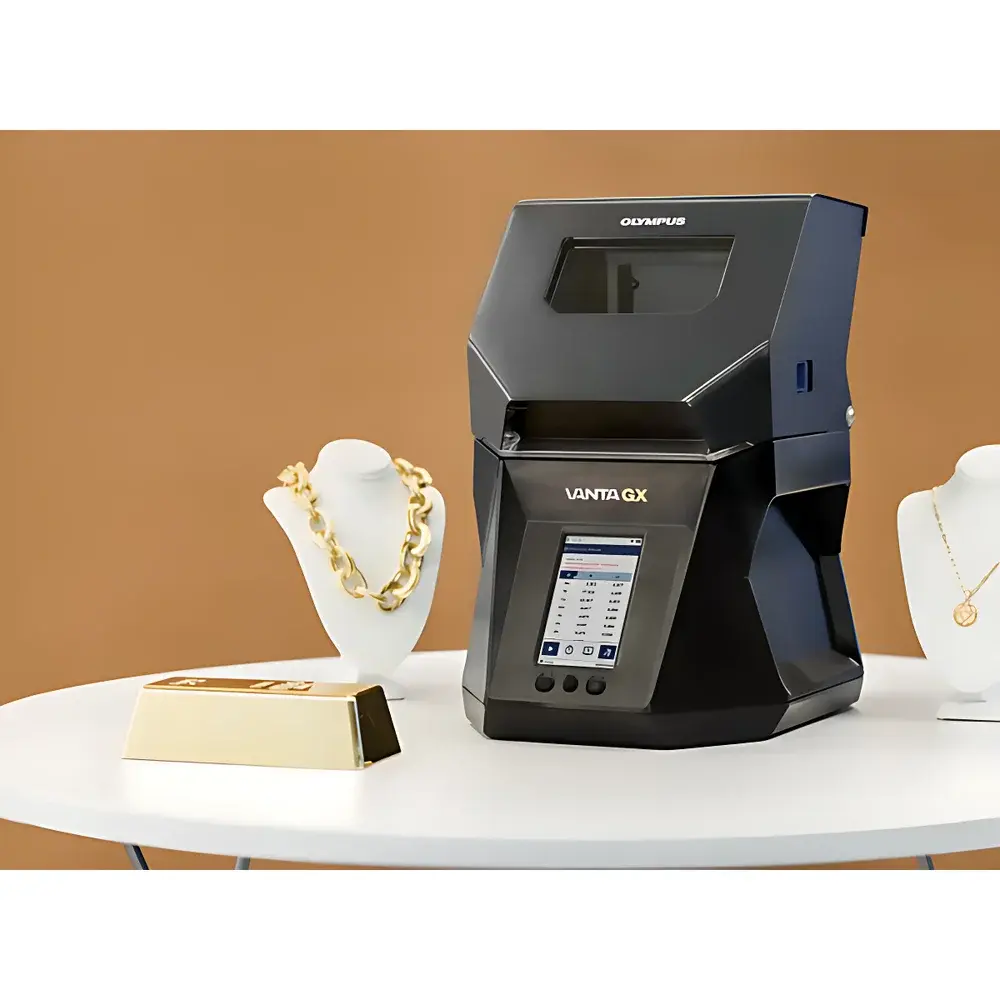
OLYMPUS Vanta GX PIN Wavelength Dispersive X-Ray Fluorescence Spectrometer
| Brand | OLYMPUS |
|---|---|
| Origin | USA |
| Manufacturer Type | Authorized Distributor |
| Origin Category | Imported |
| Model | Vanta GX PIN |
| Instrument Type | Benchtop |
| Instrument Configuration | Multi-Channel |
| X-ray Tube Power | 70 W, 18 VDC, 50–60 Hz |
| Elemental Range | Atomic Number 12 (Mg) to 92 (U) |
Overview
The OLYMPUS Vanta GX PIN Wavelength Dispersive X-Ray Fluorescence (WDXRF) Spectrometer is a benchtop analytical system engineered for high-precision, non-destructive elemental quantification in precious metal applications. Unlike energy-dispersive XRF (EDXRF) platforms, the Vanta GX PIN integrates a wavelength-dispersive detection architecture—featuring a high-resolution analyzing crystal and position-sensitive detector—to deliver superior peak separation, reduced spectral overlap, and enhanced trace-element sensitivity in complex matrices. This configuration enables rigorous compliance with ASTM E1621 (Standard Test Method for Determining the Composition of Precious Metals by XRF), ISO 11348 (for precious metal assay validation), and USP guidelines for elemental impurity testing in regulated commodities. Designed specifically for jewelry appraisal, bullion verification, numismatic evaluation, and scrap sorting, the instrument operates without sample preparation, eliminating acid testing, fire assay, or destructive sampling while maintaining measurement repeatability ≤0.15 wt% RSD for Au, Ag, and Pt group elements across routine operational conditions.
Key Features
- Benchtop form factor with integrated radiation shielding and interlocked safety door—compliant with IEC 61010-1 and FDA 21 CFR Part 1020.40 for Class I X-ray equipment
- PIN diode detector optimized for high-count-rate performance at low-energy lines (e.g., Ag Lα, Cu Kα), enabling robust detection of plating layers and surface contamination
- Fixed multi-channel WDXRF optics with selectable Bragg-angle crystals (e.g., LiF(200), PET, TAP) for simultaneous monitoring of up to 8 emission lines per analysis cycle
- Embedded microprocessor-controlled vacuum purge system for enhanced light-element sensitivity (Mg–P) in alloy certification workflows
- Pre-calibrated factory methods for karat gold (375–999.9), sterling silver (925), platinum (850–950), and palladium (500–950), traceable to NIST SRM 1140a and CRM 581
- Real-time plating thickness estimation (Au/Ni/Cu stack) via fundamental parameter (FP) modeling with matrix correction algorithms
Sample Compatibility & Compliance
The Vanta GX PIN accommodates irregularly shaped items—including rings, coins, bars, watch cases, and dental alloys—within its 100 mm × 100 mm sample chamber. Its collimated beam (φ = 3 mm) ensures spatially resolved analysis without edge effects or geometric dilution. All measurement protocols support GLP/GMP-aligned audit trails: full timestamped operator ID logging, method version control, raw spectrum archiving, and electronic signature capability compliant with FDA 21 CFR Part 11 requirements. The system meets RoHS Directive 2011/65/EU and EU REACH Annex XVII restrictions on Cd, Pb, Hg, and Cr(VI) in consumer-facing precious articles. Calibration stability is verified daily using internal reference foils; drift correction is automatically applied during acquisition.
Software & Data Management
Operated via the proprietary Olympus VantaConnect™ software suite, the instrument supports both guided workflow mode (for novice users) and advanced method editor mode (for metrology engineers). All spectra are stored in vendor-neutral .spc format with embedded metadata (instrument ID, calibration date, ambient temperature/humidity). Export options include CSV (quantitative results only), PDF reports with embedded spectra and uncertainty estimates (k=2), and XML for LIMS integration. Data integrity safeguards include write-once-read-many (WORM) archive mode, SHA-256 hash verification for exported files, and optional network-based backup to secure NAS infrastructure. Remote diagnostics and firmware updates are delivered via TLS 1.2-encrypted channels.
Applications
- Retail jewelry authentication: rapid differentiation between solid gold, gold-filled, and electroplated items with plating-thickness resolution down to 0.2 µm
- Bullion vault verification: batch-level purity screening of 1 kg gold bars against LBMA Good Delivery specifications
- Numismatic grading labs: quantitative analysis of historical coin alloys (e.g., Roman denarii, US Morgan dollars) without surface alteration
- Recycling facility QA/QC: real-time sorting of e-scrap streams for Pd/Au recovery yield optimization
- Dental laboratory compliance: verification of ISO 22674-compliant Co-Cr and Ni-Cr frameworks prior to casting
- Customs inspection: field-deployable verification of declared precious metal content under WTO HS Code 7113 and 7115 regulatory frameworks
FAQ
Does the Vanta GX PIN require annual third-party calibration certification?
No—its WDXRF architecture employs stable crystal lattice geometry and fixed detector geometry, eliminating need for annual recalibration. Users perform daily verification using certified reference foils; full performance qualification is recommended every 12 months per ISO/IEC 17025 Clause 6.5.2.
Can it quantify rhodium plating on white gold?
Yes—using Rh Lβ line (2.70 keV) with PET crystal and optimized vacuum path, detection limit is 0.08 µm at 95% confidence (n=10, 60 s live time).
Is the instrument suitable for measuring mercury amalgam in antique dental restorations?
Yes—Hg Lα (9.99 keV) is resolved from Pb M-lines using LiF(200) crystal; quantification accuracy ±0.3 wt% at 1–10 wt% range per ASTM F2519.
What consumables does the system require?
None—no gas purging, no filament replacement, no detector cryogen. Only periodic cleaning of the beryllium window and sample chamber with isopropyl alcohol is recommended.
How is data security maintained during remote support sessions?
All remote access is initiated solely by the user via one-time encrypted session keys; no persistent credentials are stored. Screen sharing is disabled by default and requires explicit operator consent per session.
Related Products





