
Olympus TERRA II Portable X-ray Diffractometer
| Brand | Olympus |
|---|---|
| Origin | USA |
| Manufacturer Type | Authorized Distributor |
| Origin Category | Imported |
| Model | TERRA II |
| Price Range | USD 65,000 – 130,000 |
| Instrument Type | Powder X-ray Diffractometer |
| Power Consumption | 0.0001 kW (100 mW typical operational power) |
Overview
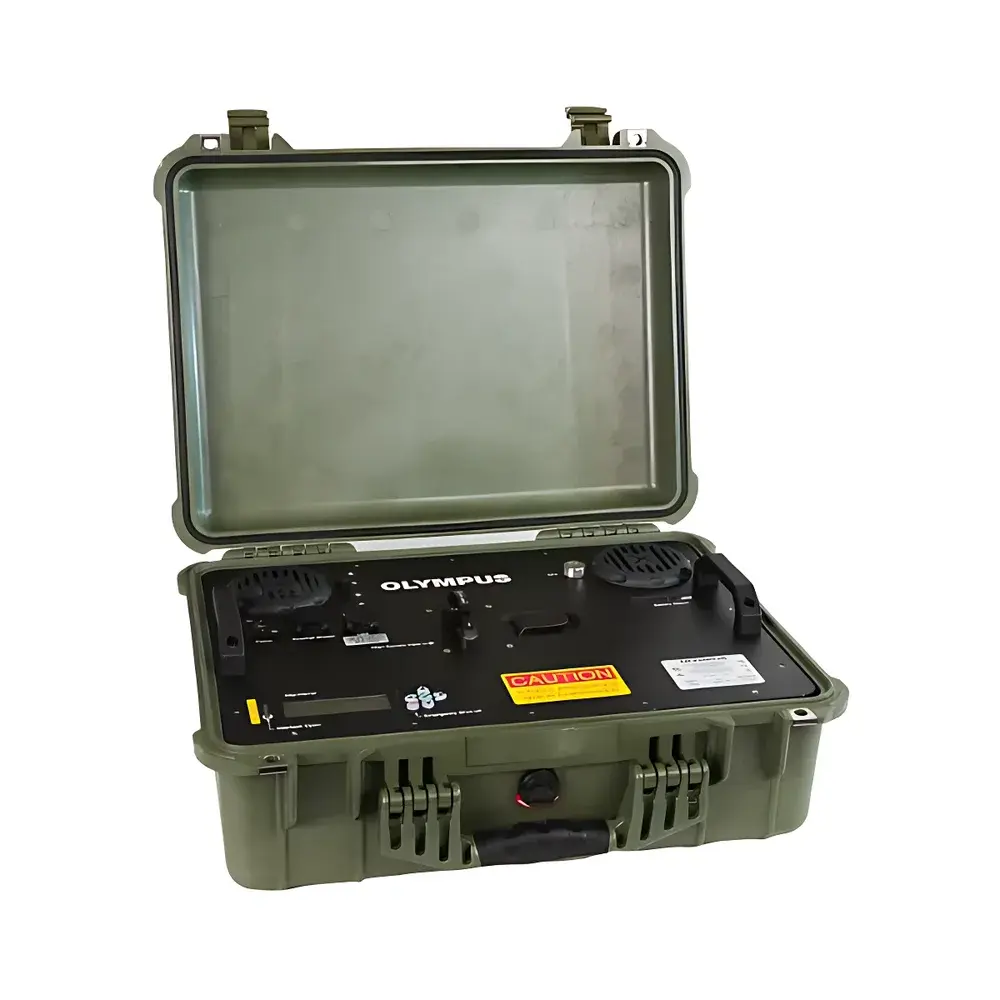
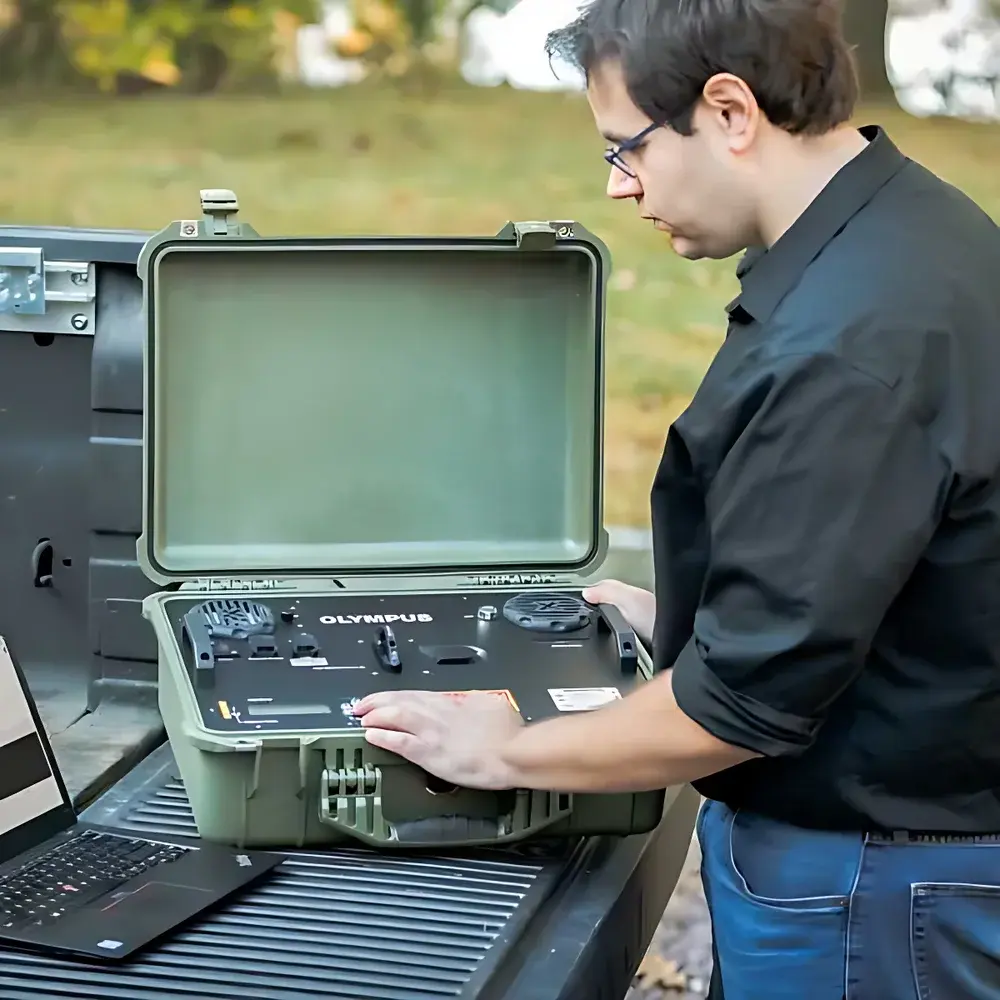
The Olympus TERRA II Portable X-ray Diffractometer is a field-deployable, battery-operated powder XRD system engineered for rapid, quantitative mineralogical and phase analysis in situ—without reliance on laboratory infrastructure. Based on Bragg’s law and utilizing a fixed-geometry, transmission-mode Cu-Kα source (λ = 1.5418 Å), the TERRA II employs a patented NASA-derived vibrating sample holder to eliminate preferred orientation effects—a critical source of error in conventional XRD measurements of polycrystalline powders. Its monolithic optical architecture contains no goniometer, slip rings, or motorized theta-theta stages; instead, it leverages a solid-state, silicon-strip detector with direct photon energy discrimination, enabling simultaneous XRD and XRF data acquisition from a single excitation event. Designed for ruggedness and operational autonomy, the instrument operates without compressed gas, water cooling, external transformers, or auxiliary chillers—making it uniquely suited for mining exploration, geochemical surveying, environmental site assessment, and industrial raw material verification under GLP-compliant workflows.
Key Features
- True portable operation: Integrated rechargeable Li-ion battery supports ≥4 hours of continuous analysis; weighs <14.5 kg with full enclosure.
- Vibrating sample stage (NASA patent #US7920672B2): Induces controlled granular convection within the 15 mg sample cavity, ensuring isotropic particle orientation and minimizing texture-related intensity bias.
- Dual-mode detection: Monolithic silicon-strip detector simultaneously resolves diffraction angle (2θ) and photon energy, enabling concurrent XRD pattern collection and elemental XRF fingerprinting from the same measurement.
- Enhanced sensitivity: Upgraded detector electronics deliver 33% higher count rate and improved signal-to-noise ratio versus TERRA I, lowering limit of detection (LOD) for minor/trace phases (e.g., clay interstratifications, low-abundance sulfides).
- Zero-maintenance optical path: No moving parts in the X-ray beam path; no alignment drift, no periodic recalibration required—ensuring long-term measurement reproducibility (RSD <1.8% for quartz standard across 6-month field deployment).
- Wireless & wired connectivity: Dual-band Wi-Fi (802.11ac) and Gigabit Ethernet support remote instrument control, real-time pattern streaming, and secure data export compliant with FDA 21 CFR Part 11 audit trail requirements.
Sample Compatibility & Compliance
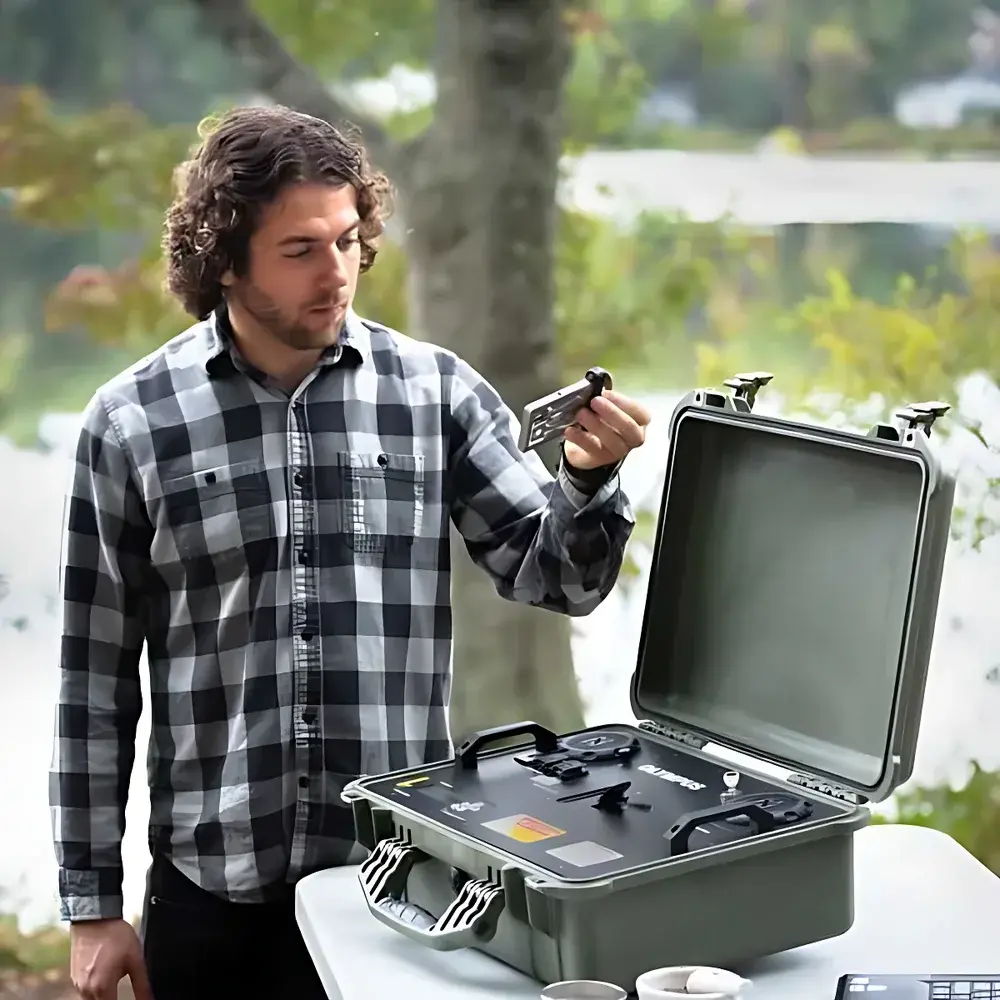
The TERRA II accepts loose powders, crushed rock chips, soil cores, and industrial powders with minimal preparation—no pelletizing, pressing, or binder addition required. Sample volume: 15 ± 5 mg; particle size: ≤150 µm (achieved via included hand mortar, sieve set, and portable mill). The instrument complies with IEC 61000-6-3 (EMC emissions), IEC 61000-6-2 (immunity), and meets Class 1 laser safety requirements per IEC 60825-1. Data integrity protocols align with ISO/IEC 17025:2017 clause 7.7 (result reporting) and support GLP/GMP documentation through SwiftMin®’s built-in electronic signature, version-controlled method storage, and immutable audit logs.
Software & Data Management
SwiftMin® v4.2 software runs natively on the TERRA II’s embedded Linux OS and provides full-phase identification, Rietveld refinement, and semi-quantitative mineral assemblage modeling using the ICDD PDF-4+ database (licensed separately). Key capabilities include:
- Real-time dashboard: Single-screen view of current scan, phase match confidence scores, crystallite size estimates (Scherrer), and residual strain indicators.
- Password-protected Lab Manager mode: Enables preloaded calibrations, user-role permissions, and method templates—ensuring consistent operation across multi-operator field teams.
- Automated data routing: Configurable triggers (time-based or button-activated) push processed reports (.pdf, .csv) and raw .xyd files to network shares or cloud endpoints via SMB or SFTP.
- Offline analysis compatibility: Raw diffraction patterns are stored in vendor-neutral .xy format, fully compatible with TOPAS, GSAS-II, and DIFFRAC.SUITE for advanced post-processing.
Applications
The TERRA II serves mission-critical roles across sectors requiring rapid, field-validated crystalline phase data:
- Geoscience: Real-time identification of alteration minerals (e.g., kaolinite vs. smectite), ore-grade estimation (hematite/goethite ratios), and regolith characterization during drill-core logging.
- Cement & construction materials: Quantification of alite/belite content, sulfate phase distribution (anhydrite/gypsum), and hydration product evolution in-situ.
- Pharmaceutical QA/QC: Polymorph screening of active pharmaceutical ingredients (APIs) and excipients at manufacturing sites—supporting ICH Q5A and USP uniformity testing.
- Environmental forensics: Detection of crystalline arsenic-bearing phases (e.g., scorodite, arsenolite) in contaminated soils and tailings without lab transport delays.
- Archaeometry & cultural heritage: Non-destructive phase mapping of pigments, glazes, and corrosion products on artifacts under ambient conditions.
FAQ
Does the TERRA II require external cooling or high-voltage power sources?
No. It operates exclusively on internal battery or 100–240 V AC input (50/60 Hz) with integrated DC-DC regulation; no chiller, gas supply, or transformer is needed.
Can XRD and XRF data be acquired in a single measurement?
Yes. The direct-excitation CCD detector captures both Bragg-diffracted photons (XRD) and characteristic fluorescence lines (XRF) simultaneously, with energy-resolved separation in post-processing.
What is the minimum detectable phase concentration?
Under standard 5-minute acquisition, LOD for crystalline phases is typically 0.5–1.0 wt% depending on scattering factor and matrix absorption—validated per ASTM E1361 for quantitative XRD.
Is SwiftMin® software validated for regulated environments?
Yes. SwiftMin® v4.2 includes 21 CFR Part 11-compliant electronic signatures, audit trail generation, and method version control—qualified for use in GxP laboratories.
How is sample homogeneity ensured without manual grinding inside the instrument?
The vibration-driven sample holder achieves dynamic reorientation at 60 Hz, statistically randomizing particle orientation over the measurement period—eliminating the need for in-situ milling or rotation mechanisms.





