
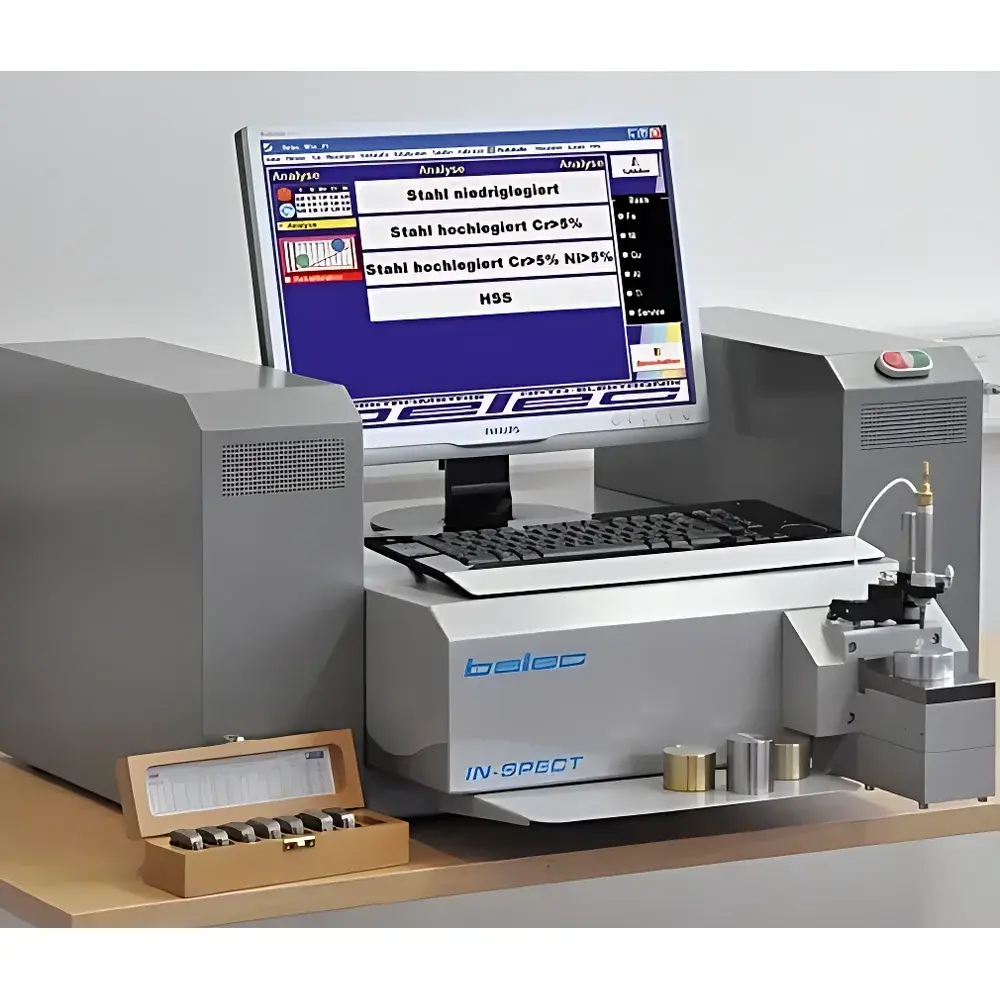
Belec In-Spect Benchtop Metal Spectrometer
| Brand | Belec |
|---|---|
| Origin | Germany |
| Model | Belec In-Spect |
| Dimensions | 750 mm × 380 mm × 600 mm |
| Optical System | 5th-Generation Spark-OES (5GSO) |
| Detector | CCD-based multi-channel spectrometer |
| Elemental Range | C, P, S, N, and standard metallic elements (Fe, Al, Cu, Zn, Ni, Ti, Mg, etc.) |
| Electrode Type | Low-consumption tungsten electrode |
| Spark Stand | Open-type, accommodating large or irregular samples |
| Calibration Stability | MCDC (Multi-Channel Drift Correction) enabled, maintaining calibration integrity for up to 2–3 weeks under routine operation |
| Software | Belec Win21 with configurable language support (10 languages including English, Chinese, German, French, Spanish, Italian, Japanese, Korean, Russian, Portuguese) |
| Compliance | Designed to meet ISO 17025 laboratory requirements |
Overview
The Belec In-Spect is a compact, benchtop spark optical emission spectrometer (Spark-OES) engineered for precise, routine elemental analysis of metals and alloys in quality control, foundry, and incoming material inspection environments. Operating on the fundamental principle of spark-induced plasma excitation, the instrument vaporizes a micro-volume of sample surface under controlled argon atmosphere, generating element-specific atomic emission lines. These spectral signatures are dispersed via a high-stability Paschen-Runge optical layout and resolved by a thermoelectrically cooled CCD detector array—enabling simultaneous multi-element quantification with high signal-to-noise ratio and excellent long-term repeatability.
Key Features
- 5th-Generation Spark-OES Optical System (5GSO): A fully sealed, purged optical chamber with optimized grating geometry and minimized stray light path ensures spectral line separation without overlap—even for critical adjacent lines such as Mn 403.3 nm / Si 403.4 nm or Cr 283.56 nm / Mo 283.73 nm—critical for accurate low-alloy steel and stainless steel certification.
- CCD Multi-Channel Detection Architecture: Unlike PMT-based systems requiring mechanical channel selection, the Belec In-Spect captures the full UV-VIS spectral range (130–800 nm) in parallel, enabling flexible method setup for ferrous, non-ferrous, and light-element matrices without hardware reconfiguration.
- Light Element Capability: Optimized vacuum-path optics and low-noise CCD readout allow reliable quantification of carbon (C), phosphorus (P), sulfur (S), and nitrogen (N) down to typical detection limits of 10–30 ppm (dependent on matrix and integration time), meeting ASTM E415, ISO 11577, and EN 10027 reporting requirements.
- MCDC (Multi-Channel Drift Correction): An embedded real-time correction algorithm continuously monitors internal reference lines and adjusts intensity baselines across all analytical channels—reducing recalibration frequency and supporting uninterrupted production-line operation over extended shifts.
- Open Spark Stand Design: Accommodates samples up to Ø 400 mm × 120 mm height with adjustable sample clamping; compatible with flat, cylindrical, and irregular geometries without auxiliary fixtures—ideal for castings, billets, and machined components.
- Low-Maintenance Excitation Source: Tungsten electrode configuration delivers >10,000 sparks per tip life under standard operating conditions, eliminating frequent consumable replacement and minimizing downtime in high-throughput labs.
Sample Compatibility & Compliance
The Belec In-Spect supports solid metallic samples conforming to ISO 11577 (spark OES sampling procedures) and ASTM E1086 (standard test method for analysis of stainless steel by spark OES). It is validated for use with certified reference materials (CRMs) traceable to NIST, BAM, or JSS standards. The open spark stand enables direct analysis of coated, plated, or heat-treated surfaces—provided surface preparation meets ISO 14284 (metal sampling for spectrochemical analysis). Instrument design adheres to IEC 61000-6-3 (EMC emissions) and IEC 61010-1 (safety requirements for electrical equipment for measurement).
Software & Data Management
Belec Win21 is a Windows-based, 64-bit application built for regulatory-compliant operation. It features configurable user roles, electronic signature support, and optional 21 CFR Part 11 compliance modules—including audit trail logging, data encryption, and change history for all calibration, method, and result records. Background correction algorithms (polynomial and iterative baseline fitting) and peak position alignment routines ensure robustness against matrix-induced spectral shifts. Export formats include CSV, XML, PDF reports, and LIMS-compatible ASTM E1382-compliant data structures. Language localization covers English, Chinese, German, French, Spanish, Italian, Japanese, Korean, Russian, and Portuguese—facilitating multinational deployment and operator training.
Applications
- Grade identification and positive material identification (PMI) in piping, valves, and pressure vessels per ASME B16.5 and ASTM A959.
- Incoming raw material verification for Fe-, Al-, Cu-, Mg-, Ni-, and Ti-based alloys.
- Heat-to-heat certification in foundries and forging plants.
- Scrap sorting and recycling facility screening for alloy segregation.
- Research and development of new metallurgical compositions requiring rapid compositional feedback.
FAQ
Does the Belec In-Spect require external vacuum pumping?
No—the optical system uses a sealed, permanently evacuated chamber with getter-based maintenance-free vacuum preservation.
Can it analyze coated or galvanized samples?
Yes, provided the coating thickness is ≤25 µm and the underlying base metal is accessible via spark ablation; surface cleaning per ISO 14284 is recommended prior to analysis.
Is method transfer possible from other Belec spectrometers?
Yes—Win21 supports cross-platform method import/export using standardized .bms file format, preserving calibration coefficients, interference corrections, and QC parameters.
What argon purity is required for stable operation?
Minimum 99.996% purity (4.6 grade); dew point ≤ –60 °C is recommended to prevent optical window fogging and plasma instability.
How is calibration stability verified during routine use?
The instrument includes daily check standards (e.g., Fe-based CRMs) and automated drift monitoring via internal reference lines; results are logged in the audit trail with pass/fail flags based on user-defined tolerance windows.






