
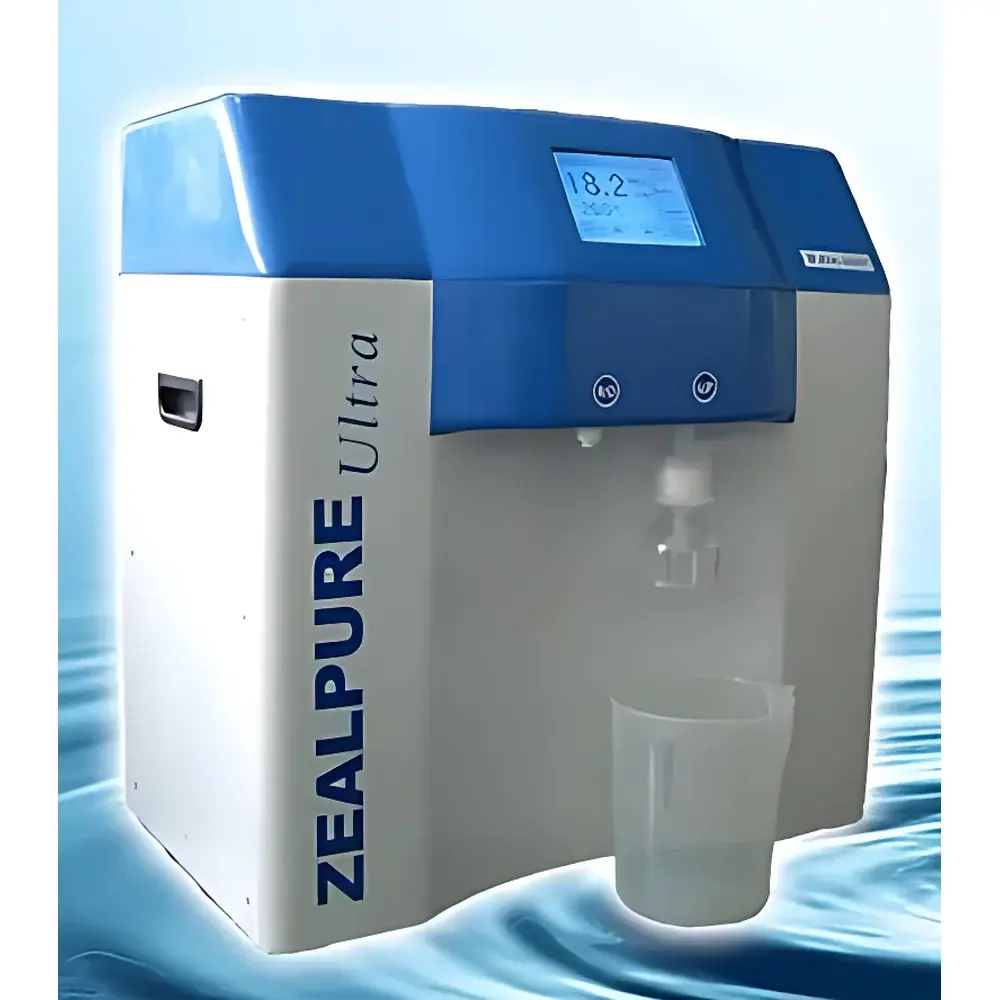
Zealpure Ultra ZP15UF Ultra-Pure Water System with Endotoxin Removal
| Origin | Shanghai, China |
|---|---|
| Manufacturer Type | Authorized Distributor |
| Product Origin | Domestic (China) |
| Model | ZP15UF |
| Price Range | USD 1,400–4,200 |
| Pure Water Grade | ASTM Type I |
| Resistivity | 18.2 MΩ·cm @ 25°C |
| Heavy Metals & Soluble Silica | <0.1 ppb |
| Total Organic Carbon (TOC) | <3 ppb |
| Microbial Count / Endotoxin | <0.001 EU/mL |
| Particles (>0.1 µm) | <1 particle/mL |
| Flow Rate | 15 L/h (at 25°C) |
| Dual Outlet | RO Water + Ultra-Pure Water |
| Integrated UF Module | 5 kDa Molecular Weight Cut-Off (MWCO) |
| UV Sterilization | Dual-Wavelength (185 nm + 254 nm), Lamp Life ≈ 8,000 h |
| Final Filtration | Sartorius 0.22 µm Terminal Filter |
| Pre-treatment | Integrated 10″ PP + Activated Carbon + Post-Carbon Cartridges |
| Deionization | Imported Mixed-Bed Ion Exchange Resin |
| System Disinfection | Onboard Chemical Sanitization Kit |
| Display | Backlit LCD Touchscreen with Real-Time Monitoring |
| Compliance | Meets ASTM D1193-20, ISO 3696:1987, CLSI EP22-A, and supports GLP/GMP documentation workflows |
Overview
The Zealpure Ultra ZP15UF Ultra-Pure Water System is an engineered solution for laboratories requiring consistent, endotoxin-free water in molecular biology, cell culture, and diagnostic applications. It employs a multi-stage purification architecture grounded in established physicochemical principles: reverse osmosis (RO) for bulk ion and particulate rejection; activated carbon adsorption for chlorine, chloramines, and low-MW organics; mixed-bed deionization for residual ionic species removal; dual-wavelength ultraviolet irradiation (185 nm for TOC photo-oxidation, 254 nm for microbial inactivation); and ultrafiltration (5 kDa MWCO) to selectively retain endotoxins, nucleases, and large biomolecular contaminants. Unlike single-stage systems, the ZP15UF integrates these technologies into a closed-loop, recirculating distribution path—minimizing stagnation and preventing biofilm formation in the final delivery loop. Its design adheres to core principles of pharmaceutical and life science water system validation: reproducibility, traceability, and contamination control.
Key Features
- Endotoxin-Specific Purification: Integrated 5 kDa ultrafiltration module certified to reduce endotoxin levels to <0.001 EU/mL—validated per USP and EP 2.6.14 protocols.
- Dual-Wavelength UV System: 185 nm UV oxidizes organic compounds to CO₂ and H₂O; 254 nm UV disrupts microbial DNA—ensuring both TOC reduction (<3 ppb) and bioburden control.
- Real-Time Conductivity & Temperature Monitoring: High-precision sensor array continuously reports resistivity (18.2 MΩ·cm), temperature-compensated conductivity, and flow status on a 5.7″ backlit touchscreen interface.
- Automated Maintenance Intelligence: Predictive cartridge life algorithms track usage hours, volume throughput, and pressure differentials—triggering visual/audible alerts for PP, carbon, RO membrane, and mixed-bed resin replacement.
- Sealed Recirculation Loop: Ultra-pure water circulates at >0.5 m/s through electropolished 316L stainless steel or PFA-lined tubing, minimizing microbial adhesion and enabling periodic thermal or chemical sanitization.
- RO Membrane Protection: Programmable automatic flush cycle activates post-shutdown and during idle periods—reducing scaling and extending membrane service life beyond 3 years under typical municipal feedwater conditions (TDS <250 ppm).
Sample Compatibility & Compliance
The ZP15UF delivers water compliant with ASTM Type I specifications (D1193-20), ISO 3696 Grade 1, and CLSI EP22-A requirements for critical life science workflows. Its endotoxin removal capability satisfies stringent demands of primary cell culture, transfection-grade reagent preparation, and in vitro fertilization (IVF) media formulation. The system’s architecture supports regulatory alignment with FDA 21 CFR Part 11 when paired with optional audit-trail-enabled software modules. All wetted materials—including Sartorius-certified 0.22 µm terminal filters, PTFE-sealed valves, and USP Class VI-compliant tubing—meet extractables and leachables thresholds defined in USP . Routine verification includes daily resistivity checks, weekly TOC measurements, and quarterly endotoxin testing using kinetic chromogenic LAL assays.
Software & Data Management
The embedded microcontroller logs timestamped operational data—including inlet pressure, RO rejection rate, UV intensity output, resistivity trends, and cartridge runtime—for up to 12 months. Optional RS232 or USB interfaces enable direct export to LIMS or ELN platforms. When configured with external printer support, the system generates GMP-compliant printouts containing date/time stamps, operator ID (via optional RFID badge integration), and pass/fail status against user-defined alarm thresholds (e.g., resistivity 5 ppb). Audit trails are immutable and include event type, parameter value, and system state—fully supporting ALCOA+ data integrity principles required under Annex 11 and 21 CFR Part 11.
Applications
- Molecular Biology: PCR master mix preparation, qRT-PCR, NGS library construction, CRISPR-Cas9 editing buffers—where nuclease and endotoxin contamination compromise assay fidelity.
- Cell Culture: Feeder-layer-dependent stem cell expansion, hybridoma monoclonal antibody production, and 3D organoid culture—requiring endotoxin-free water to prevent TLR4-mediated inflammatory responses.
- Clinical Diagnostics: Immunoassay diluents, ELISA substrate preparation, and flow cytometry sheath fluid—where particulate-induced instrument clogging or false-positive signals must be eliminated.
- Analytical Instrumentation: Mobile phase preparation for UHPLC-MS/MS, calibration standards for ICP-MS trace metal analysis, and rinse solutions for capillary electrophoresis—demanding sub-ppt metal and organic impurity levels.
- Pharmaceutical R&D: Buffer exchange for protein therapeutics, dissolution media for IV formulations, and cleaning validation studies—requiring documented compliance with pharmacopeial water quality monographs.
FAQ
What is the maximum allowable feed water TDS for optimal ZP15UF performance?
Feed water TDS should not exceed 250 ppm. For sources above this threshold, a dedicated pre-treatment unit (e.g., softener or additional carbon polishing stage) is recommended to prevent premature RO membrane fouling.
How frequently must the 5 kDa UF module be replaced?
UF cartridge replacement is volume- and application-dependent; typical service life ranges from 6 to 12 months under continuous operation with validated feed water quality. Performance verification via endotoxin challenge testing is advised prior to each replacement.
Does the system support remote monitoring via Ethernet or Wi-Fi?
The base ZP15UF model includes RS232 and USB ports. Ethernet connectivity and cloud-based telemetry require the optional ZealLink™ Communication Module, which enables SNMP-based network integration and real-time dashboard visualization.
Can the system be validated according to IQ/OQ/PQ protocols?
Yes—comprehensive validation documentation packages (including test scripts, acceptance criteria, and blank execution records) are available upon request and align with ISO/IEC 17025 and ASTM E2500-18 guidelines.
Is the terminal filter sterilized in place (SIP) capable?
No—the Sartorius 0.22 µm final filter is a single-use, gamma-irradiated component designed for aseptic installation. SIP functionality is not supported; however, the upstream UV/UF loop enables robust microbial control without reliance on terminal filtration alone.



