
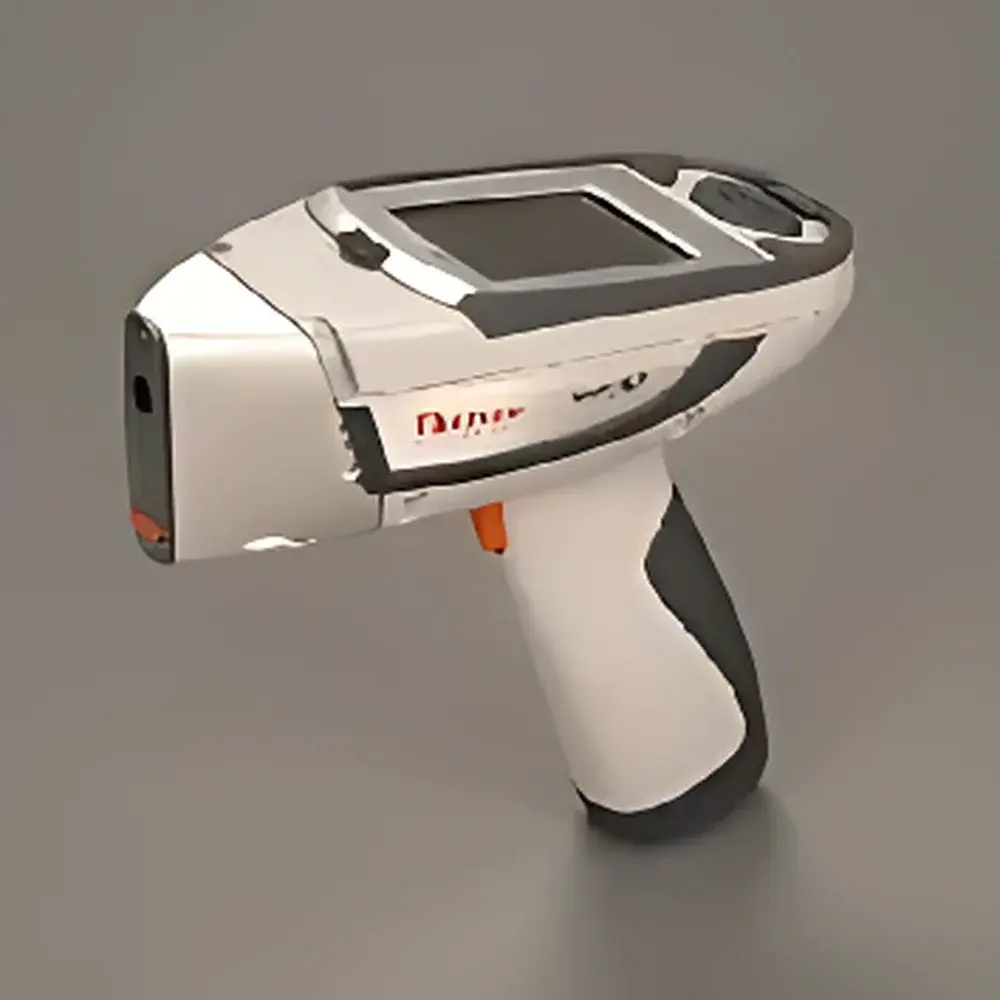
Thermo Fisher Niton XL3T700 Handheld Energy Dispersive X-Ray Fluorescence (EDXRF) Spectrometer for RoHS and Halogen-Free Compliance Testing
| Brand | Thermo Fisher |
|---|---|
| Origin | USA |
| Model | Niton XL3T700 |
| Form Factor | Handheld / Portable |
| Elemental Range | Na (Z=11) to U (Z=92) |
| Detection Limit | 1 ppm (typical for heavy metals in homogeneous matrices) |
| Energy Resolution | <140 eV at Mn Kα |
| Repeatability | ≤0.1% RSD (for major elements under controlled conditions) |
| X-ray Tube | Rh anode, 50 kV, 2 W |
| Detector | High-performance Si-PIN |
| Operating Temperature | –10 °C to 50 °C |
| Weight | <1.3 kg |
| Dimensions | 244 × 230 × 95.5 mm |
Overview
The Thermo Fisher Niton XL3T700 is a field-deployable, handheld energy dispersive X-ray fluorescence (EDXRF) spectrometer engineered for rapid, non-destructive elemental analysis in regulatory compliance workflows—specifically targeting RoHS Directive 2011/65/EU, IEC 62321-5:2013, JEITA EG-0201, and halogen-free requirements per IPC-4101D and JIG-STD-709. Based on fundamental EDXRF physics, the instrument excites atoms in a sample using a high-stability rhodium-target microfocus X-ray tube (50 kV, 2 W), inducing characteristic secondary X-ray emission. These fluorescent photons are resolved by a thermoelectrically cooled silicon PIN (Si-PIN) detector with real-time digital pulse processing (80 MHz ASICs + 533 MHz ARM11 CPU), enabling high-fidelity spectral acquisition and quantitative analysis without liquid nitrogen cooling. Its design prioritizes robustness for industrial environments—featuring IP54-rated ingress protection, shock-absorbing housing, and a sealed, tilting VGA color touchscreen operable under direct sunlight or low-light warehouse conditions.
Key Features
- Optimized dual-filter system with user-configurable filter switching intervals—enhancing sensitivity and accuracy for Cl, Br, Cr, and other regulated halogens and heavy metals.
- Two measurement spot sizes: standard 8 mm diameter and optional micro-spot mode (3 mm diameter) for localized analysis of small components or heterogeneous surfaces.
- Integrated barcode scanner for automated sample ID capture—synchronizing test results with LIMS or ERP systems and eliminating manual entry errors.
- Thickness compensation algorithm enables reliable quantification of thin polymer films and coatings (e.g., PVC, ABS, PC) without stacking or substrate correction.
- Pre-loaded, certified calibrations for RoHS (Pb, Cd, Hg, Cr⁶⁺ surrogate, Br, Cl), halogen-free screening, alloy identification (ASTM E2209), and mining-grade geochemical profiling.
- Onboard pass/fail decision logic with customizable threshold limits per element—supporting real-time go/no-go verification during incoming inspection or production line audits.
- Hot-swappable dual lithium-ion battery system (4- or 6-cell options) delivering >10 hours of continuous operation—validated per MIL-STD-810G for drop, vibration, and thermal cycling resilience.
Sample Compatibility & Compliance
The XL3T700 accommodates irregular, curved, granular, and layered samples—including PCBs, solder joints, plastic housings, metal alloys, powders, and coated wires—without requiring homogenization or vacuum chambers. Its geometry-insensitive measurement head ensures reproducible results across surface finishes (matte, glossy, textured) and material densities (polymers, ceramics, ferrous/non-ferrous metals). Regulatory alignment includes full traceability to ISO/IEC 17025:2017 analytical validation protocols, CE marking per EU Directive 2014/30/EU (EMC) and 2014/35/EU (LVD), and conformity with RoHS Annex II substance restrictions. Instrument firmware and NDT software support audit-ready data integrity: all spectra, calibration logs, operator IDs, GPS stamps (optional), and environmental metadata are cryptographically timestamped and stored in immutable .ndt files compliant with FDA 21 CFR Part 11 requirements for electronic records and signatures.
Software & Data Management
Niton Data Transfer (NDT) software serves as the central hub for method development, report generation, fleet management, and regulatory documentation. It supports customizable certificate templates aligned with ISO/IEC 17025 reporting clauses, batch export to CSV/Excel/XML, and integration with LabWare LIMS, SAP QM, and Oracle EBS via ODBC. Each .ndt file embeds raw spectral data, acquisition parameters, calibration history, and QA/QC flags—enabling retrospective reprocessing without loss of provenance. Remote device control is available via USB, RS-232, or Bluetooth 4.0; over-the-air firmware updates preserve long-term compliance with evolving standards such as IEC 62321-7-2 (Cl/Br determination in polymers). All software modules undergo annual GLP/GMP-aligned validation per Thermo Fisher’s Quality Management System (ISO 9001:2015 certified).
Applications
- Electronics manufacturing: Incoming material verification of PCB laminates, connectors, and encapsulants against RoHS and JIG-STD-709 halogen thresholds.
- Automotive supply chain: Rapid screening of interior trims, wiring harnesses, and gaskets for restricted substances prior to PPAP submission.
- Recycling & scrap sorting: On-site differentiation of stainless steel grades (304 vs. 316), aluminum alloys, and copper-bearing materials.
- Consumer goods QA: Batch-level compliance checks of toys, packaging inks, and children’s apparel textiles per CPSIA Section 101.
- Industrial hygiene: Field screening of workplace dust samples for Pb, As, and Cd exposure assessment per OSHA Z-1 and NIOSH Method 7702.
FAQ
Does the XL3T700 require annual recalibration to maintain RoHS compliance?
No—calibration stability is verified per ASTM E1621 and IEC 62321-2:2017. The instrument includes onboard reference checks and drift correction algorithms; formal recalibration is recommended every 12 months or after 500 operating hours, whichever occurs first.
Can it quantify hexavalent chromium (Cr⁶⁺) directly?
No—EDXRF measures total chromium. Cr⁶⁺ quantification requires chemical extraction followed by UV-Vis or IC analysis per IEC 62321-7-1. The XL3T700 screens for total Cr as a proxy indicator and flags samples exceeding 1000 ppm for confirmatory testing.
Is Bluetooth connectivity secure for enterprise networks?
Yes—Bluetooth pairing uses AES-128 encryption and supports IEEE 802.1X authentication when integrated with corporate MDM platforms. Data transmission adheres to TLS 1.2+ for cloud-synced NDT deployments.
What training is required for ISO 17025-compliant operation?
Thermo Fisher provides a 4-hour GxP-aligned operator qualification program covering measurement uncertainty estimation, CRM usage, and documented SOP execution—satisfying ILAC-G8:2021 competency requirements.
How does the instrument handle overlapping spectral peaks (e.g., S Kα and Pb Mα)?
The 4096-channel MCA and proprietary deconvolution engine apply iterative least-squares fitting with library-based interference correction, validated against NIST SRM 2582 and BAM BCR-681 reference materials.





