
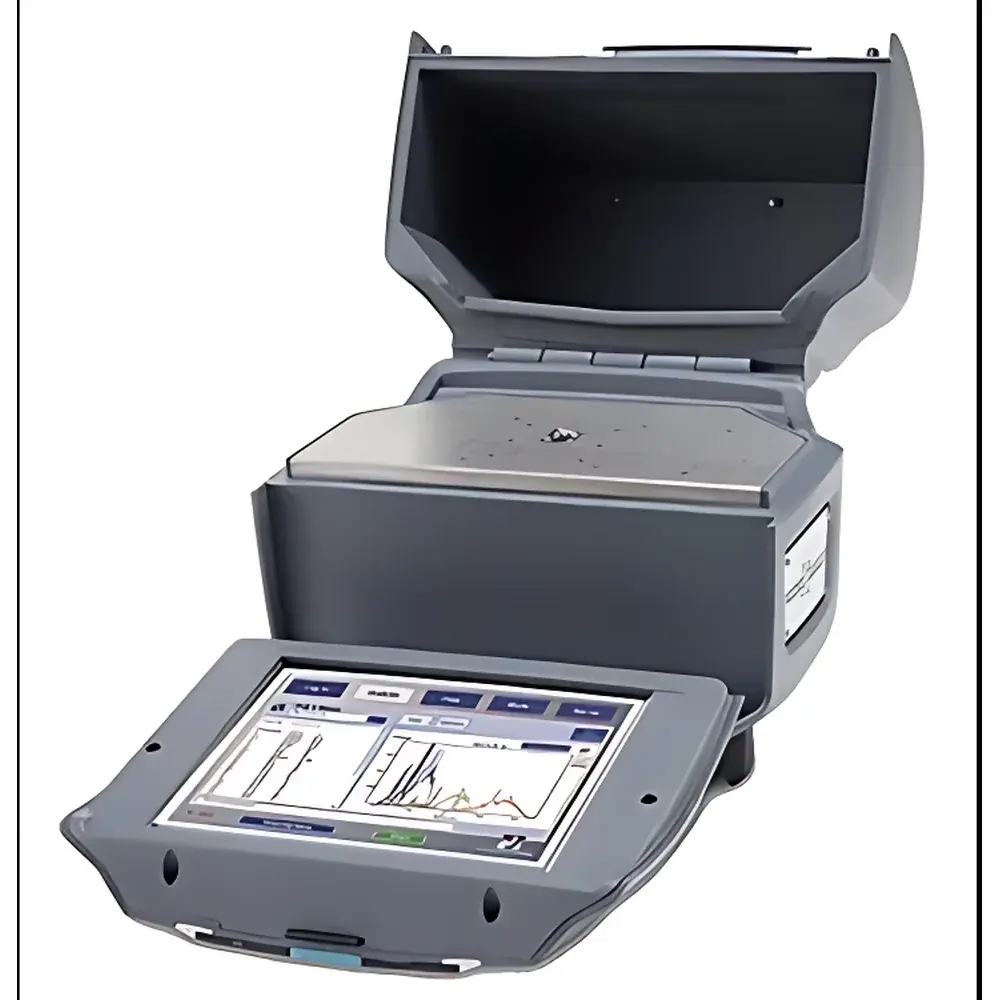
Olympus X-5000a Portable Energy Dispersive X-Ray Fluorescence Spectrometer
| Brand | Olympus |
|---|---|
| Origin | USA |
| Model | X-5000a |
| Application | Field-portable soil and sediment analysis |
| Elemental Range | Na to U |
| Detection Range | 1 ppm to 100% |
| Energy Resolution | <140 eV |
| Repeatability | 0.1% |
| Detector Type | Silicon Drift Detector (SDD) |
| Compliance | EPA Method 6200, ISO/DIS 13196, TCLP, RCRA 8 Metals, ASTM D6729, OSHA/NIOSH/NIH/HUD guidelines |
| Certifications | ISO 9001, NATO AQAPI-110 |
Overview
The Olympus X-5000a is a field-deployable Energy Dispersive X-Ray Fluorescence (EDXRF) spectrometer engineered for rapid, non-destructive elemental quantification in soil, sediment, and environmental solid matrices. Based on the fundamental principle of X-ray fluorescence—where primary X-rays excite atoms in the sample, inducing characteristic secondary (fluorescent) X-ray emission—the X-5000a delivers lab-grade compositional data directly at the point of sampling. Its design prioritizes robustness under variable outdoor conditions, including temperature fluctuations, dust exposure, and mechanical shock typical of field surveys. The instrument employs a high-brightness microfocus X-ray tube and a high-resolution silicon drift detector (SDD), enabling precise peak separation and accurate identification of elements from sodium (Na, Z=11) through uranium (U, Z=92). It is specifically calibrated and validated for regulatory compliance with U.S. Environmental Protection Agency (EPA) Method 6200, serving as a primary tool for site characterization, brownfield assessment, and remediation verification.
Key Features
- Field-optimized EDXRF architecture with integrated shock-absorbing housing and IP54-rated ingress protection against dust and water splashes
- Real-time spectral acquisition and on-board quantification using fundamental parameters (FP) and empirical calibration models
- Direct analysis of samples sealed in polyethylene or Mylar bags—eliminating sample preparation delays and cross-contamination risks
- Automated beam filtration and voltage/current optimization for enhanced sensitivity across light (Na–Ca) and heavy (Pb, As, Cr, Cd, Hg, Ni, Cu, Zn) elements
- Battery-powered operation (up to 8 hours continuous use) with hot-swappable Li-ion modules for uninterrupted survey workflows
- On-device reporting with customizable templates aligned to EPA, ASTM, and ISO reporting requirements
Sample Compatibility & Compliance
The X-5000a accommodates heterogeneous, moist, or granular soil and sediment samples without homogenization or pelletization—provided surface moisture is controlled to minimize scattering artifacts. It supports both bulk analysis (e.g., composite grab samples) and depth-resolved profiling via optional collimated beam attachments. Regulatory alignment includes full traceability to EPA Method 6200 for total element screening, EPA Method 1311 (TCLP) leachate correlation protocols, and the Resource Conservation and Recovery Act (RCRA) list of eight priority metals (As, Ba, Cd, Cr, Pb, Hg, Se, Ag). Instrument performance validation adheres to ASTM D6729 for field-portable XRF in environmental applications and meets ISO/DIS 13196 criteria for portable EDXRF in soil testing. All calibrations are documented per GLP principles, with audit-ready calibration logs and daily QC check records.
Software & Data Management
The instrument operates on Olympus’ proprietary GeoChem Pro software, supporting both on-device operation and PC-based post-processing. Data files (.xrf, .csv, .xml) include full spectral metadata: acquisition time, tube settings, detector live time, ambient temperature/humidity, GPS coordinates (via integrated module), and operator ID. Software features include spectral deconvolution with peak fitting algorithms (based on Gaussian-Lorentzian hybrid models), matrix correction routines for organic/inorganic soil types, and statistical outlier detection. Export options comply with FDA 21 CFR Part 11 requirements when configured with electronic signature and audit trail modules—enabling use in regulated environmental consulting and third-party verification labs. Cloud synchronization (via secure TLS 1.2) allows centralized data aggregation for multi-site projects.
Applications
- Rapid screening of contaminated sites prior to Phase II investigations per ASTM E1527
- Verification of excavation boundaries during soil removal operations
- Monitoring of landfill cover soils and leachate collection systems
- Assessment of agricultural land for trace metal accumulation (e.g., Cd in phosphate-fertilized fields)
- Regulatory compliance reporting for HUD Lead-Safe Housing Rule and EPA’s Toxic Substances Control Act (TSCA) enforcement actions
- Baseline geochemical mapping in ecological restoration and watershed management programs
FAQ
Does the X-5000a require annual recalibration by an authorized service center?
Yes—Olympus recommends factory recalibration every 12 months or after 500 operational hours, whichever occurs first, to maintain traceability to NIST SRM standards.
Can the instrument quantify light elements such as sulfur or phosphorus in clay-rich soils?
Yes, under optimized vacuum or helium purge conditions; however, detection limits for Mg, Al, Si, P, and S increase significantly in high-moisture or organic-rich matrices.
Is method validation documentation available for EPA 6200 compliance?
Yes—Olympus provides a comprehensive Method Validation Report (MVR) package, including precision/accuracy studies, detection limit determinations (IDL/MDL), and interlaboratory comparison data per ISO/IEC 17025 guidelines.
How does the X-5000a handle spectral interference from iron and manganese in highly weathered soils?
The SDD’s high count-rate capability (>100,000 cps) and real-time pile-up rejection algorithms minimize overlap artifacts; FP-based deconvolution further resolves Mn Kβ–Fe Kα and Cr Kα–V Kβ overlaps.
Is GPS data embedded in exported reports compliant with ISO 19115 metadata standards?
Yes—geotagged results include WGS84 coordinates, horizontal/vertical accuracy estimates, and timestamped UTC/GPS time sync, exportable in GML or GeoJSON formats.





