
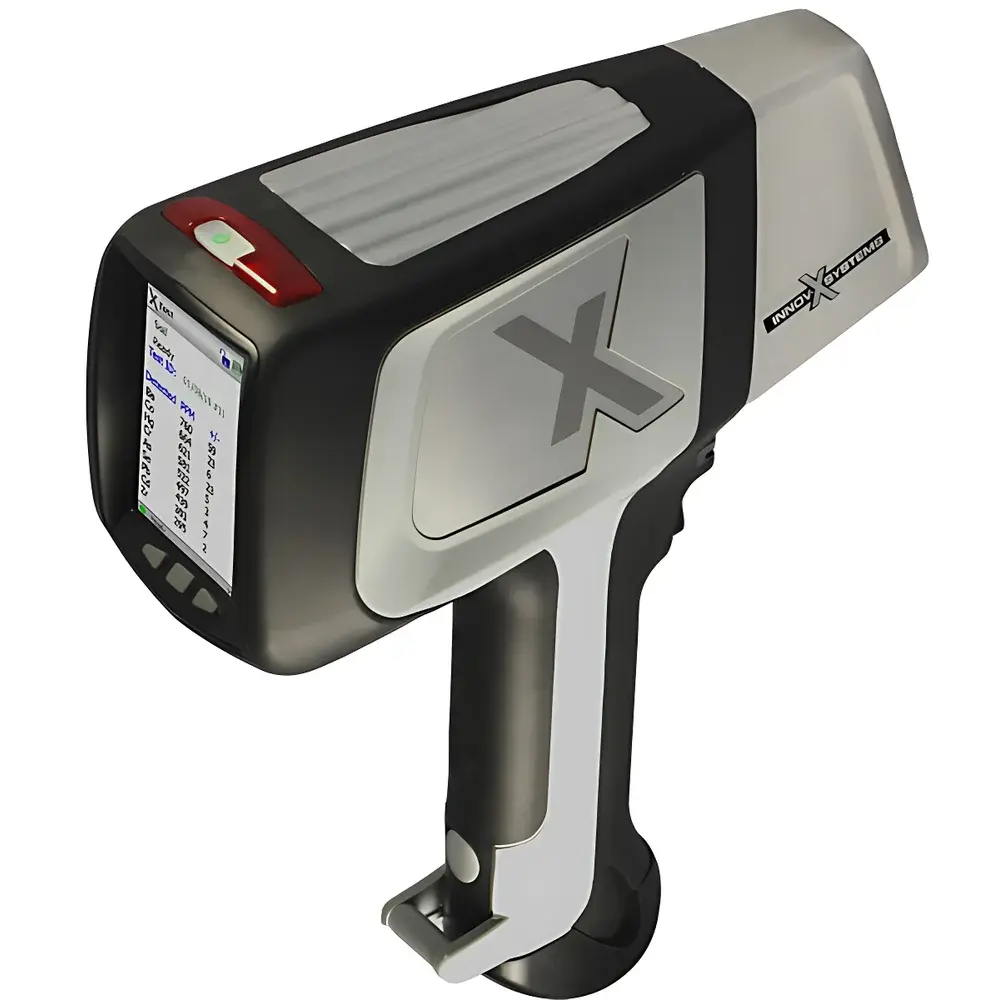
Olympus Delta DCC-4000 Handheld Energy Dispersive X-Ray Fluorescence (EDXRF) Spectrometer for Soil and Environmental Analysis
| Brand | Olympus |
|---|---|
| Origin | USA |
| Model | DCC-4000 |
| Portability | Handheld |
| Application Domain | Soil & Atmospheric Environmental Monitoring |
| Elemental Range | K (19) to U (92) |
| Detection Limit | 1 ppm |
| Quantification Range | 1 ppm – 100% |
| Energy Resolution | <140 eV (at Mn Kα) |
| Repeatability | ±0.1% RSD |
| Dimensions | 245 × 250 × 88 mm |
| Weight | <1.5 kg |
| Operating Temperature | −10 °C to +50 °C |
| Relative Humidity | 0–95% non-condensing |
| Excitation Source | High-power micro-focus X-ray tube (15–40 kV) |
| Detector | Si-PIN semiconductor detector with Peltier cooling to −35 °C |
| Filter System | 8-position automatic filter changer |
| Data Storage | MicroSD card (≥100,000 spectra) |
| Connectivity | USB 2.0, Bluetooth v2.1 + EDR |
| Operating System | Windows CE 6.0 |
| Battery | Dual hot-swappable Li-ion packs |
Overview
The Olympus Delta DCC-4000 is a field-deployable, handheld energy dispersive X-ray fluorescence (EDXRF) spectrometer engineered for rapid, non-destructive elemental analysis of soils, sediments, dust, coatings, and environmental matrices in situ. Based on fundamental XRF physics—where primary X-rays excite characteristic secondary (fluorescent) X-rays from atoms in the sample—the DCC-4000 delivers quantitative and semi-quantitative results for elements from potassium (K, Z=19) through uranium (U, Z=92). Its optimized excitation geometry, high-efficiency Si-PIN detector, and multi-filter beam conditioning enable reliable detection at sub-ppm levels for heavy metals (e.g., Pb, As, Cd, Cr, Hg) and transition elements critical to RCRA, EPA Method 6200, NIOSH 7702, and OSHA OSSI compliance workflows. Designed for continuous operation under variable ambient conditions—including high humidity, temperature extremes, and particulate-laden environments—the instrument meets the rigorous demands of environmental site assessments, brownfield characterization, regulatory screening, and remediation verification.
Key Features
- High-power micro-focus X-ray tube (15–40 kV adjustable) with eight-position automated filter changer for optimized excitation across light, mid-, and heavy-element groups.
- Si-PIN semiconductor detector with Peltier thermoelectric cooling capable of stable operation down to −35 °C, ensuring consistent spectral resolution (<140 eV at Mn Kα) independent of ambient thermal drift.
- Hot-swappable dual Li-ion battery system enabling uninterrupted analysis during extended field campaigns—no power-down required for battery replacement.
- Ergonomic, self-balancing chassis with top-mounted aluminum finned heat sink, eliminating active fans and enhancing long-term reliability in dusty or humid conditions.
- IP54-rated sealed enclosure with interlocking groove-and-ridge gasket design, providing resistance to dust ingress, water splashes, and mechanical shock per MIL-STD-810G criteria.
- Multi-beam excitation technology and 25 pre-configured, user-editable analysis modes—including soil-specific calibrations traceable to NIST SRM 2710a and 2711a—support rapid method deployment without lab-based recalibration.
- Industrial-grade capacitive touchscreen display with Blanview transmissive backlighting, fully operable with gloved hands and under direct sunlight.
- Digital pulse processor with real-time dead-time correction, peak deconvolution, and matrix-effect compensation algorithms compliant with ASTM E1621 and ISO 21043 standards.
Sample Compatibility & Compliance
The DCC-4000 is validated for heterogeneous, unprepared solid samples including moist or dry soils, surface dust wipes, paint chips, corrosion products, air filter media, and construction debris. No grinding, pressing, or vacuum requirements are necessary—analysis occurs directly on native substrates. Regulatory alignment includes full support for EPA Method 6200 (field-portable XRF for soil metals), RCRA waste characterization, OSHA OSSI lead-in-paint screening, and NIOSH 7702 airborne lead monitoring on filters. Instrument firmware and data management architecture comply with GLP/GMP principles, supporting audit-ready metadata capture (GPS coordinates, operator ID, time stamp, atmospheric pressure, temperature, humidity) and optional 21 CFR Part 11–compliant electronic signatures via PC software integration.
Software & Data Management
Embedded Windows CE 6.0 OS enables local execution of advanced spectral processing routines—including fundamental parameter (FP) quantification, empirical calibration, and interference correction. Data is stored in vendor-neutral .CSV and .DXF formats on removable MicroSD cards (up to 128 GB), with ≥100,000 spectra capacity per card. Remote operation and batch report generation are supported via Olympus Delta PC Suite, which provides spectral library management, calibration validation tracking, statistical process control (SPC) charts, and export to LIMS-compatible XML or PDF. Bluetooth and USB 2.0 interfaces allow seamless synchronization with enterprise asset management systems and GIS platforms for spatial trend mapping.
Applications
- Rapid delineation of contamination plumes and boundary mapping at legacy industrial sites, landfills, and mining-impacted areas.
- Real-time verification of excavation cut-off concentrations during remediation earthwork operations.
- On-site screening of demolition debris, recycled aggregates, and building materials for hazardous element content prior to disposal or reuse.
- Monitoring fugitive emissions pathways—including tailings, windblown dust, and stormwater runoff sediments—in compliance with NPDES and TMDL reporting requirements.
- Quality assurance of soil amendments, composts, and biosolids against EPA 503 and state-specific heavy metal thresholds.
FAQ
Does the DCC-4000 require annual factory recalibration to maintain accuracy?
No—its factory-installed calibration is traceable to NIST-certified reference materials and remains stable over time; however, daily verification using a check standard (e.g., stainless steel or soil CRM) is recommended per ASTM E2857 and EPA guidance.
Can the instrument quantify light elements such as Mg, Al, and Si in silicate-rich soils?
Yes—optimized low-kV excitation (15 kV), helium purge capability (optional accessory), and atmospheric pressure correction via integrated barometer enable reliable quantification of elements down to Mg (Z=12) in field conditions.
Is spectral data export compatible with third-party chemometric software?
Yes—raw spectra (.SPE) and processed results (.CSV) are fully exportable; spectral libraries may be imported into Unscrambler, Pirouette, or MATLAB for multivariate modeling and classification.
What safety certifications does the DCC-4000 hold for international deployment?
It carries CE marking (EMC Directive 2014/30/EU, RoHS 2011/65/EU), FCC Part 18 compliance, and IEC 61010-1:2010 safety certification for portable radiation-emitting devices.
How is measurement uncertainty estimated for field-reported concentrations?
Uncertainty propagation is calculated in real time using type-A (repeatability) and type-B (calibration, matrix correction, counting statistics) components per ISO/IEC 17025:2017 Annex A, with expanded uncertainty (k=2) displayed alongside each result.






