
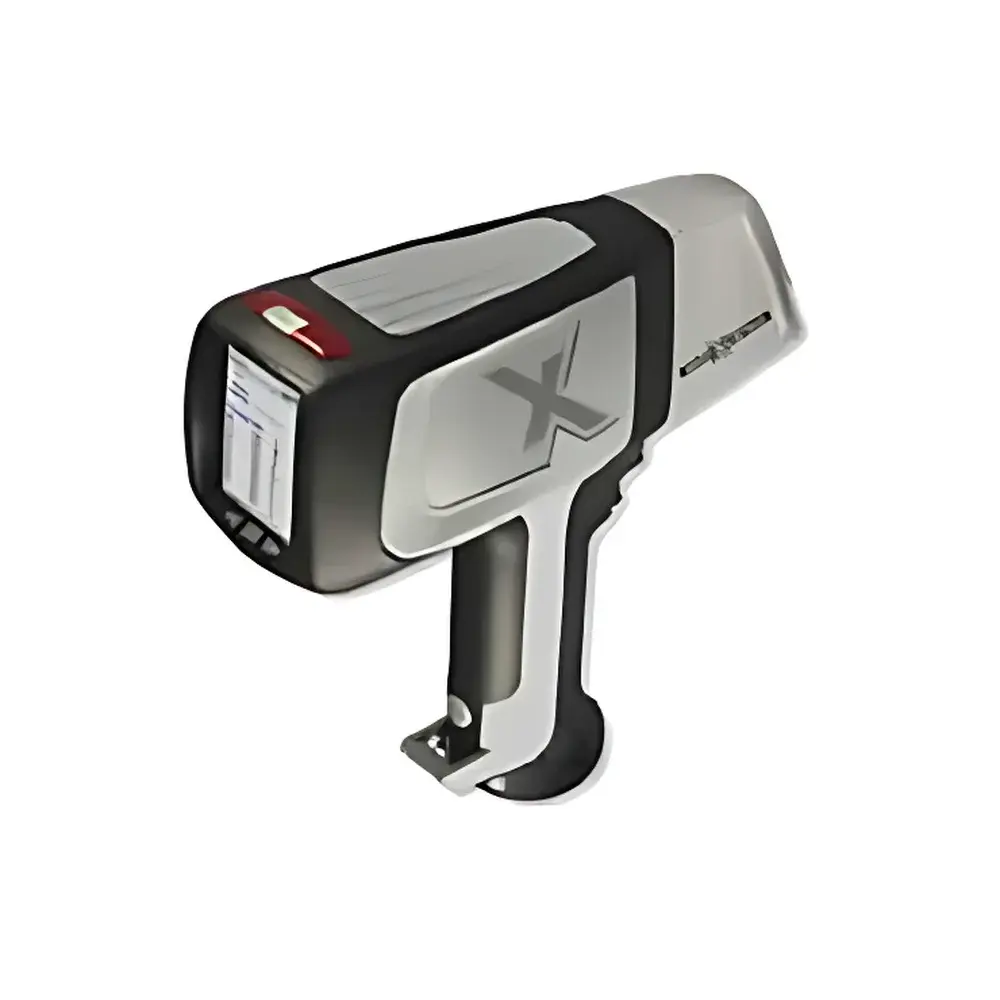
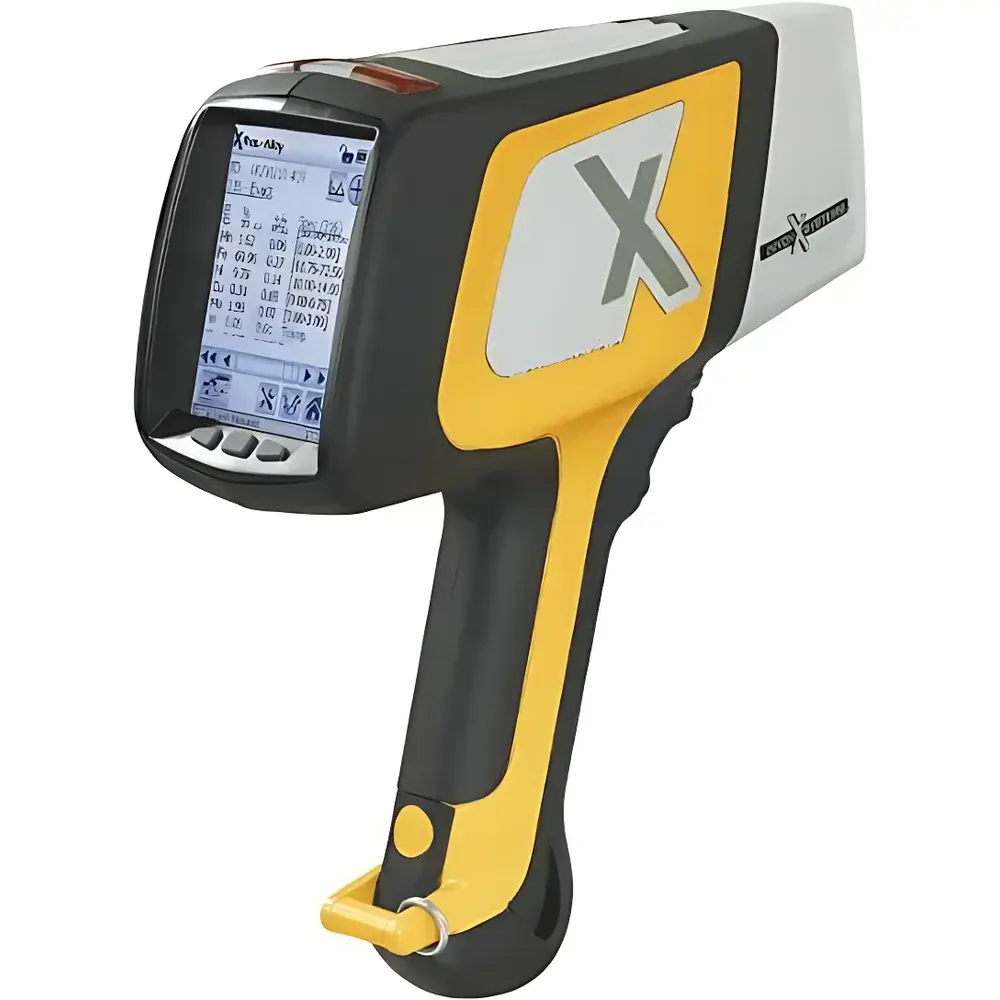
Olympus DELTA DCC2000 Handheld Energy Dispersive X-Ray Fluorescence (EDXRF) Spectrometer
| Brand | Olympus |
|---|---|
| Origin | USA |
| Model | DCC2000 |
| Application | Handheld/Portable |
| Elemental Range | Mg (12) to U (92) |
| Concentration Range | 1 ppm – 100% |
| Energy Resolution | <150 eV |
| Repeatability | 0.1% |
| Dimensions | 245 × 250 × 88 mm |
| Weight | <1.5 kg |
| Operating Temperature | −10 °C to +50 °C |
| Humidity | 0–95% RH (non-condensing) |
| Excitation Source | High-power micro-focus X-ray tube (8–40 kV) |
| Detector | Si-PIN semiconductor detector with Peltier cooling (down to −35 °C) |
| Filter System | 8-position automatic filter changer |
| Power Supply | Dual hot-swappable Li-ion batteries |
| Display | High-resolution transflective color touchscreen |
| Data Storage | SD card (≥100,000 spectra) |
| Connectivity | USB 2.0, Bluetooth 2.1 (Microsoft-compatible stack) |
| OS | Windows CE 6.0 |
| Software | Delta PC Suite for remote control, report generation, and spectral library management |
Overview
The Olympus DELTA DCC2000 is a field-deployable, handheld energy dispersive X-ray fluorescence (EDXRF) spectrometer engineered for rapid, non-destructive elemental analysis of metallic alloys and industrial materials. Based on fundamental XRF physics—where primary X-rays excite characteristic secondary (fluorescent) X-rays from sample atoms—the instrument quantifies elemental composition by measuring energy spectra of emitted photons. Its optimized geometry, high-efficiency Si-PIN detector, and Peltier-cooled detection system enable reliable detection of light elements (starting from magnesium, Z=12) through heavy elements (up to uranium, Z=92), making it suitable for positive material identification (PMI), grade verification, and compositional screening in demanding industrial environments. Designed for rugged daily use, the DCC2000 meets MIL-STD-810G environmental robustness requirements and operates continuously under variable ambient conditions without performance degradation.
Key Features
- High-performance micro-focus X-ray tube with adjustable voltage (8–40 kV) and multi-stage filtration for optimized excitation across diverse matrices.
- Si-PIN detector with thermoelectric (Peltier) cooling to −35 °C, ensuring stable spectral resolution (<150 eV at Mn Kα) and low-noise operation even during extended field use.
- Dual hot-swappable lithium-ion battery system supporting uninterrupted operation; batteries may be replaced without powering down the instrument.
- Integrated industrial-grade touchscreen display with transflective Blanview technology—readable under direct sunlight and resistant to dust, moisture, and mechanical shock (IP54 rated).
- SmartSort™ intelligent sorting algorithm automates pass/fail decisions based on user-defined tolerance thresholds and alloy grade libraries—reducing operator dependency and increasing throughput in QA/QC workflows.
- Comprehensive onboard alloy library containing >500 standardized grades (e.g., ASTM, UNS, EN, JIS, GB), with support for custom user-defined grade definitions and weld-specific composition templates.
- Real-time atmospheric pressure compensation using integrated barometric sensor—critical for accurate light-element quantification (e.g., Mg, Al, Si) in varying elevation or weather conditions.
Sample Compatibility & Compliance
The DCC2000 is validated for direct analysis of solid metallic samples including castings, forgings, weldments, pipes, valves, fasteners, and scrap fragments. It supports both flat and curved surfaces up to 15 mm radius without auxiliary fixtures. The instrument complies with IEC 62471 (photobiological safety), ANSI N43.3 (radiation safety), and EU Directive 2011/65/EU (RoHS). Its measurement protocols align with ASTM E1621 (standard guide for XRF analysis of metals), ASTM E2857 (quantitative analysis of alloys), and ISO 21043 (handheld XRF safety and performance). For regulated environments—including pharmaceutical equipment validation, nuclear component certification, and aerospace material release—the system supports audit-ready data logging with time-stamped spectra, operator ID tagging, and GLP/GMP-compliant metadata capture.
Software & Data Management
Data acquisition and post-processing are managed via the Olympus Delta PC Suite—a Windows-based application enabling remote instrument control, spectral deconvolution, calibration curve management, and customizable reporting. All raw spectra and processed results are stored in vendor-neutral formats (CSV, DXF, XML) with embedded traceability metadata. The software supports FDA 21 CFR Part 11 compliance through configurable electronic signatures, role-based access control, and immutable audit trails. Spectral libraries may be synchronized across fleets via encrypted network deployment. Firmware updates and method transfers are performed over USB or Bluetooth, with version-controlled configuration backups.
Applications
- Positive Material Identification (PMI): Verification of alloy grade conformity in piping systems, pressure vessels, turbine blades, and structural components across oil & gas, power generation, and chemical processing facilities.
- Scrap Sorting & Recycling: Real-time classification of mixed ferrous/non-ferrous streams—including stainless steels, nickel superalloys, titanium grades, and precious metal-bearing residues—to optimize recovery economics and regulatory compliance (e.g., EPA 40 CFR Part 261).
- Weld Inspection & Certification: Analysis of weld metal, heat-affected zones (HAZ), and parent material using dedicated weld-grade libraries—supporting ASME BPVC Section IX and AWS D1.1 conformance documentation.
- QA/QC in Metal Fabrication: Incoming raw material inspection, in-process verification of heat treatment effects, and final product release testing—reducing reliance on lab-based wet chemistry or OES methods.
- High-Temperature In-Service Monitoring: Optional thermal management accessories enable safe analysis of components operating up to 480 °C—valuable for refinery turnaround inspections and furnace tube integrity assessment.
FAQ
What elements can the DCC2000 detect?
It detects elements from magnesium (Mg, Z=12) to uranium (U, Z=92) in solid metallic matrices, with quantitative capability from 1 ppm to 100 wt% depending on element, matrix, and measurement time.
Is the instrument certified for use in hazardous locations?
The standard DCC2000 is not ATEX or IECEx certified; however, it may be deployed in Zone 2/Class I Div 2 areas when operated per manufacturer-specified safety protocols and with appropriate radiation monitoring.
Can it analyze coated or painted surfaces?
Surface coatings thinner than ~5 µm (e.g., paint, plating, oxide layers) generally do not impede bulk alloy analysis; thicker or multi-layered coatings require empirical correction or removal prior to measurement.
How is calibration maintained in the field?
Factory calibrations are traceable to NIST SRMs; users perform daily verification using supplied check standards, with optional periodic recalibration services available through Olympus-certified labs.
Does the system support multi-language UI and reporting?
Yes—the Windows CE interface and Delta PC Suite support English, Spanish, French, German, Chinese, Japanese, and Korean language packs, with exportable reports in localized units and terminology.





