
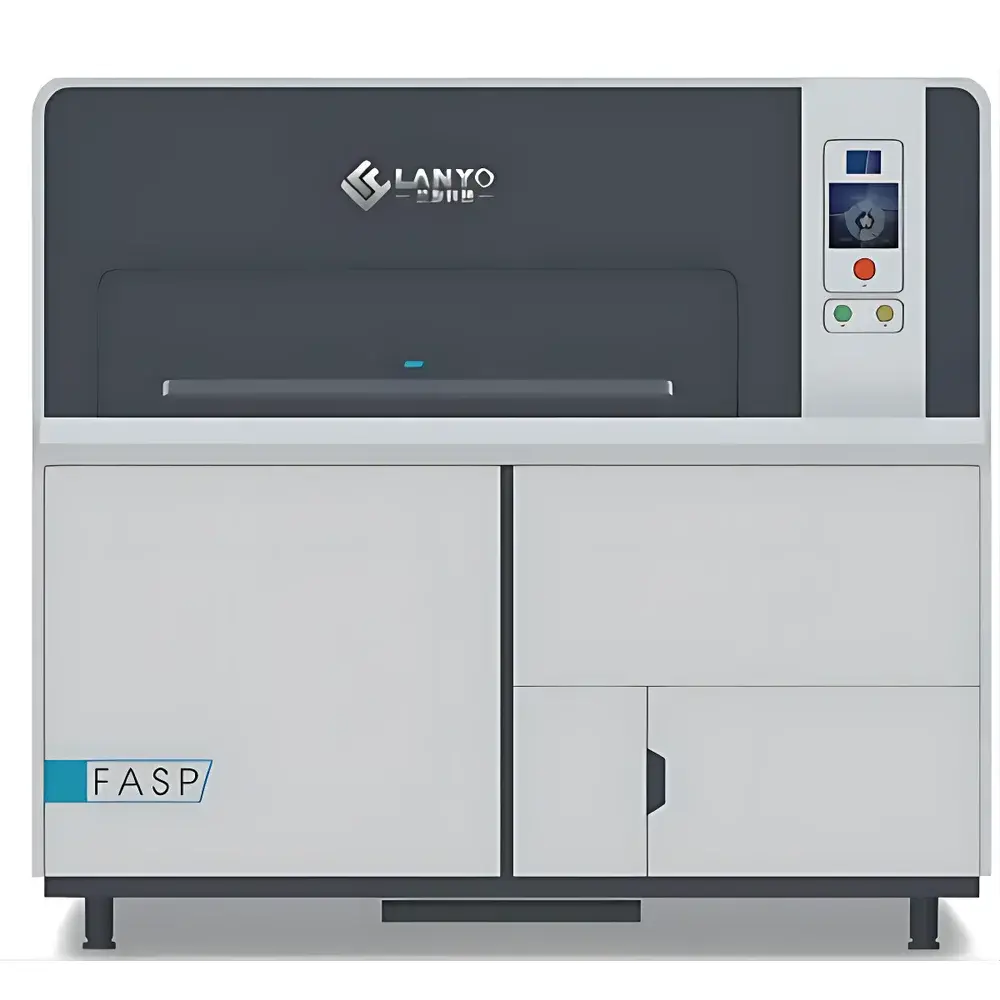
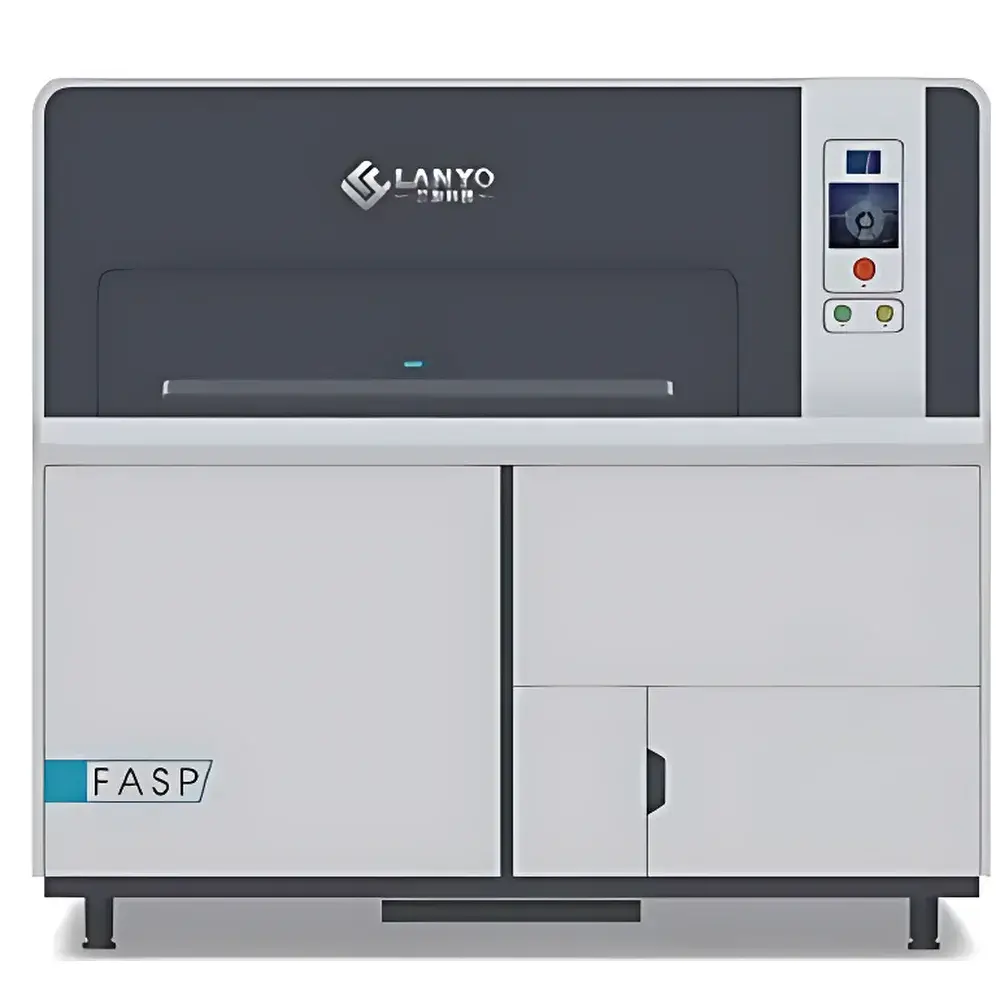
FASP-05B Automated Soil Sample Preparation System
| Origin | Beijing |
|---|---|
| Manufacturer Type | Distributor |
| Origin Category | Domestic |
| Model | FASP-05B |
| Price | Upon Request |
Overview
The FASP-05B Automated Soil Sample Preparation System is an engineered solution for standardized, contamination-controlled soil sample processing in environmental monitoring and geochemical laboratories. Designed in accordance with core principles of mechanical sample homogenization, size reduction, and fractionation—without metal contact—the system implements a closed-loop, sequential workflow grounded in physical separation physics and gravimetric control. It operates on a dual-arm robotic architecture that coordinates sample handling, grinding, sieving, splitting, weighing, labeling, and decontamination without manual intervention. Unlike manual or semi-automated workflows, the FASP-05B eliminates operator-induced variability by enforcing fixed procedural logic, dwell times, and motion trajectories, ensuring repeatability across batches and operators. Its primary application domain spans regulatory-compliant soil analysis workflows where trace-level integrity, particulate uniformity, and audit-ready documentation are mandatory—not optional.
Key Features
- Five-position dry-sample loading station compatible with field-collected air-dried soils per HJ/T 166–2004 and NY/T 395–2012 requirements
- Dual independent robotic arms enabling parallel execution of grinding, sieving, and weighing subroutines
- Non-metallic grinding mechanism utilizing rotational abrasive action with ceramic or polymer composite media to prevent elemental leaching or cross-contamination
- Programmable multi-stage sieving: simultaneous selection of any three mesh sizes from 10, 20, 60, and 100 US Standard Sieve Series (conforming to GB/T 6003.1–2012)
- Integrated high-resolution analytical balance controlled via robotic arm; automatic tare, gross weight acquisition, and mass-based subsampling
- Two-dimensional barcode scanning at load-in and post-prep stages for unambiguous sample lineage tracking
- Automated cleaning cycle using compressed air and inert wipe protocols between samples to meet GLP-grade cross-contamination thresholds
- Onboard process logging with timestamped event records—including motor current draw, sieve vibration frequency, and arm positioning error margins—for full operational traceability
Sample Compatibility & Compliance
The FASP-05B accepts air-dried soil specimens ranging from coarse sandy loams to fine clays, provided moisture content remains below 15% w/w to ensure consistent feed-through during grinding and sieving. It complies with national technical specifications governing soil sample preparation in China, including HJ/T 166–2004 (Soil Environmental Monitoring Technical Specifications), DZ/T 0130.4–2006 (Geological Laboratory Quality Management), and EJ 428–1989 (Nuclear Environmental Soil Sampling and Preparation). While not certified to ISO/IEC 17025 or ASTM D6913 for method validation, its deterministic workflow supports laboratory-developed methods aligned with ISO 11464:2020 (Soil quality — Pretreatment of samples) and facilitates alignment with EPA Method 5035A (Soil and Waste Extraction) sample prep prerequisites. All mechanical components contacting samples are fabricated from FDA-compliant polymers or alumina ceramics, documented in material traceability reports supplied with each unit.
Software & Data Management
The system runs on embedded Linux-based firmware with a web-accessible interface (HTTPS-enabled) for remote monitoring and method configuration. Software modules include: (1) SOP Manager for defining and versioning preparation protocols; (2) Audit Trail Engine compliant with ALCOA+ principles—capturing user ID, action timestamp, parameter values, and digital signatures; (3) Integrated LIMS connector supporting HL7 and ASTM E1384 message formats for bidirectional sample ID exchange; (4) Report Generator producing PDF and CSV outputs containing raw weight logs, sieve retention percentages, coefficient of variation (CV) per batch, and deviation alerts. Data retention defaults to 18 months on internal SSD, extendable via network-attached storage with TLS 1.2 encryption. The software architecture conforms to FDA 21 CFR Part 11 requirements for electronic records and signatures when deployed with institutional authentication infrastructure.
Applications
- Regulatory soil monitoring programs requiring adherence to HJ/T 166–2004 and China’s National Soil Pollution Survey protocols
- Field-scale agricultural soil health assessment under NY/T 395–2012, including heavy metal speciation and nutrient availability studies
- Site investigation and risk assessment for contaminated land (e.g., industrial brownfields), supporting TCLP and SPLP extraction readiness
- Reference material homogenization and sub-sampling in certified reference material (CRM) production labs
- Method development and validation studies in academic and governmental geochemical research institutes
- High-throughput preprocessing for XRF, ICP-MS, AAS, and TOC analyzers where particle size distribution directly impacts measurement accuracy
FAQ
Does the FASP-05B support wet or frozen soil samples?
No. It is designed exclusively for air-dried soil specimens with moisture content ≤15% w/w. Wet or frozen samples require pre-drying in climate-controlled chambers prior to loading.
Can sieve mesh sizes be customized beyond 10/20/60/100 US Standard?
Not natively. Custom sieve trays may be commissioned as OEM accessories, subject to mechanical compatibility verification and recalibration of the sieving module’s vibration amplitude and duration parameters.
Is remote diagnostics supported?
Yes. The system provides secure SSH access and real-time telemetry (motor status, temperature sensors, vacuum pressure) via encrypted API endpoints for authorized service engineers.
How is calibration traceability maintained?
Gravimetric calibration uses NIST-traceable weights; sieve mesh certification follows GB/T 6003.1–2012 with annual third-party verification recommended. Calibration logs are stored in the audit trail database.
What maintenance intervals are recommended?
Daily visual inspection of grinding media and sieve frames; biweekly lubrication of robotic arm guide rails; quarterly replacement of particulate filters in the cleaning module; annual full-system metrological verification.
Related Products





