
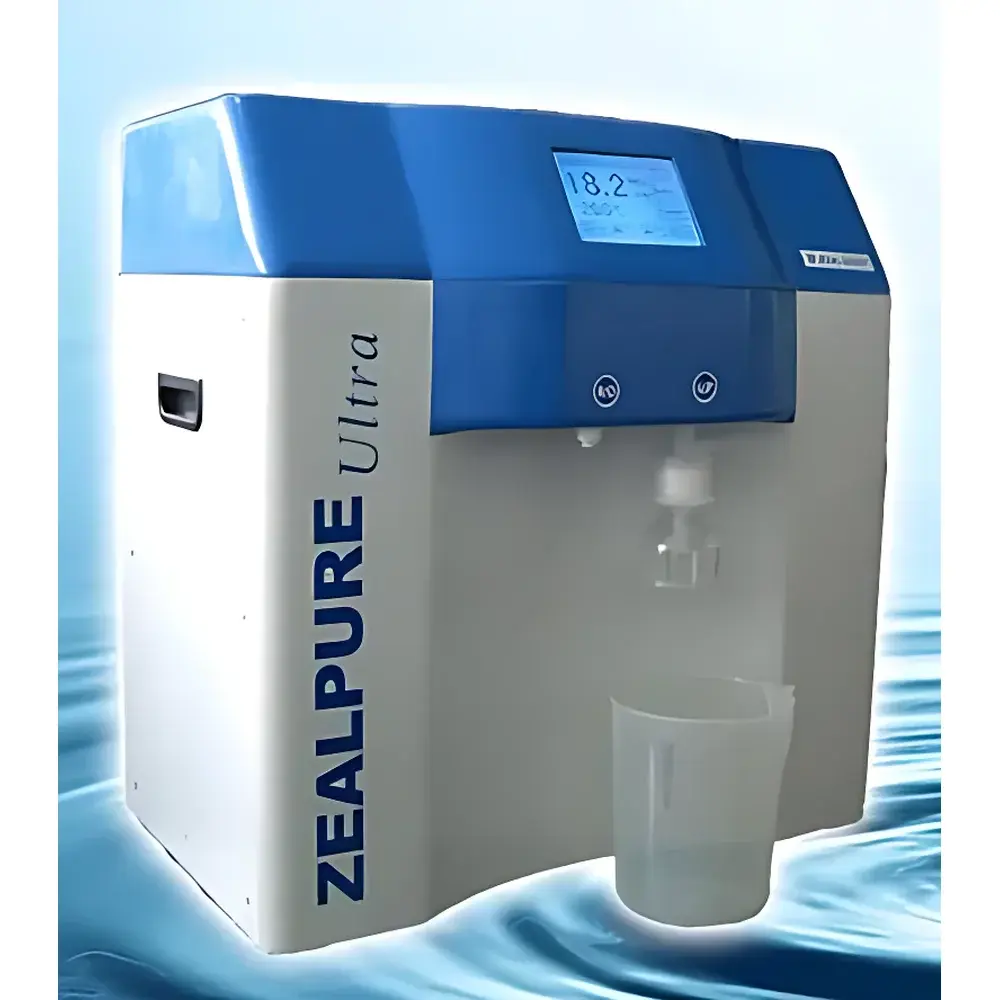
Zealpure Ultra ZP15DI Benchtop Ultra-Pure Water System
| Origin | Shanghai, China |
|---|---|
| Manufacturer Type | Authorized Distributor |
| Product Origin | Domestic (China) |
| Model | ZP15DI |
| Output Flow Rate | 15 L/h at 25°C |
| Resistivity | ≥18.2 MΩ·cm @ 25°C |
| Heavy Metals & Soluble Silica | <0.1 ppb |
| Total Organic Carbon (TOC) | <3 ppb |
| Microbial Count | <0.001 EU/mL |
| Particles (>0.1 µm) | <1 particle/mL |
Overview
The Zealpure Ultra ZP15DI is a benchtop ultra-pure water system engineered for laboratories requiring consistent, high-fidelity Type I ultrapure water per ISO 3696:1987, ASTM D1193-06, and CLSI EP22-A guidelines. It integrates five complementary purification stages—reverse osmosis (RO), activated carbon adsorption, mixed-bed ion exchange, ultrafiltration (UF), and dual-wavelength UV photooxidation (185 nm + 254 nm)—to achieve trace-level contaminant removal essential for sensitive analytical and life science applications. Unlike single-stage systems, the ZP15DI employs a closed-loop recirculation architecture with continuous internal circulation of ultrapure water, minimizing stagnant zones and suppressing microbial regrowth. Its modular design enables seamless configuration for DI-only (ZP15DI), endotoxin-free (ZP15UF), low-TOC (ZP15UV), or combined UV/UF (ZP15UVF) operation—ensuring adaptability across QC, research, and regulated environments.
Key Features
- Integrated dual-wavelength UV chamber (185 nm for TOC oxidation; 254 nm for microbial inactivation) delivering sustained TOC reduction to <3 ppb
- 5 kDa molecular weight cutoff ultrafiltration module for effective endotoxin removal (<0.001 EU/mL), validated per USP and EP 2.6.14
- High-capacity nuclear-grade mixed-bed ion exchange cartridge ensuring stable resistivity ≥18.2 MΩ·cm and low ionic leaching
- Automated RO membrane antiscalant flush cycle triggered by pressure differential and runtime, extending membrane service life beyond 24 months under typical municipal feedwater (TDS <250 ppm)
- Sealed, non-leaching fluid path constructed from pharmaceutical-grade PEEK, PVDF, and stainless steel 316L—compliant with USP Class VI biocompatibility testing
- Intelligent touchscreen interface with real-time monitoring of conductivity, temperature, flow rate, and consumable status—including predictive replacement alerts based on cumulative volume processed
- Onboard data logging with timestamped records of all critical parameters, supporting GLP/GMP audit trails and FDA 21 CFR Part 11 compliance when paired with optional secure network interface
Sample Compatibility & Compliance
The ZP15DI produces water meeting or exceeding specifications for ASTM Type I, ISO Grade 1, and CLSI-recommended ultrapure water for analytical instrumentation and cell culture. Feedwater compatibility is defined for municipal tap water with TDS ≤250 ppm, temperature range 1–40°C, and inlet pressure 1.0–3.5 kg/cm². Systems include integrated pre-filtration for particulate and chlorine removal; optional pretreatment units are recommended for feedwater exceeding 250 ppm TDS. All models conform to IEC 61010-1 safety standards and electromagnetic compatibility (EMC) requirements per EN 61326-1. Certificates of Conformance and material declarations (RoHS, REACH) are provided with each unit shipment.
Software & Data Management
The embedded control firmware supports configurable alarm thresholds (e.g., resistivity deviation >0.1 MΩ·cm, TOC excursion >5 ppb), automatic event logging, and USB export of CSV-formatted operational logs. Optional Ethernet or RS232 interfaces enable integration into laboratory information management systems (LIMS) and centralized monitoring platforms. Audit trail functionality includes user login history, parameter changes, maintenance events, and calibration actions—all time-stamped and digitally signed. Data retention spans ≥12 months onboard; external storage via USB drive extends archival capacity indefinitely. Firmware updates are delivered via encrypted firmware packages with SHA-256 signature verification.
Applications
- HPLC, UHPLC, and LC-MS mobile phase preparation where ionic contamination induces baseline drift or column fouling
- Atomic absorption spectroscopy (AAS), ICP-OES, and ICP-MS sample dilution and standard preparation requiring sub-ppt metal purity
- Molecular biology workflows including PCR, qRT-PCR, CRISPR-Cas9 editing, and mammalian cell culture—validated for endotoxin-sensitive applications
- TOC analysis, GC-MS solvent blanks, and trace organic residue testing demanding ultra-low background carbon levels
- Buffer and reagent formulation for ELISA, Western blotting, and immunoassay development
- Capillary electrophoresis and microfluidic device priming where particulate-induced clogging must be avoided
FAQ
What is the minimum feedwater quality required for reliable ZP15DI operation?
Municipal tap water with TDS ≤250 ppm, free chlorine <2 ppm, and turbidity <1 NTU is recommended. For higher TDS or variable feed conditions, a dedicated pretreatment station (e.g., softener + sediment + carbon filter) is advised.
How frequently must consumables be replaced under standard usage?
RO membrane: 24–36 months; DI cartridge: 6–12 months depending on feedwater TDS and daily usage volume; UF module: 12–24 months; UV lamp: 9,000 hours (≈12 months continuous operation). System software calculates remaining life based on actual throughput.
Is the ZP15DI compatible with regulatory documentation requirements for pharmaceutical labs?
Yes—the system supports IQ/OQ documentation templates, provides full electronic audit trails, and meets key elements of FDA 21 CFR Part 11 for electronic records and signatures when deployed with appropriate access controls and backup protocols.
Can the system be configured for remote monitoring and alarm notification?
Via optional Ethernet module, real-time status can be viewed through web browser interface; email/SMS alerts for critical faults (e.g., low pressure, high TOC, expired cartridge) are configurable through integrated SMTP client.
Does the internal recirculation loop introduce additional contamination risk?
No—the loop operates at laminar flow with constant UV exposure and zero dead-leg geometry. Pressure-controlled circulation prevents biofilm formation and maintains TOC stability within ±0.5 ppb over 72-hour hold periods, as verified per ASTM D5127-18.



