
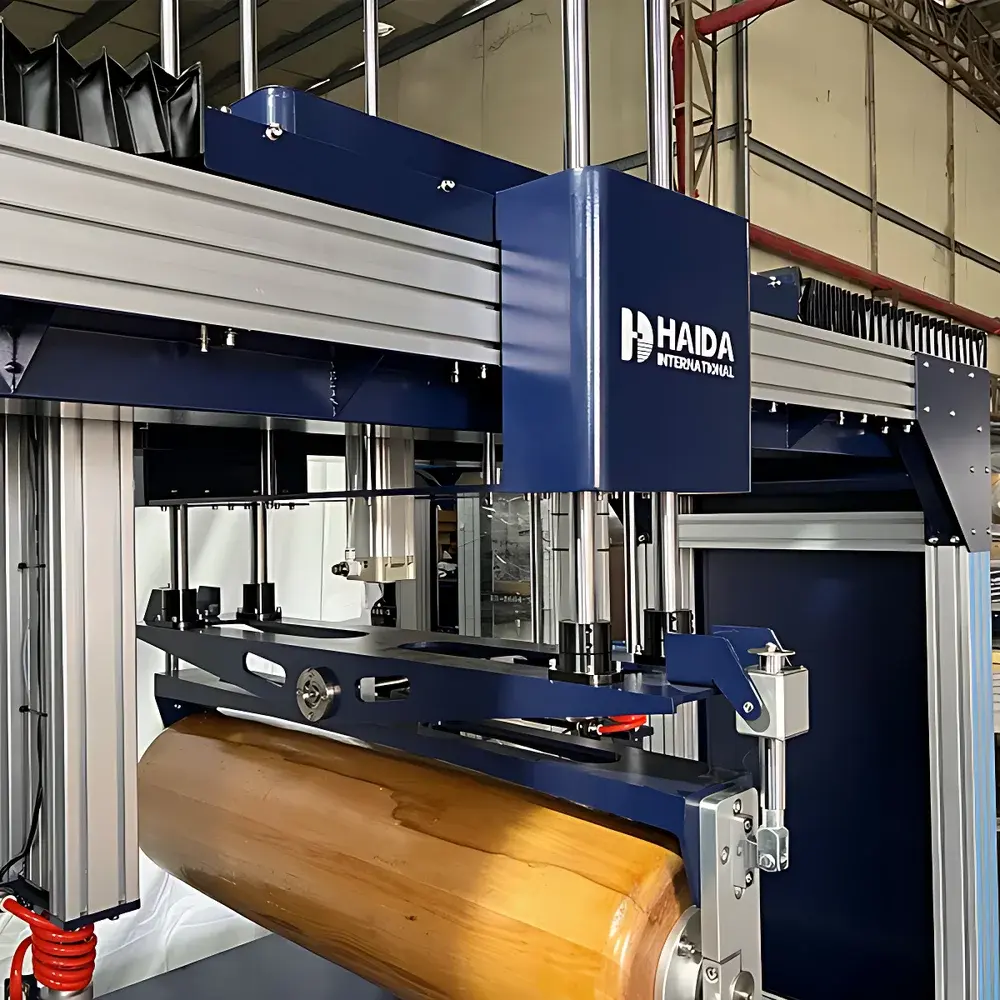
HAIDA HD-F764-S Mattress Rolling Durability Tester (Touchscreen Tri-Function System)
| Brand | HAIDA INTERNATIONAL |
|---|---|
| Origin | Guangdong, China |
| Manufacturer Type | Direct Manufacturer |
| Product Origin | Domestic (China) |
| Model | HAIDA HD-F764-S Mattress Rolling Durability Tester (Touchscreen Tri-Function System) |
| Quotation | Upon Request |
| Force Sensor | 2 × 2 kN |
| Servo Motor Power | 0.4 kW (softness/thickness), 1.5 kW (rolling) |
| Electro-Cylinder Stroke | 450 mm, Max Thrust: 1.39 kN |
| Control System | Industrial PLC with HMI Touchscreen |
| Test Speed | 10–18 cycles/min (GB/EN: 16 ± 2 cpm |
| ASTM | ≤20 cpm) |
| Rolling Travel | GB/EN: ±250 mm from centerline |
| ASTM | min(70% mattress width, 965 mm) |
| Displacement Accuracy | ±0.1 mm |
| Loading Speed (Thickness/Softness) | 50–250 mm/min |
| Force Accuracy | 0.1–480 N (±0.1 N), 0.1–1300 N (±0.1 N) |
| Edge Durability Load | 1000 N × 5000 cycles (1–3 s dwell per cycle) |
| Roller Static Load | Cylindrical roller: (1400 ± 7) N |
| Hexagonal roller (optional) | 109 ± 4 kg |
| Rolling Fatigue Life | 30,000 cycles (cylindrical), 100,000 cycles (hexagonal) |
| Data Export | USB interface |
| Max Test Specimen | 2200 × 2000 × 400 mm (L×W×H) |
| Power Supply | 1-phase AC 220 V, 50 Hz |
| Total Power Consumption | ~2.2 kW |
| Required Air Pressure | ≥6 bar |
| Dimensions (L×W×H) | 2650 × 2340 × 2150 mm (height extends to 2670 mm with roller raised) |
| Net Weight | ~1400 kg |
Overview
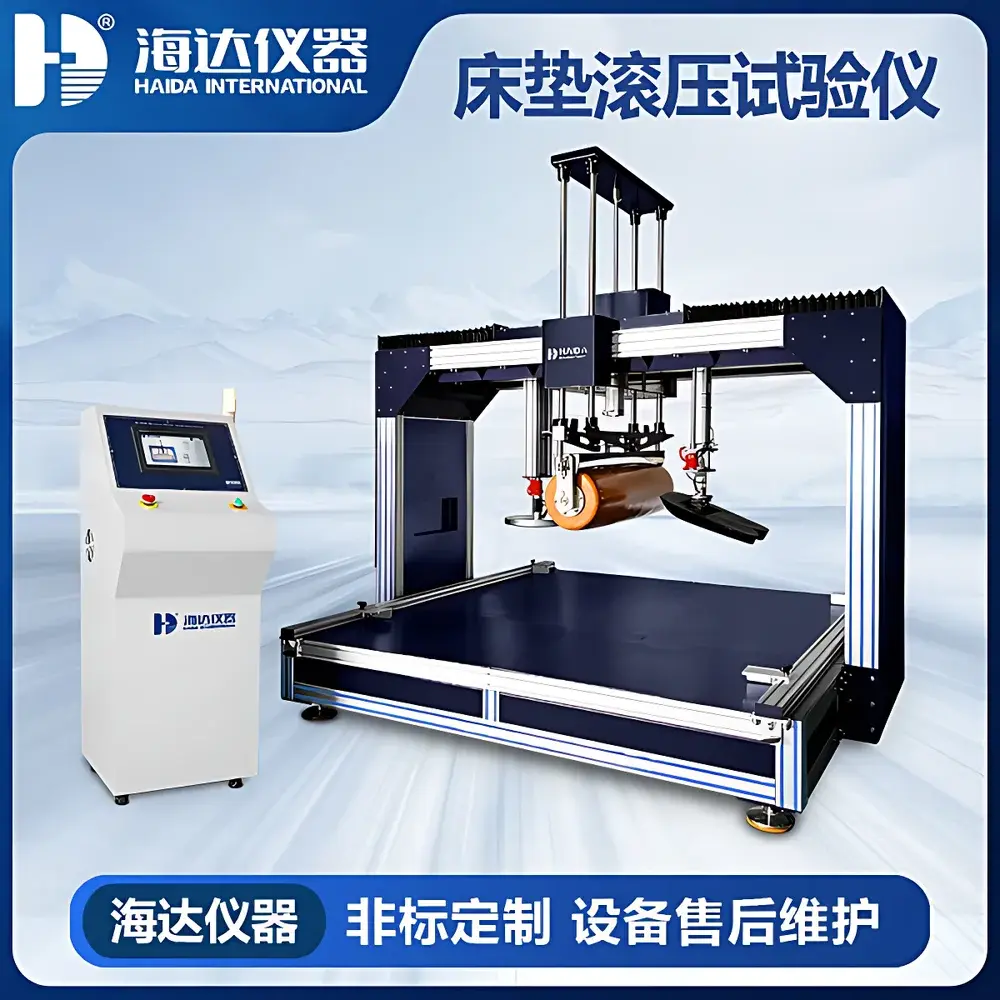
The HAIDA HD-F764-S Mattress Rolling Durability Tester is an integrated tri-function mechanical testing platform engineered for standardized evaluation of long-term structural integrity and functional performance in domestic and commercial mattresses. It operates on the principle of controlled cyclic mechanical loading—mimicking real-world human nocturnal movement—to assess resistance to progressive deformation, layer delamination, support loss, and edge collapse under repetitive dynamic stress. The system combines three core test modalities within a single rigid frame: rolling fatigue simulation (per ISO 1957, EN 1957, QB/T 1952.2), static softness/hardness profiling (per GB/T 26706), and thickness retention measurement (including initial height, compression set, and permanent loss after cycling). Its dual-servo architecture enables independent, high-fidelity control of rolling kinematics and vertical force-displacement profiles—ensuring traceable, repeatable, and metrologically sound data acquisition aligned with international regulatory expectations.
Key Features
- Modular mechanical architecture featuring reinforced aluminum extrusion framing and structural steel base—designed for rigidity, long-term dimensional stability, and vibration-damped operation during high-cycle testing.
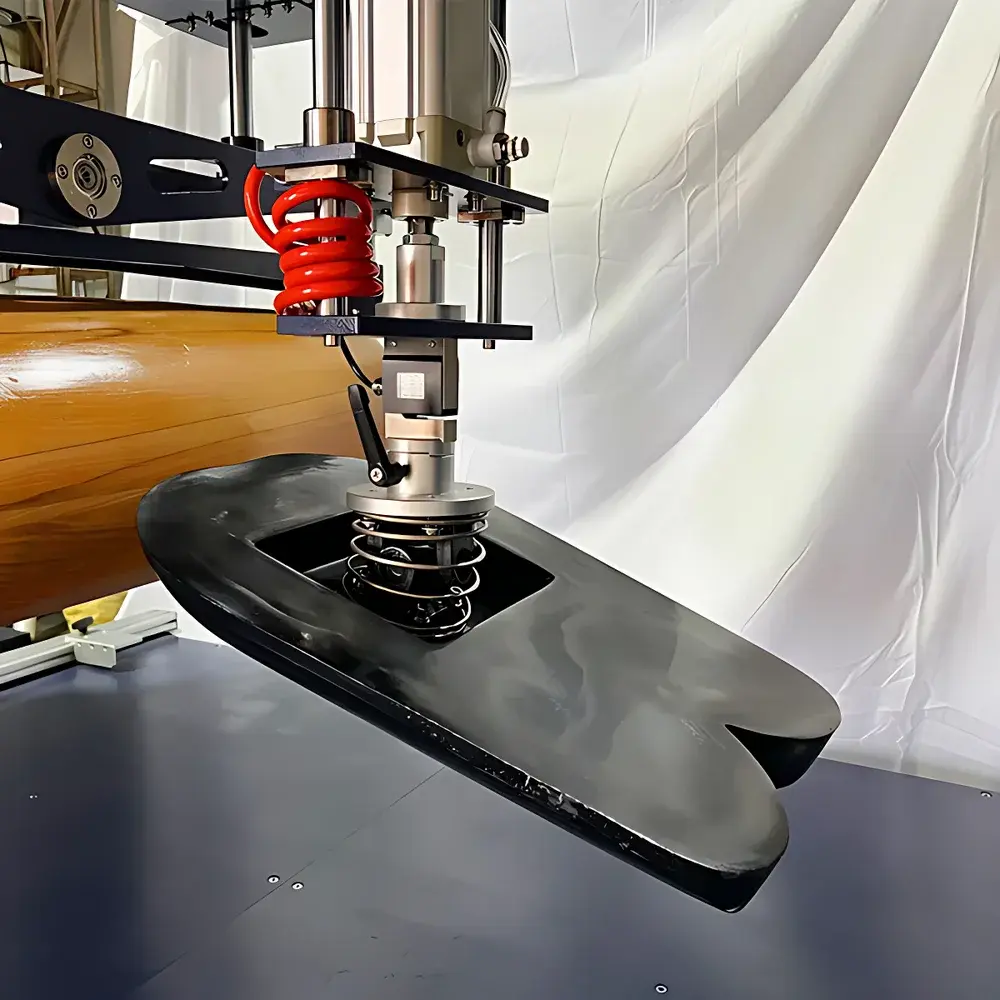
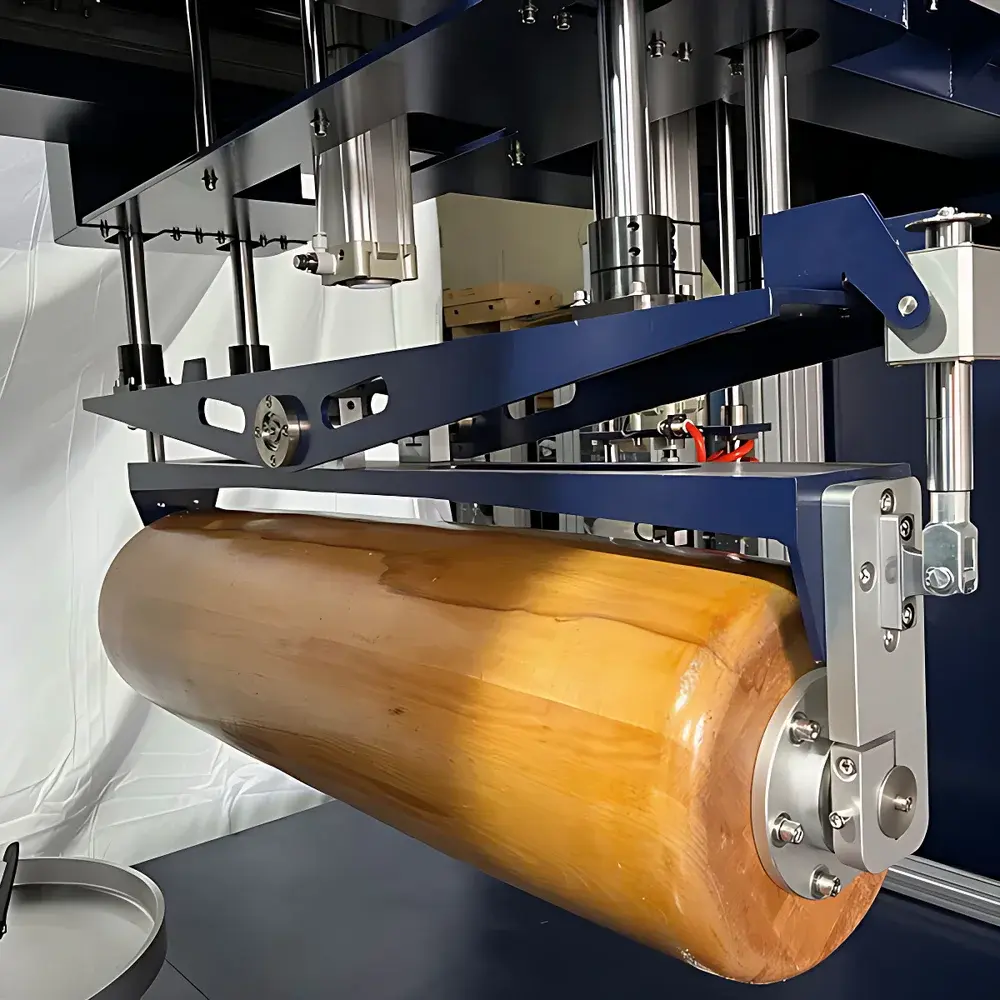
- Open-access test chamber with tool-free, rail-mounted fixture system—enabling rapid reconfiguration for full-size mattresses (up to 2200 × 2000 mm) and compatibility with both cylindrical and hexagonal rollers (latter optional).
- Dual-servo actuation: a 1.5 kW servo motor drives precision synchronous-belt rolling motion with programmable frequency, amplitude, and dwell; a separate 0.4 kW servo controls vertical displacement for softness and thickness tests with closed-loop position and force feedback.
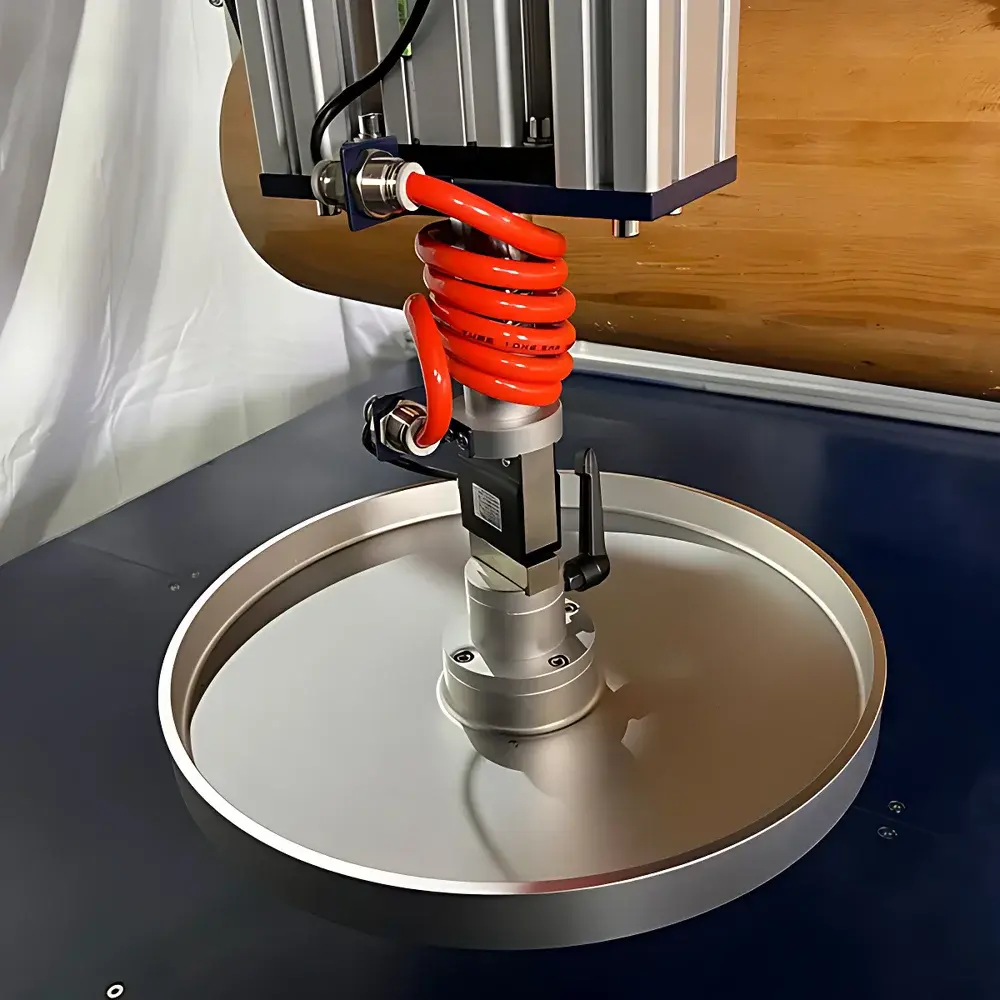
- High-resolution electro-cylinder (450 mm stroke, 1.39 kN max thrust) and dual 2 kN load cells calibrated to ±0.1 N accuracy across low- and high-force ranges—supporting both edge durability (1000 N × 5000 cycles) and surface compliance profiling.
- Industrial-grade PLC-based control system with 10.1″ capacitive touchscreen HMI—providing intuitive workflow navigation, real-time parameter monitoring, multi-stage test sequencing, and embedded safety interlocks including overtravel limit switches, overload cut-off, and emergency stop logic.
- Comprehensive data integrity safeguards: power-loss recovery memory, automatic fault logging, audit-trail-capable event timestamps, and USB-exportable CSV reports compliant with GLP documentation requirements.
Sample Compatibility & Compliance
The HD-F764-S accommodates all mainstream mattress constructions—including innerspring (bonnell, pocketed, continuous coil), foam (polyurethane, memory, latex), hybrid, and natural fiber (coir, wool-blend) cores—within its 2200 × 2000 × 400 mm test envelope. Fixture adaptability ensures secure clamping of irregular geometries without distortion. The system supports full conformance with globally recognized standards: QB/T 1952.2–2023 (Chinese national standard for spring mattresses), GB/T 26706–2011 (foam mattress specifications), EN 1957:2012 (European durability and comfort assessment), and optionally ASTM F1566–2014 (U.S. standard for mattress rolling endurance). All test protocols—including rolling amplitude definition, dwell time, force ramp rates, and pass/fail criteria—are programmable to match clause-specific requirements, facilitating cross-laboratory reproducibility and regulatory submission readiness.
Software & Data Management
The embedded control software features a deterministic real-time kernel running on industrial PLC hardware, eliminating OS-level latency or crash risks associated with PC-dependent systems. Test sequences are defined via graphical workflow editor—allowing users to chain rolling fatigue, softness indentation, and thickness measurement steps into a single automated protocol. Each test generates timestamped raw data streams (force vs. time, displacement vs. time, cycle count) stored locally on non-volatile memory. USB export delivers structured CSV files containing metadata (operator ID, sample ID, standard reference, environmental conditions), processed metrics (mean roll force, % thickness loss, softness slope, edge deflection), and full-cycle waveform traces. Optional integration with LIMS platforms is supported via Modbus TCP. Software design adheres to principles outlined in FDA 21 CFR Part 11 for electronic records and signatures—featuring user role-based access control, mandatory electronic signatures for report finalization, and immutable audit logs recording all parameter modifications and test executions.
Applications
This instrument serves quality assurance laboratories in mattress manufacturing, third-party certification bodies (e.g., SGS, TÜV, Intertek), and R&D departments developing next-generation sleep surfaces. Primary use cases include: validating batch-to-batch consistency of foam density and resilience; verifying edge reinforcement efficacy in premium models; benchmarking competitive products against target durability KPIs (e.g., ≤5% permanent thickness loss after 30,000 rolls); supporting ISO 9001 internal audits with objective mechanical evidence; and generating technical dossiers for CE marking or FDA registration of medical-grade therapeutic mattresses. Its ability to decouple and quantify individual failure modes—such as core buckling versus cover stretching—makes it indispensable for root-cause analysis during design iteration.
FAQ
What mattress types can be tested on the HD-F764-S?
It supports innerspring, foam, hybrid, and natural-fiber mattresses up to 2200 × 2000 × 400 mm.
Is ASTM F1566 testing capability built-in or optional?
ASTM F1566 mode requires optional hexagonal roller assembly and corresponding software license—configured at time of order.
Does the system provide compliance documentation for ISO/IEC 17025 accreditation?
Yes—calibration certificates traceable to NIM (China) or UKAS-accredited labs are supplied; uncertainty budgets and GUM-compliant validation reports available upon request.
Can test results be exported directly to Excel or LIMS?
Raw and processed data export via USB to CSV format; Modbus TCP enables direct SCADA/LIMS integration.
What maintenance is required for long-term reliability?
Scheduled lubrication of linear guides every 500 operating hours; annual verification of load cell linearity and displacement encoder resolution by authorized service technician.



