
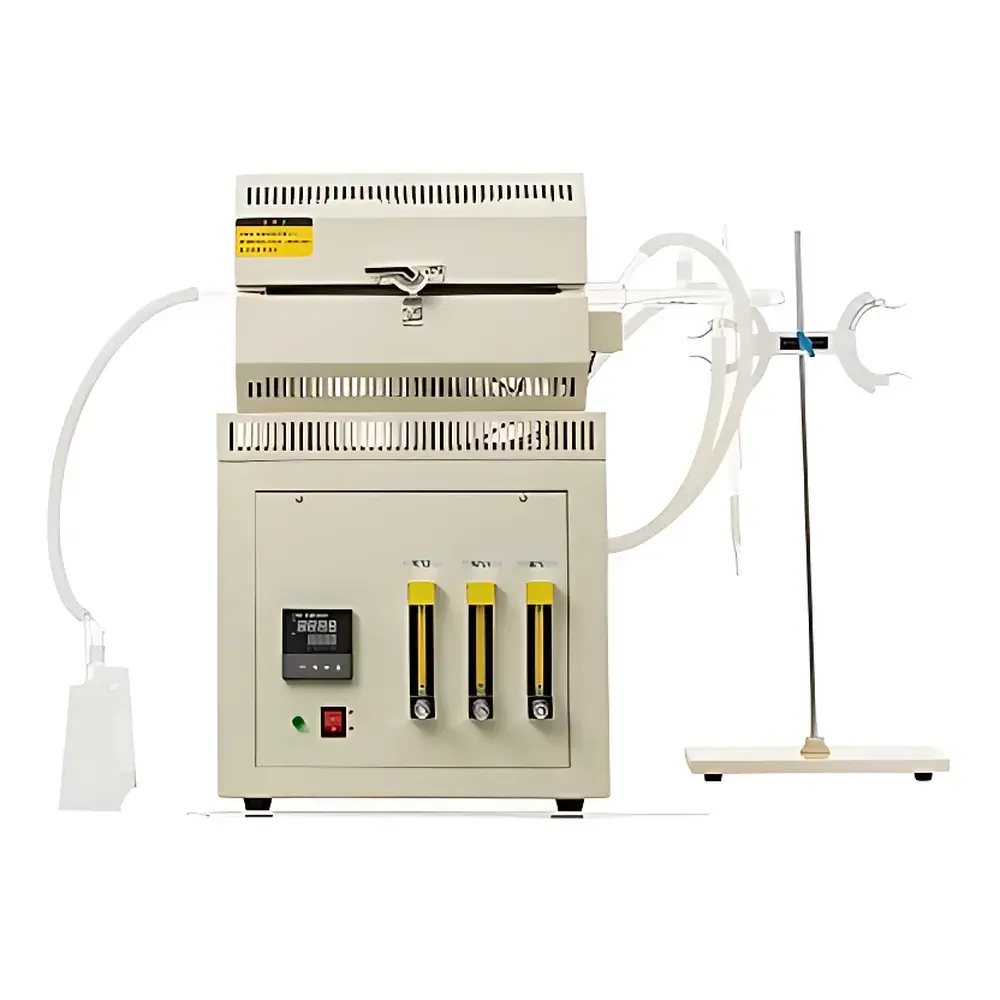
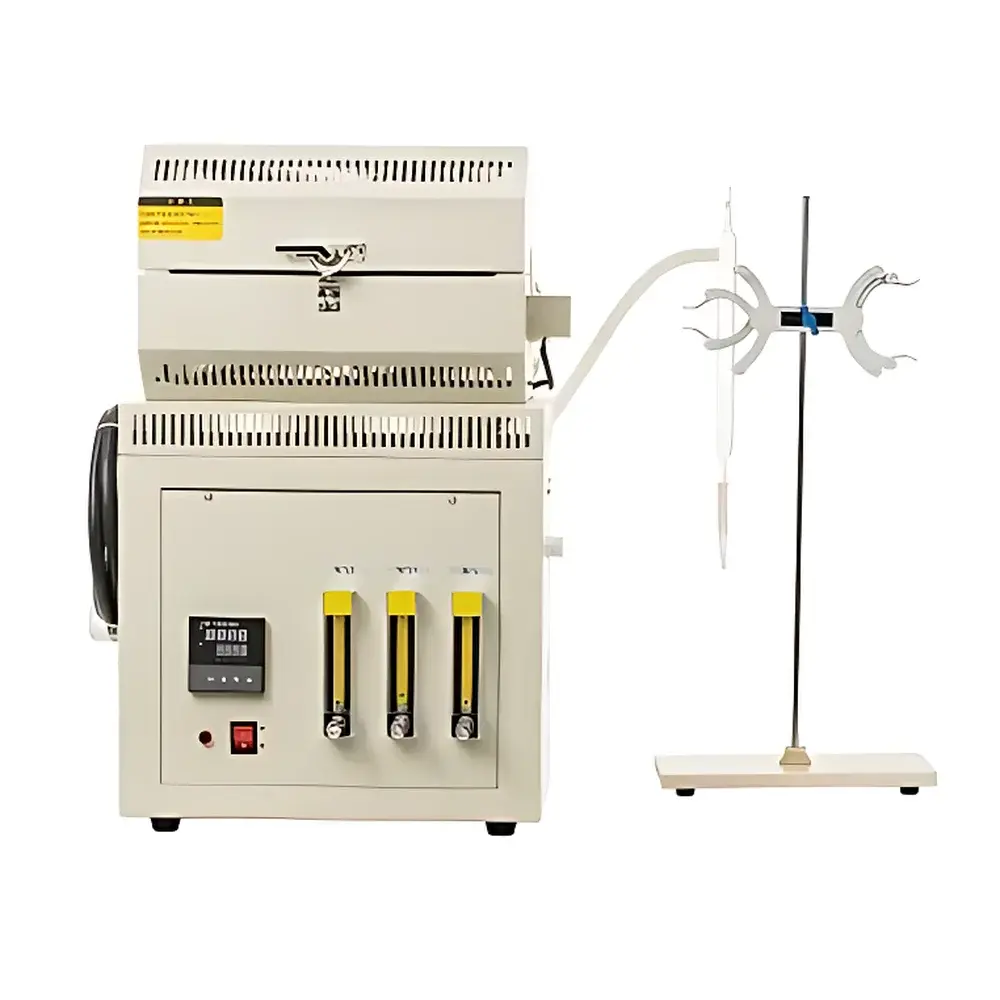
Zhuochi AOX-3 Combustion Furnace for Adsorbable Organic Halogens (AOX)
| Brand | Zhuochi |
|---|---|
| Origin | Zhejiang, China |
| Model | AOX-3 |
| Detection Principle | High-Temperature Combustion Coupled with Coulometric Titration or Ion Chromatography |
| Detection Range | 0.8 µg/L – 1000 µg/L |
| Accuracy | ±1% |
| Repeatability | ≤1% RSD |
| LOD | 0.8 µg/L |
| Resolution | 0.01 µg |
| Max Operating Temperature | 1150 °C |
| Temperature Stability | ±1 °C |
| Furnace Chamber Dimensions | Ø40 × 300 mm |
| Power Supply | 220 V, 50 Hz, 1.5 kW |
| Net Weight | 26 kg |
| Compliance | HJ/T 83–2001, ISO 9562:1989, GB/T 15959–1995, GB 8978–1996, GB 3544–2008 |
Overview
The Zhuochi AOX-3 Combustion Furnace is a dedicated high-temperature thermal oxidation system engineered for the quantitative determination of Adsorbable Organic Halogens (AOX) in environmental matrices. It operates on the principle of controlled high-temperature combustion (up to 1150 °C), followed by halogen quantification via either microcoulometric titration or ion chromatography—fully aligned with internationally recognized standard methods including ISO 9562:1989, HJ/T 83–2001, and GB/T 15959–1995. The furnace integrates a precisely regulated ceramic-fiber insulated chamber, dual-zone resistive heating elements, and programmable PID temperature control to ensure reproducible oxidative mineralization of adsorbed organic halides from activated carbon traps. This enables complete conversion of organohalogen compounds (e.g., chlorinated pesticides, brominated flame retardants, fluorinated surfactants) into inorganic halide ions (Cl⁻, Br⁻, F⁻, I⁻), which are subsequently captured in aqueous absorption solution for downstream instrumental analysis.
Key Features
- Programmable LTDE controller with PID+SSR regulation, supporting ramp-hold profiles and automatic shutdown upon completion or over-temperature event
- Ceramic fiber insulation with embedded high-stability resistance wire heating elements, enabling rapid thermal response (≤50 °C/min) and energy-efficient operation
- Openable dual-segment furnace design for real-time visual monitoring of sample combustion and immediate access to the quartz combustion tube
- Integrated built-in gas washing system with five standardized scrubbing bottles for O₂ purification and removal of acidic/oxidizing interferences prior to combustion
- Dual oxygen inlet configuration: inner tube for sample oxidation, outer tube for thermal stabilization—ensuring uniform temperature distribution across the combustion zone
- Compact footprint (345 × 360 × 660 mm) and low-voltage (220 V) operation optimized for continuous 24-hour laboratory deployment
- High-efficiency activated carbon recovery pathway with nitrogen-pressure-assisted column adsorption module (included as standard)
- Robust mechanical construction: cold-rolled steel housing with phosphate coating and electrostatic powder finish; thermally stable quartz sample boats and push rods included
Sample Compatibility & Compliance
The AOX-3 supports both liquid and solid environmental samples—including drinking water, surface water, groundwater, wastewater, effluents, seawater, pulp mill discharges, soils, sediments, sludges, and waste oils—following standardized pretreatment per HJ/T 83–2001. Sample preparation employs activated carbon column adsorption under controlled nitrogen pressure, followed by desorption-free thermal oxidation. All hardware and procedural workflows comply with regulatory requirements for AOX testing under ISO 9562, US EPA Method 1650 (adapted), and EU Directive 2013/39/EU on priority substances. The system architecture supports audit-ready documentation when paired with compliant data acquisition software, facilitating GLP/GMP-aligned reporting and traceability in accredited environmental laboratories.
Software & Data Management
While the AOX-3 furnace itself functions as a standalone thermal module, optional PC-based control and data logging software enables remote temperature profile programming, real-time thermal monitoring, and automated event logging—including ramp rate, hold time, final temperature, and system fault codes. When interfaced with certified ion chromatography (IC) or microcoulometric analyzers (e.g., Metrohm 851, Thermo Scientific ICS-5000+), full analytical sequences—from adsorption through combustion to quantitation—can be documented in accordance with FDA 21 CFR Part 11 requirements, provided electronic signatures and audit trail features are enabled on the connected instrumentation. Raw thermal data files are exportable in CSV format for integration into LIMS environments.
Applications
- Regulatory compliance testing for AOX in municipal and industrial wastewater discharges per GB 3544–2008 and GB 8978–1996
- Monitoring halogenated disinfection by-products (DBPs) in drinking water treatment plants
- Environmental fate studies of persistent organic pollutants (POPs), including PCBs, PBDEs, and PFAS precursors
- Quality assurance of activated carbon regeneration efficiency in water reuse facilities
- Research-grade quantification of total organohalogen burden in sediment cores and biota tissues
- Method validation and reference material analysis in national environmental monitoring networks
FAQ
What gases are required for optimal operation?
High-purity oxygen (≥99.999%) is strongly recommended to eliminate the need for pre-combustion gas scrubbing. Technical-grade oxygen (99.6%) may be used but requires integration with the supplied five-bottle gas washing system.
Is the furnace compatible with both coulometric and ion chromatographic detection?
Yes—the AOX-3 delivers halide-laden absorption solution suitable for direct injection into either microcoulometric titrators or ion chromatographs, as specified in ISO 9562 and HJ/T 83–2001 respectively.
Can solid samples such as soil or sludge be analyzed directly?
Solids require extraction and pre-concentration via Soxhlet or ultrasonic-assisted leaching prior to carbon column adsorption; the furnace itself processes only the adsorbed carbon trap.
What maintenance intervals are recommended for long-term reliability?
Quartz combustion tubes should be inspected after every 50 runs; ceramic insulation integrity should be verified annually. Oxygen line filters and absorption bottle solutions must be replaced before each analytical batch.
Does the system support automated sample throughput?
The AOX-3 is designed for manual batch processing. For higher throughput, it may be integrated with autosamplers for sequential carbon trap insertion, though such configurations require third-party engineering validation.







