
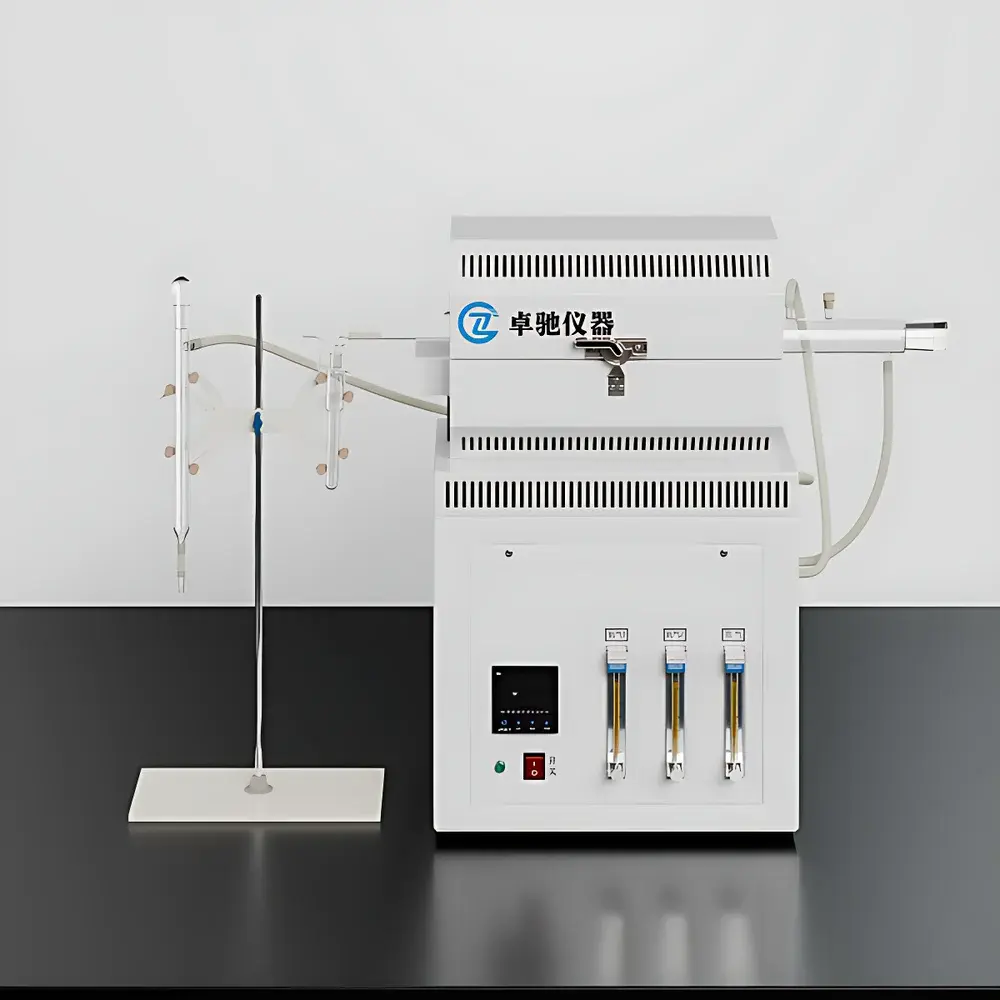
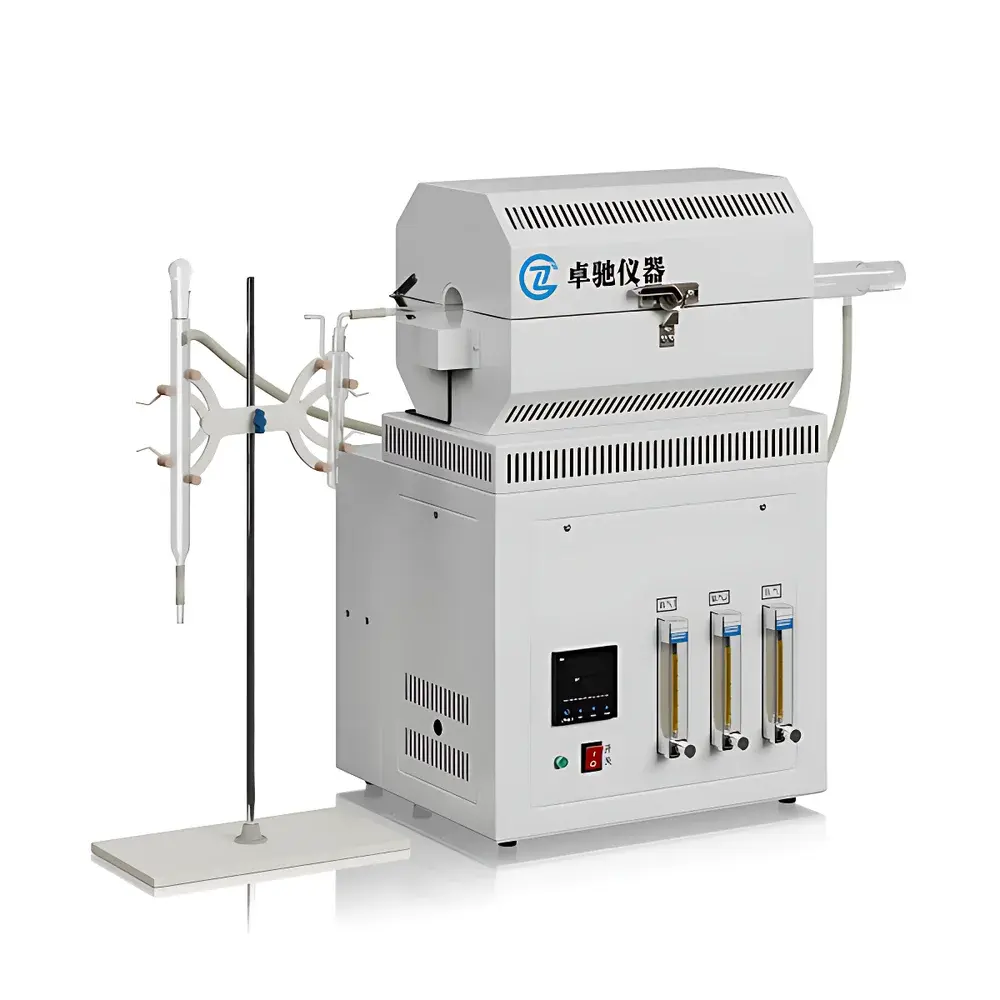
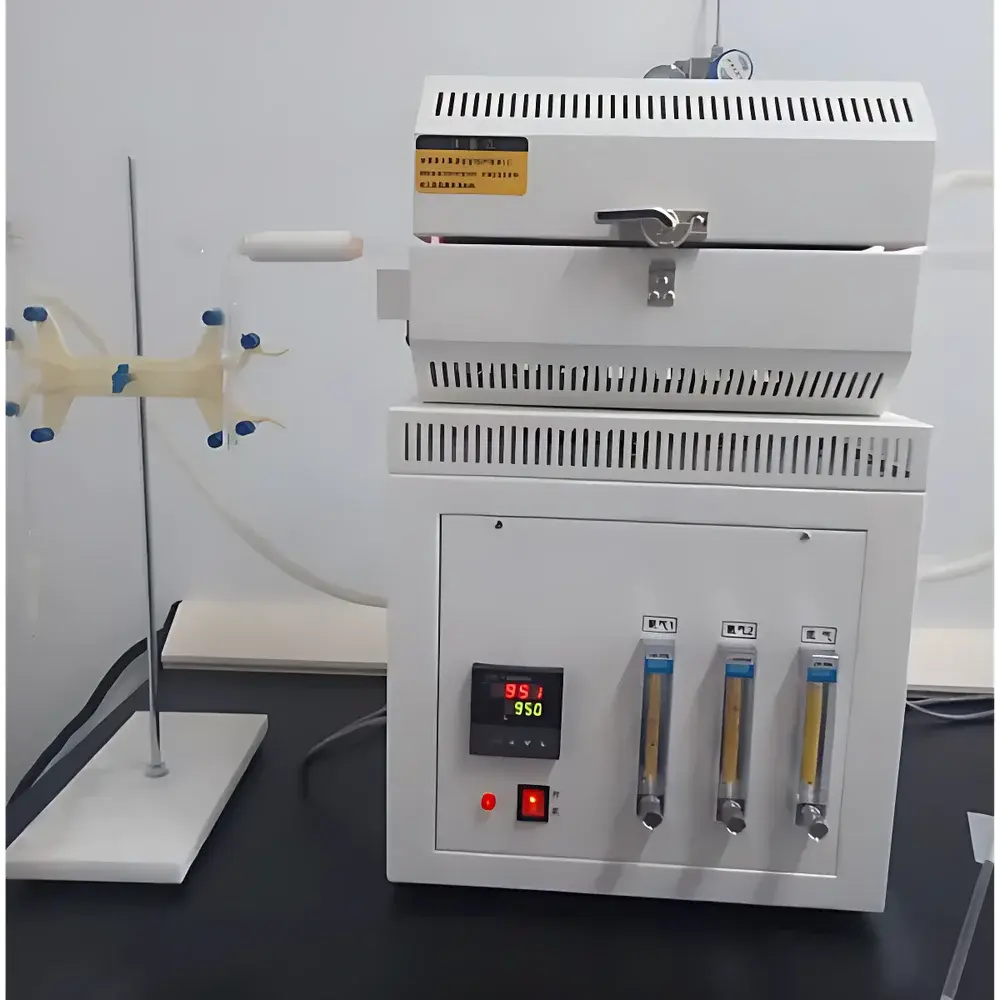
Zhuochi AOX-3 Standard Organic Halogen Combustion Furnace per HJ/T 83–2001
| Brand | Zhuochi |
|---|---|
| Origin | Zhejiang, China |
| Model | AOX-3 Standard |
| Measurement Principle | High-Temperature Combustion Coupled with Coulometric Titration |
| Detection Range | 0.8 μg/L to 1000 μg/L |
| Accuracy | <1% |
| Repeatability | <10% |
| Limit of Detection (LOD) | 0.1 μg |
| Resolution | 0.01 μg |
| Max Combustion Temperature | 1150 °C |
| Sample Introduction | Pressurized Nitrogen-Driven Column Adsorption (5–1000 mg) |
| Analysis Time (Combustion & Detection) | 3–10 min (excluding pre-concentration) |
| Required Gases | O₂ ≥99.6% (99.999% recommended), N₂ for adsorption |
Overview
The Zhuochi AOX-3 Standard Organic Halogen Combustion Furnace is a dedicated analytical system engineered for the quantitative determination of Adsorbable Organic Halogens (AOX) in environmental matrices—primarily water, wastewater, sludge, sediments, and solid industrial residues. It operates on the internationally recognized high-temperature combustion–coulometric titration principle, fully compliant with HJ/T 83–2001 (China’s Environmental Protection Industry Standard for “Determination of AOX in Water by Ion Chromatography”), ISO 9562:1989 (“Water Quality — Determination of Adsorbable Organic Halogen (AOX) — Microcoulometric Method”), and GB/T 15959–1995 (“Water Quality — Determination of Adsorbable Organic Halogen (AOX) — Microcoulometric Method”). The instrument integrates a precision-controlled vertical high-temperature furnace (up to 1150 °C), an optimized quartz combustion tube assembly, and a modular gas-handling architecture—including dual oxygen supply lines (inner/outer tube heating zones) and nitrogen-driven pressurized adsorption. This configuration ensures complete oxidative mineralization of adsorbed organic halides into halide ions (Cl⁻, Br⁻, I⁻), which are subsequently quantified via external coulometric titration or ion chromatography—enabling trace-level detection with rigorous metrological traceability.
Key Features
- Compact, benchtop-integrated design with front-accessible combustion chamber and real-time visual monitoring through a borosilicate observation window
- Low-voltage (220 V AC), high-efficiency ceramic heating element (1500 W) delivering stable thermal profiles and extended service life (>5000 h rated)
- Optimized sample introduction: direct injection onto quartz sample boats; no manual transfer required post-adsorption
- Rapid thermal ramp-up: full operational temperature (1150 °C) achieved in <10 minutes, minimizing laboratory downtime
- Dual-zone oxygen delivery system—separate inner-tube (oxidation zone) and outer-tube (pre-heating zone) flow paths—ensuring stoichiometric combustion and minimizing carbon carryover
- High-efficiency activated carbon recovery module integrated into the adsorption unit, reducing reagent consumption and improving method reproducibility
- 24/7 unattended operation capability with robust thermal insulation, overtemperature cutoff, and fail-safe gas interlocks
Sample Compatibility & Compliance
The AOX-3 supports liquid samples (e.g., drinking water, surface water, groundwater, effluent, seawater, pulp mill discharges) and solid-phase matrices (soil, sediment, sludge, waste grease) following standardized pretreatment protocols outlined in HJ/T 83–2001 and ISO 9562. Solid samples require homogenization and acidification prior to column adsorption. All hardware components—including quartz combustion tubes, fused-silica sample boats, and PTFE-sealed absorption train fittings—are chemically inert and compatible with halogen-rich combustion gases. The system meets essential requirements for GLP-compliant laboratories: full documentation support for calibration verification, performance qualification (PQ), and routine system suitability testing (SST). While the AOX-3 itself does not embed data integrity controls, its analog/digital outputs interface seamlessly with LIMS or 21 CFR Part 11–compliant software platforms when coupled with certified coulometers or IC systems.
Software & Data Management
The AOX-3 operates as a standalone hardware platform with manual process control; however, it is fully compatible with optional PC-based instrument control and data acquisition modules. These modules provide real-time monitoring of furnace temperature, gas flow rates (O₂/N₂), and combustion cycle timing. Raw output signals (e.g., mV from coulometric cells or peak area from IC detectors) are exported in CSV or ASCII format for integration into validated laboratory informatics environments. Calibration curves may be generated and stored per batch, supporting audit-ready records including operator ID, date/time stamps, and QC sample results. Instrument logs retain all thermal cycles and gas pressure events—critical for root-cause analysis during regulatory audits.
Applications
This system is routinely deployed in municipal water quality labs, industrial effluent monitoring centers, environmental consulting firms, and academic research facilities conducting regulatory AOX compliance testing. Key use cases include: monitoring chlorinated disinfection by-products (DBPs) in drinking water distribution systems; assessing halogenated pollutant loadings in pulp/paper mill and pharmaceutical wastewater; evaluating AOX removal efficiency across biological and advanced oxidation treatment trains; and supporting risk assessment of legacy contaminants (e.g., PCBs, chlorinated pesticides) in dredged sediments and landfill leachates. Its rapid turnaround (50 samples.
FAQ
What standards does the AOX-3 comply with?
It conforms to HJ/T 83–2001, ISO 9562:1989, and GB/T 15959–1995 for AOX determination.
Can the AOX-3 analyze solid samples directly?
No—solid matrices require homogenization, acidification, and column adsorption prior to combustion; the system handles only pre-concentrated samples.
Is oxygen purity critical for accurate results?
Yes—oxygen ≥99.6% is required; use of ultra-high-purity O₂ (99.999%) is strongly recommended to prevent interference from hydrocarbon impurities.
What is the typical lifetime of the quartz combustion tube?
Under normal operating conditions (≤1100 °C, clean sample matrix), the tube maintains structural integrity for ≥2 years or 1000+ combustion cycles.
Does the system include automated data reporting?
No—the AOX-3 is hardware-only; reporting functionality requires integration with external coulometric or IC instrumentation and third-party software.







