
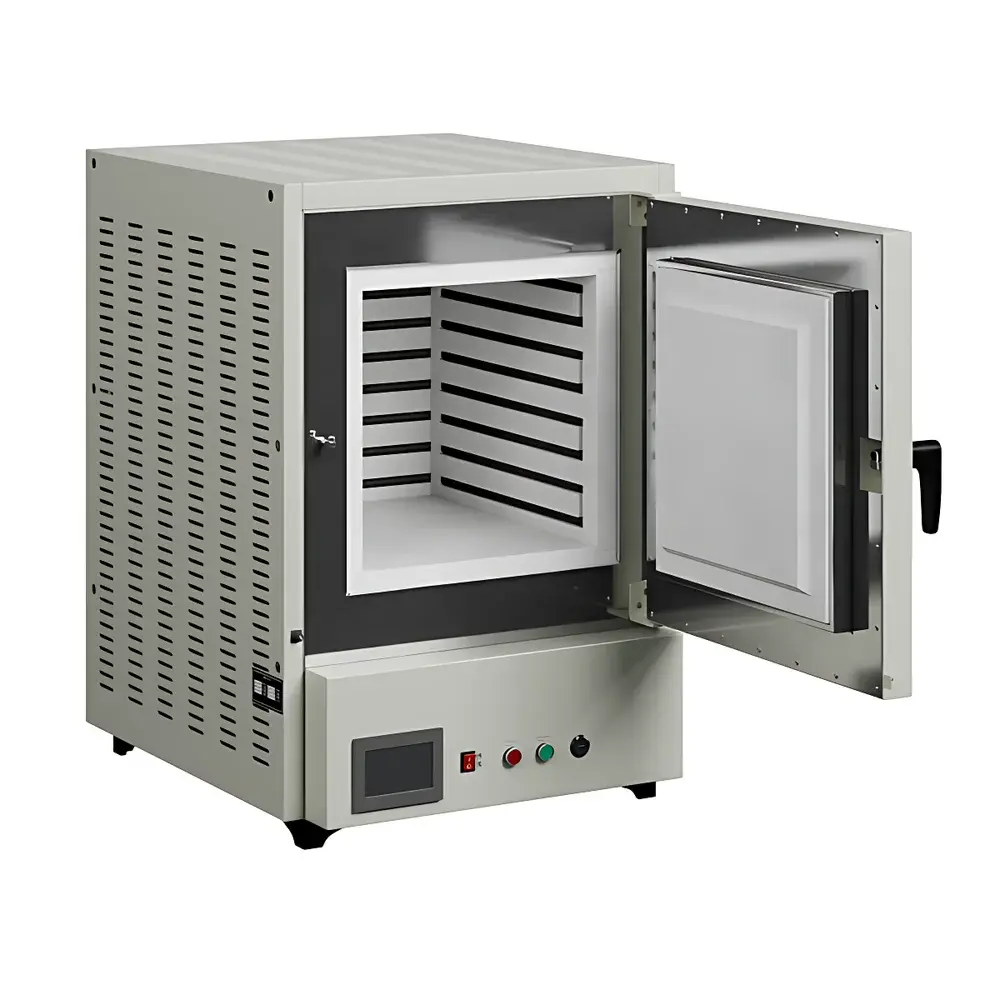
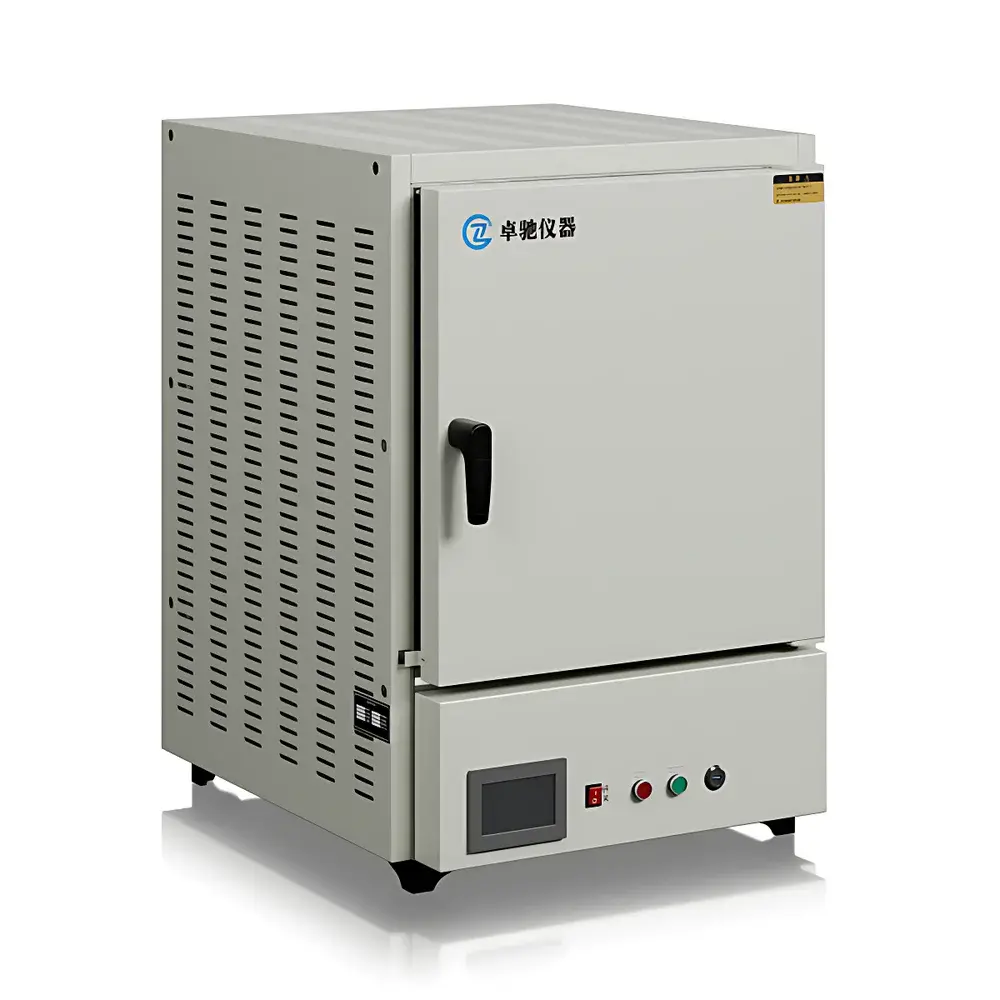
Zhuochi SX3-4-11 High-Temperature Muffle Furnace
| Brand | Zhuochi |
|---|---|
| Origin | Zhejiang, China |
| Model | SX3-4-11 |
| Instrument Type | Box-Type Muffle Furnace |
| Maximum Temperature | 1100 °C |
| Temperature Control Accuracy | ±1 °C |
| Rated Power | 4 kW |
| Heating Time to Max Temp | 60 min |
| Heating Method | Resistance Wire Heating |
| Internal Chamber Dimensions | 300 × 300 × 300 mm |
| Nominal Volume | 27 L |
| Temperature Range | 100–1100 °C |
| Temperature Uniformity | ±1 °C (at 1000 °C) |
| Heating Rate Adjustment | 0–50 °C/min (continuously variable) |
| Chamber Material | High-Radiation, Low-Heat-Capacity Ceramic Fiber Panels |
| Thermocouple Type | K-Type (Chromel–Alumel) |
| Controller | LTDE Programmable PID Controller with 30-Stage Ramp-Soak Programming |
| Safety Protection | Dual-Stage Overtemperature Cut-Off |
| Power Supply | 220 V, 50 Hz |
Overview
The Zhuochi SX3-4-11 High-Temperature Muffle Furnace is a precision-engineered box-type laboratory furnace designed for applications requiring stable, uniform, and programmable thermal environments up to 1100 °C. It operates on the principle of resistive heating via high-stability nickel-chromium resistance wire elements embedded within a low-thermal-mass ceramic fiber insulation chamber. Unlike traditional brick-lined furnaces, this model employs six-sided modular ceramic fiber panels—engineered for rapid thermal response, minimal heat storage, and exceptional thermal shock resistance. Its lightweight construction (approx. 70 kg) and compact external footprint (615 × 520 × 720 mm) deliver an unusually large effective working volume (27 L) relative to physical size—enabling efficient batch processing without compromising spatial constraints in modern analytical or materials laboratories.
Key Features
- Ultra-low thermal inertia architecture: Achieves 1000 °C in ≤30 minutes under standard conditions; full 1100 °C ramp completed within 60 minutes, with continuous rate control from 0.1 to 50 °C/min.
- Precision temperature regulation: ±1 °C control accuracy maintained across the full operating range (100–1100 °C), verified at 1000 °C using calibrated K-type thermocouples with cold-junction compensation.
- LTDE-based 30-stage programmable controller: Supports complex thermal profiles including ramp-soak-cool cycles, automatic hold termination, and user-defined end-of-program actions (e.g., standby or power-off).
- Dual-level overtemperature protection: Independent hardware-based cut-off circuit engages if primary PID controller exceeds setpoint by >10 °C, ensuring compliance with IEC 61000-4-2 and EN 60519-2 safety directives for industrial heating equipment.
- Robust mechanical design: Outer casing fabricated from phosphated and epoxy-powder-coated cold-rolled steel (computer gray finish); internal chamber fully lined with high-emissivity, low-conductivity ceramic fiber boards rated for repeated cycling above 1000 °C.
- Plug-and-play integration: Pre-wired control electronics housed beneath the base; no field assembly required—operational after connection to single-phase 220 V, 50 Hz supply with appropriate circuit protection (≥25 A breaker recommended).
Sample Compatibility & Compliance
The SX3-4-11 accommodates crucibles, sintering boats, ashing trays, and ceramic setters up to 300 mm cubed. Its muffle configuration isolates samples from direct flame or combustion gases, making it suitable for ash content determination (ASTM D3174, ISO 1171), loss-on-ignition (LOI) analysis, calcination of catalyst precursors, and pre-sintering of oxide ceramics. The furnace meets general requirements for GLP-compliant thermal treatment workflows when paired with external data loggers supporting 21 CFR Part 11 audit trails. While not intrinsically rated for hazardous atmospheres, its sealed chamber design minimizes ambient air ingress during inert-gas purging (N₂ or Ar)—a common practice for controlled-atmosphere annealing in metallurgical QA/QC labs.
Software & Data Management
The integrated LTDE controller provides local display and manual operation but does not include native PC connectivity. For traceable data acquisition, users may interface the furnace’s analog output (0–5 V or 4–20 mA, configurable) with third-party DAQ systems or chart recorders. When deployed in regulated environments (e.g., pharmaceutical stability testing per ICH Q1A(R2)), the system supports documentation of calibration certificates (thermocouple verification, controller linearity), maintenance logs, and thermal profile validation reports. Optional accessories include calibrated reference thermocouples (NIST-traceable), purge gas fittings, and insulated observation windows for real-time process monitoring.
Applications
- Quantitative ash residue analysis in coal, biomass, foodstuffs, and polymers per AOAC 942.05 and EPA Method 2540E.
- Thermal decomposition studies in materials science research, including phase transformation kinetics of metal oxides and battery cathode precursors.
- Pre-firing of dental porcelain and investment casting molds in dental laboratories and foundry R&D facilities.
- Calibration and annealing of thermocouples and RTDs in metrology labs following ASTM E230/E230M protocols.
- Heat treatment of small-scale metallurgical samples for microstructural evaluation (e.g., grain growth, recrystallization onset).
FAQ
What is the maximum recommended continuous operating temperature?
The SX3-4-11 is rated for sustained operation at 1100 °C; however, long-term use above 1050 °C may accelerate degradation of heating elements and fiber insulation. For optimal service life, continuous operation at ≤1000 °C is advised.
Can this furnace be used under vacuum or reducing atmospheres?
No—the standard configuration lacks vacuum-tight seals or gas inlet/outlet ports. For controlled-atmosphere applications, optional purge adapters and flanged access ports are available as factory-installed modifications.
Is the controller compliant with FDA 21 CFR Part 11 requirements?
The embedded LTDE controller does not provide electronic signatures, audit trails, or user-access controls required for Part 11 compliance. Integration with validated external SCADA or LIMS platforms is necessary for regulated data capture.
How often should thermocouple calibration be performed?
Per ISO/IEC 17025 guidelines, verification against a certified reference standard is recommended before each critical run or at least daily in high-throughput QA environments. Annual full calibration by an accredited lab is advised for GMP-aligned operations.
What maintenance is required to sustain temperature uniformity?
Annual inspection of fiber panel integrity, thermocouple seating, and contactor performance is sufficient under normal usage. Avoid thermal shock by limiting ramp rates below 30 °C/min when chamber is fully loaded or cold.



