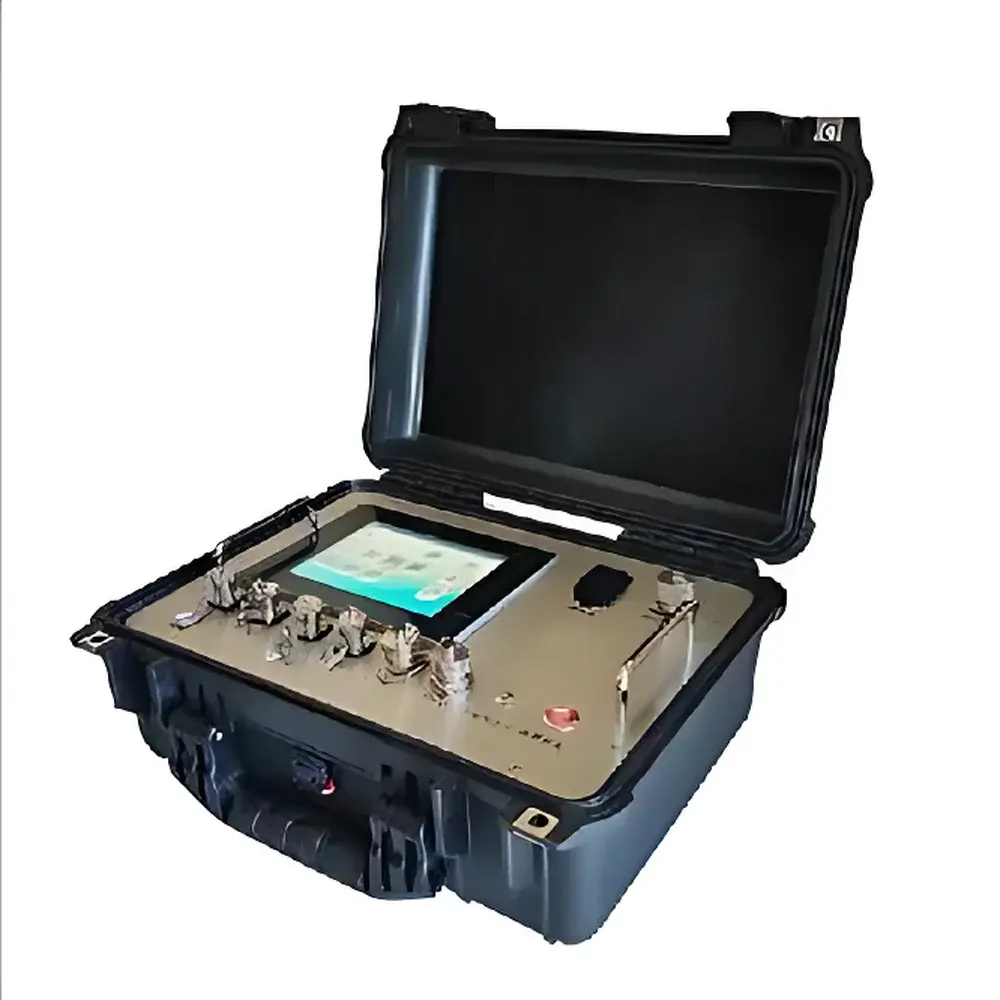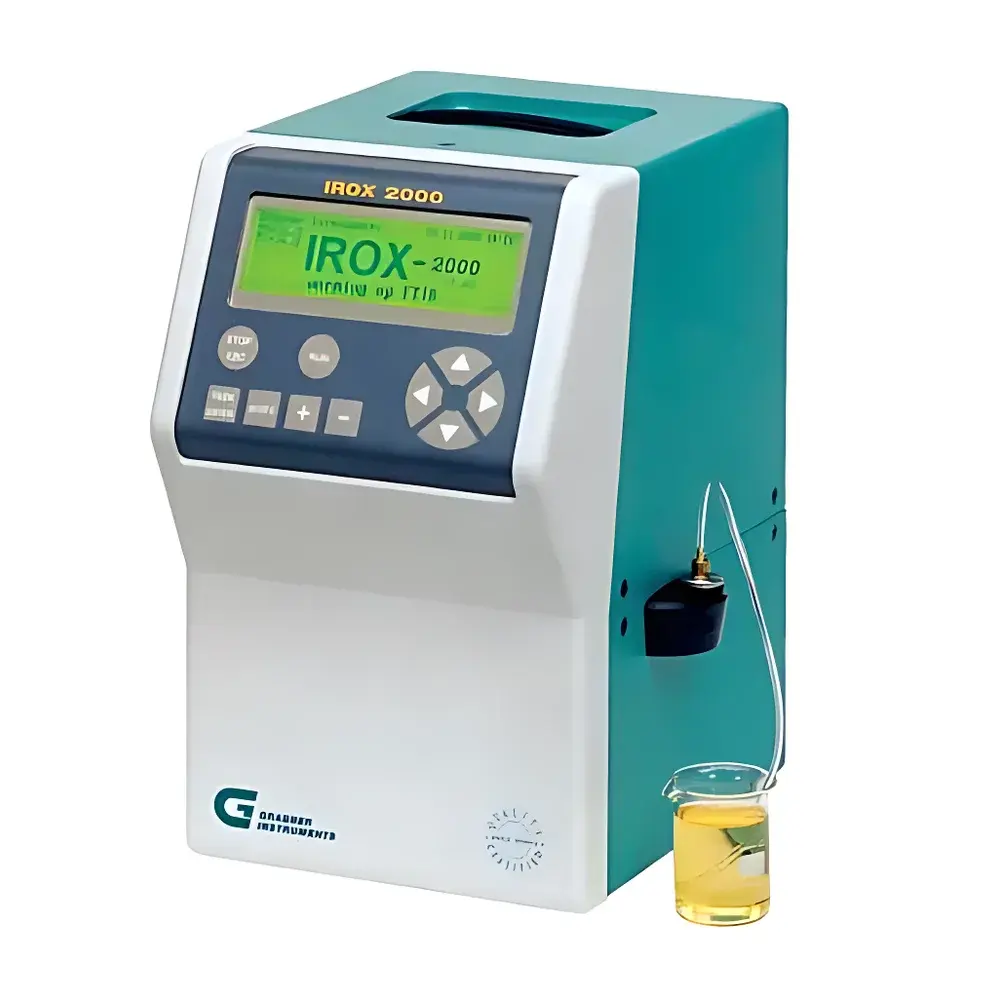
Grabner IROX 2000 Portable Mid-Infrared Gasoline and Diesel Fuel Analyzer
| Brand | Grabner |
|---|---|
| Origin | Austria |
| Manufacturer | Grabner Instruments GmbH |
| Type | Imported |
| Model | IROX 2000 |
| Measurement Parameters | Gasoline Octane Number (RON/MON), Diesel Cetane Number |
| Portability | Portable |
| Detection Principle | Mid-Infrared (MIR) Spectroscopy |
| Measurement Range | 70–110 (Octane/Cetane scale) |
| Accuracy | ±0.5 Cetane Number |
| Analysis Time | 60 s |
| Sample Volume | 10 mL |
| Density Measurement | ±0.001 g/cm³ (integrated Anton Paar density module) |
| Spectral Range | 4000–400 cm⁻¹ |
| Data Points | ~3000 per spectrum |
| Storage Capacity | ~200 test records |
| Power Supply | 100/200/230 V AC, 50 Hz, 65 W |
| Optional DC Input | 12 V / 8 A |
| Dimensions | 200 × 320 × 220 mm |
| Weight | 13 kg |
Overview
The Grabner IROX 2000 is a field-deployable, mid-infrared (MIR) spectrometer engineered for rapid, non-destructive quantification of critical fuel quality parameters in gasoline and diesel. Operating on the principle of absorption spectroscopy in the 4000–400 cm⁻¹ range, the instrument leverages chemometric calibration models to determine octane numbers (RON and MON), cetane number, hydrocarbon composition (aromatics, olefins), oxygenates (MTBE, ethanol, methanol), benzene, toluene, MMT, and total oxygen content—up to 30 analytes per 10 mL sample. Its optical architecture features high-resolution spectral acquisition with approximately 3000 data points per scan, ensuring robust multivariate regression performance and high reproducibility across heterogeneous fuel matrices. Designed initially for military logistics applications, the IROX 2000 integrates an Anton Paar density module (±0.001 g/cm³) and fully automated liquid handling—including syringe-driven sample aspiration, solvent rinse cycles, and vapor-phase purging—to minimize operator intervention and cross-contamination risk.
Key Features
- Portable benchtop form factor (13 kg, 200 × 320 × 220 mm) suitable for laboratory, refinery gate, depot, or mobile vehicle-mounted deployment
- Single-button analysis workflow with full automation: sample introduction, spectral acquisition, chemometric evaluation, and result display within 60 seconds
- Integrated density measurement using a certified Anton Paar oscillating U-tube sensor compliant with ASTM D4052 and ISO 12185
- Pre-validated, region-specific calibration databases—including comprehensive Chinese refinery gasoline and diesel formulations—eliminating requirement for user-built models
- Dual power operation: standard AC input (100–230 V, 50 Hz) and optional 12 V DC automotive interface for real-time field verification at fuel terminals or transport hubs
- Onboard data storage for up to 200 test records with timestamp, operator ID, and raw spectral metadata; export via RS232 to LIMS or external PCs
- Compliance-ready architecture supporting audit trails, user access levels, and electronic signature protocols aligned with GLP and GMP documentation practices
Sample Compatibility & Compliance
The IROX 2000 accepts neat liquid hydrocarbon samples without dilution or derivatization. It is validated for use with unleaded gasoline, oxygenated blends (E10, E15, MTBE-doped), reformulated fuels, and low-sulfur diesel. Analytical compliance includes direct alignment with ASTM D5845 (benzene by IR), ASTM D6277 (oxygenates by IR), and ASTM D2699/D2700 (octane rating correlation); cetane number results correlate with ASTM D613 reference methodology. All calibrations are traceable to NIST-certified reference materials and undergo periodic verification per ISO/IEC 17025 internal quality control protocols. The system supports 21 CFR Part 11-compliant data integrity when connected to validated laboratory information management systems.
Software & Data Management
The embedded firmware provides intuitive touchscreen navigation and real-time spectral visualization. Quantitative results are reported in both volume % and mass % units, with configurable uncertainty estimates based on calibration validation statistics (e.g., SEC, SEP, R²). Raw interferograms and processed absorbance spectra are stored in standardized JCAMP-DX format. Export options include CSV, PDF reports, and XML-compatible datasets. Optional PC software enables advanced model refinement, outlier detection, and trend analysis across historical batches. Audit logs record all method changes, calibration updates, and user logins—supporting regulatory inspections under FDA, CNPC, or Sinopec QA frameworks.
Applications
- Real-time quality assurance at refinery off-gas lines and blending facilities
- Field verification of fuel compliance during transportation and distribution (e.g., highway checkpoints, port customs)
- Rapid screening of adulteration, dilution, or mislabeling in retail fuel supply chains
- Support for R&D formulation studies requiring high-throughput compositional profiling
- Regulatory monitoring programs targeting benzene limits (<1 vol%), oxygenate mandates, and octane/cetane labeling accuracy
- Integration into automated fuel certification workflows for military, aviation, and emergency response fleets
FAQ
Does the IROX 2000 require daily recalibration?
No—factory-installed chemometric models are stabilized against thermal drift and detector aging; routine verification using certified reference fuels is recommended every 24 hours or after 20 samples.
Can it analyze ethanol-blended gasoline above E15?
Yes, the instrument’s extended calibration domain covers ethanol concentrations up to 85 vol% (E85), with dedicated models for flex-fuel characterization.
Is spectral data export compatible with third-party chemometrics platforms?
Yes—JCAMP-DX files are natively supported by Unscrambler®, Pirouette®, and MATLAB-based PLS toolkits for custom model development.
What maintenance is required beyond routine cleaning?
Annual optical alignment verification and detector dark-current calibration are advised; no consumables other than standard IR-grade solvents (e.g., cyclohexane) are needed.
How does it handle water-contaminated samples?
The integrated drying module removes trace moisture prior to analysis; samples with >0.1 vol% free water must be pre-filtered to avoid spectral interference in the O–H stretch region (3600–3200 cm⁻¹).