
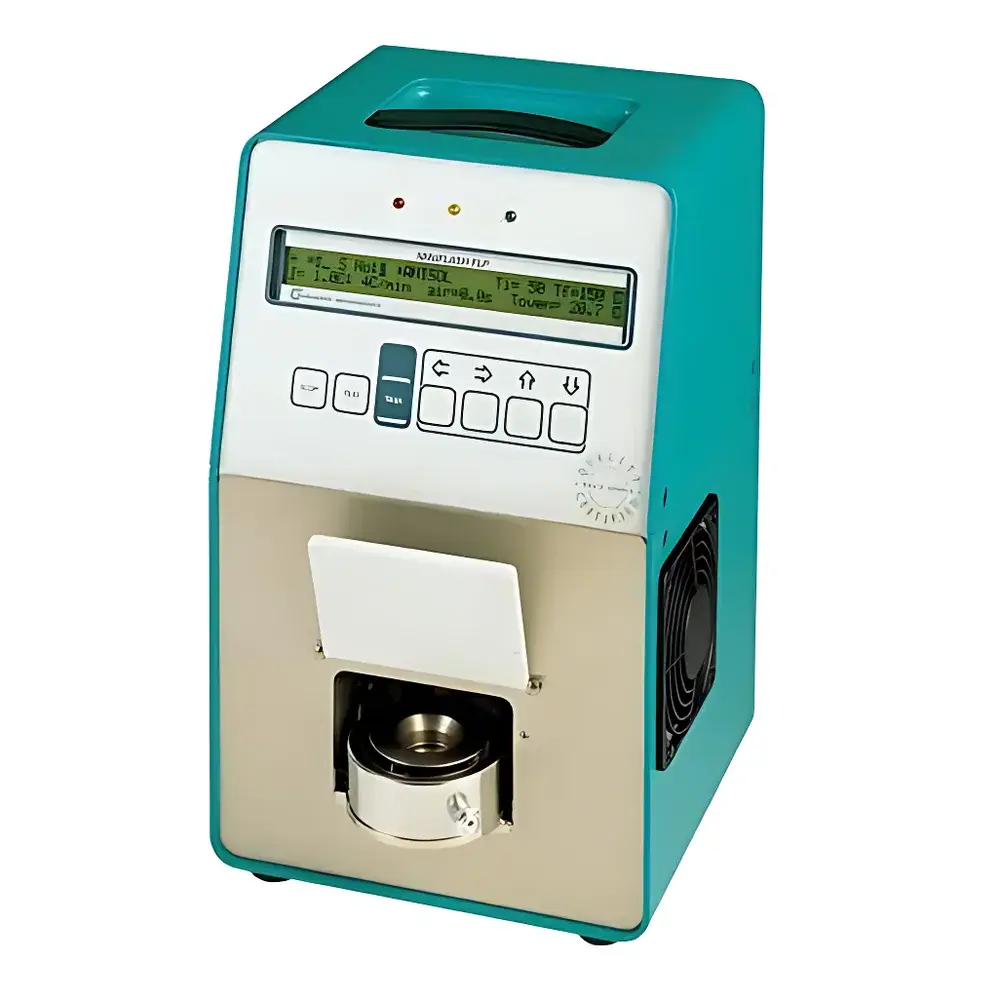
Grabner MiniFlash Automatic Closed-Cup Flash Point Tester
| Brand | Grabner |
|---|---|
| Origin | Austria |
| Manufacturer Type | Original Equipment Manufacturer (OEM) |
| Product Category | Imported Instrument |
| Model | MiniFlash |
| Detection Method | Closed-Cup (ASTM D6450 / D7094, ISO 2719, SH/T 0768-2005) |
| Operation Mode | Fully Automatic |
| Temperature Range | –25 °C to 400 °C |
| Ignition Source | Electric Arc |
| Sample Volume | 1–2 mL |
| Temperature Accuracy | ±0.1 °C |
| Test Duration | 3–5 min per sample |
| Data Storage | Internal memory for multiple test records |
| Connectivity | RS-232, LIMS-ready interface, printer & PC compatible |
| Power Supply | 100/200/230 V AC, 50 Hz, 65 W |
| Optional DC Input | 12 V / 8 A (vehicle battery) |
| Dimensions | 196 × 315 × 175 mm |
| Weight | 8 kg |
Overview
The Grabner MiniFlash Automatic Closed-Cup Flash Point Tester is an engineered solution for precise, repeatable flash point determination across petroleum, chemical, fragrance, coatings, and regulatory compliance laboratories. It operates on the principle of continuous closed-cup (CCCFP) methodology—where the sample cup remains hermetically sealed throughout heating, vapor accumulation, and electric arc ignition—ensuring thermodynamic equilibrium and eliminating uncontrolled evaporation or ambient interference. Unlike conventional Pensky-Martens (ASTM D93) or Tag (ASTM D56) instruments that rely on intermittent cup opening and open-flame ignition, the MiniFlash maintains true closed-system conditions, delivering flash point values aligned with fundamental safety and volatility characterization requirements. Its design conforms to globally harmonized test standards including ASTM D6450 (low-volume, low-energy), ASTM D7094 (extended range, high-precision), ISO 2719, and the Chinese national standard SH/T 0768–2005. As a certified instrument referenced by U.S. Department of Transportation (DOT), NATO (STANAG 6630-25-145-3256 & 6630-25-146-0895), and EU REACH/GHS frameworks, it supports hazard classification, transport categorization, and SDS authoring under CLP Regulation (EC No. 1272/2008).
Key Features
- Continuous Closed-Cup Flash Point (CCCFP) technology ensures full containment from sample loading through ignition—eliminating exposure to open flame, reducing operator risk, and improving measurement fidelity.
- Micro-sample capability (1–2 mL) minimizes consumption of high-value or hazardous materials while lowering waste generation and disposal burden in accordance with green lab principles.
- Integrated Peltier-based cooling and high-resolution PID temperature control enable stable ramping across –25 °C to 400 °C without external chillers or auxiliary hardware.
- Electric arc ignition system provides consistent, contamination-free energy delivery—no wick degradation, no fuel dependency, and zero particulate emission.
- Automated post-test cup cooling cycle reduces surface temperature to safe handling levels before next sample introduction—enhancing ergonomics and lab safety protocols.
- Compact monolithic architecture (196 × 315 × 175 mm, 8 kg) supports benchtop deployment, mobile field testing, and integration into QC/QA workflows with minimal footprint.
- Compliance-ready firmware includes audit trail logging, user access levels, and electronic signature support—facilitating alignment with FDA 21 CFR Part 11 and GLP/GMP documentation requirements.
Sample Compatibility & Compliance
The MiniFlash accommodates diverse sample matrices requiring flash point assessment under standardized conditions: refined fuels (gasoline, diesel, jet fuel), crude fractions, solvents, lubricants, resins, paint thinners, essential oils, synthetic fragrances, polymer emulsions, and reactive intermediates. Its adaptive thermal profile management handles high-viscosity liquids (e.g., bitumen cutbacks), volatile blends (e.g., ethanol-gasoline mixtures), and thermally sensitive formulations (e.g., citrus terpenes) without compromising repeatability. Validation studies demonstrate superior reproducibility vs. traditional Pensky-Martens testers—particularly for low-flash (<60 °C) and borderline-classification samples—meeting ASTM precision criteria for both repeatability (r) and reproducibility (R). The instrument is formally recognized by IFRA (International Fragrance Association) as a recommended platform for fragrance safety evaluation and is routinely deployed in OEM R&D labs subject to ICH Q5C stability guidelines.
Software & Data Management
Built-in firmware supports standalone operation with intuitive touchscreen navigation and context-sensitive prompts. All measurements—including time-stamped temperature curves, vapor pressure trends, and ignition event detection—are stored internally with configurable retention policies. RS-232 serial output enables direct export to LIMS, ELN, or custom QA databases; optional USB-to-serial adapters allow legacy PC integration. The included PC software (MiniFlash Control Suite) provides real-time graphing, statistical analysis (mean, SD, CV%), report generation in PDF/CSV/XLSX formats, and customizable templates compliant with ISO/IEC 17025 documentation structures. Audit trails record operator ID, method version, calibration status, and any parameter override—fully traceable for internal audits or regulatory inspections.
Applications
- Petroleum refining QC: Rapid verification of distillate cuts, blending stock conformity, and finished product release per ASTM D93/D56 equivalency.
- Hazardous material classification: GHS Category 1–4 assignment for SDS preparation and UN transport labeling (UN 1263, UN 1993, etc.).
- Coatings & inks formulation: Flash point monitoring during solvent selection, VOC reduction initiatives, and regulatory substitution programs.
- Fragrance & flavor development: Stability screening of natural isolates and synthetic aroma chemicals under controlled thermal stress.
- Pharmaceutical excipient testing: Volatility assessment of propellants, solubilizers, and co-solvents used in topical or inhalation products.
- Military & aerospace logistics: Field-deployable verification of fuel integrity per MIL-STD-1H0099-LL-H41-1846 and NATO STANAG specifications.
FAQ
What distinguishes CCCFP from traditional closed-cup methods like Pensky-Martens?
CCCFP maintains uninterrupted cup closure during heating, vapor equilibration, and ignition—enabling true thermodynamic equilibrium measurement. Pensky-Martens requires periodic lid lifting, introducing uncontrolled air exchange and vapor loss.
Is the MiniFlash suitable for testing highly viscous or waxy samples?
Yes—pre-heating options and programmable soak times accommodate samples up to 1000 cSt; optional heated sample probe prevents premature crystallization during transfer.
Does the instrument support 21 CFR Part 11 compliance?
Firmware v4.2+ includes role-based access control, electronic signatures, and immutable audit logs—validated for use in regulated pharmaceutical and contract manufacturing environments.
Can test results be exported directly to LIMS?
Yes—RS-232 output supports ASCII-based protocol mapping; configuration files are provided for major LIMS vendors including LabWare, STARLIMS, and Thermo Fisher SampleManager.
What maintenance is required for long-term reliability?
No consumables beyond routine cleaning of the sample cup and electrode; annual calibration verification using NIST-traceable reference standards is recommended for ISO/IEC 17025 accreditation.






