
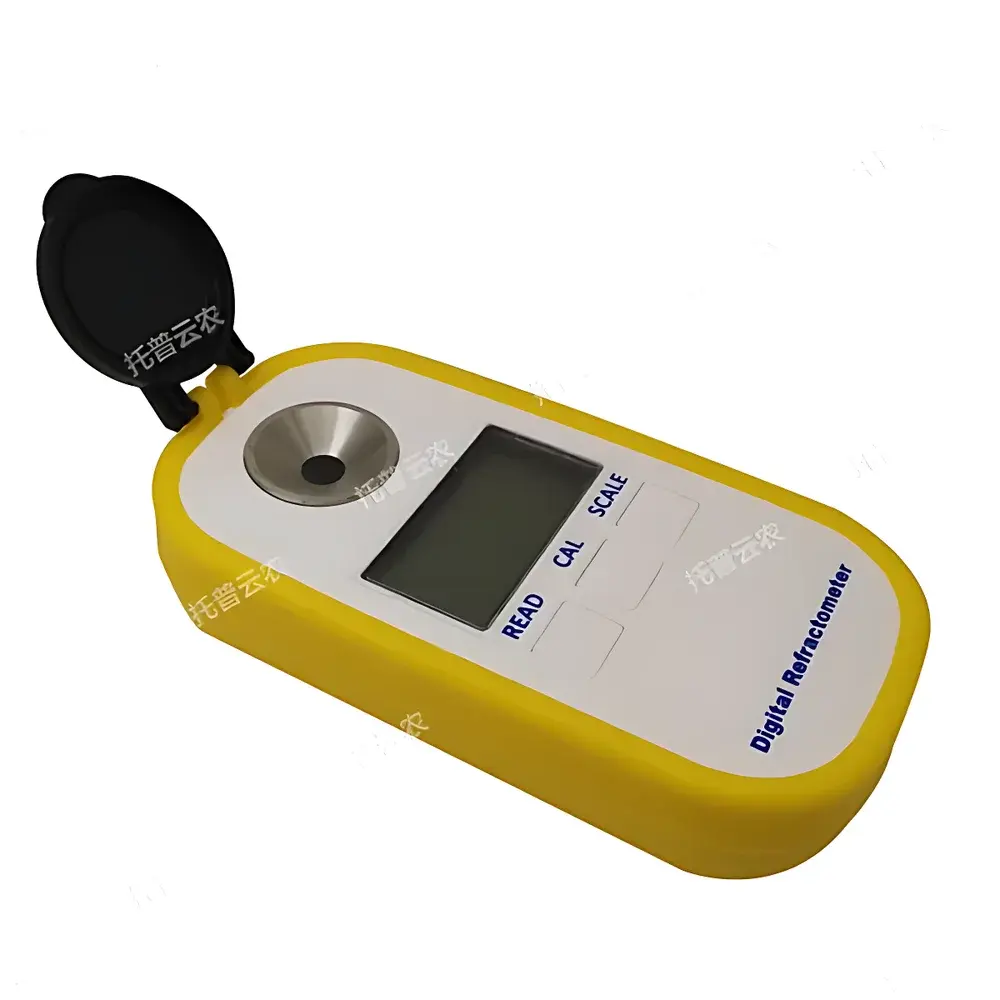
Top Cloud-agri TD-45 Digital Refractometer for Brix and Refractive Index Measurement
| Brand | Top Cloud-agri |
|---|---|
| Origin | Zhejiang, China |
| Manufacturer Type | Direct Manufacturer |
| Country of Origin | China |
| Model | TD-45 |
| Instrument Type | Destructive Sampling |
| Measurement Range (Brix) | 0–55% w/w |
| Resolution (Brix) | 0.1% |
| Accuracy (Brix) | ±0.2% |
| Measurement Range (Refractive Index, nD) | 1.3330–1.4535 |
| Resolution (nD) | 0.0001 |
| Accuracy (nD) | ±0.0003 |
| Power Source | 1 × AAA battery (up to 8,000 measurements) |
| Auto-off | After 3 minutes of inactivity |
| Calibration | Distilled water (nD = 1.3330 at 20 °C) |
| Sample Cell | Stainless steel |
| Prism Cover | Integrated protective lid |
Overview
The Top Cloud-agri TD-45 Digital Refractometer is a precision optical instrument engineered for rapid, field-deployable determination of soluble solids content (expressed as Brix % w/w) and refractive index (nD) in liquid samples. It operates on the fundamental principle of total internal reflection at the prism-sample interface: incident light undergoes critical angle shift proportional to the sample’s refractive index, which correlates linearly with dissolved solute concentration under controlled temperature conditions. Designed specifically for agricultural and food industry applications, the TD-45 delivers repeatable, operator-independent readings without requiring solvent extraction or thermal equilibration—enabling real-time assessment of fruit ripeness, juice quality, fermentation progress, and post-harvest maturity grading. Its compact form factor, robust stainless-steel sample chamber, and sealed optical path ensure consistent performance across variable ambient conditions typical of orchards, packing houses, wineries, and QC laboratories.
Key Features
- High-resolution dual-parameter display: Simultaneous digital readout of Brix (0–55%, 0.1% resolution) and refractive index (1.3330–1.4535, 0.0001 resolution) on a backlit LCD screen.
- Stainless-steel sample well with integrated prism cover: Minimizes contamination risk, prevents evaporation during measurement, and maintains optical alignment stability over extended use cycles.
- Low-power architecture: Powered by a single AAA battery supporting up to 8,000 measurements; auto-power-off after 180 seconds of inactivity ensures extended operational readiness without manual intervention.
- Factory-calibrated and user-verifiable: Pre-calibrated against NIST-traceable standards; routine verification using distilled water (nD = 1.3330 at 20 °C) satisfies ISO 2173 and AOAC 932.12 calibration traceability requirements.
- Ergonomic tactile interface: Sealed membrane keypad resistant to moisture and particulate ingress; intuitive navigation with minimal training required.
- Temperature-compensated optics: Optimized for ambient operation between 10–30 °C; measurement uncertainty remains within ±0.2% Brix across this range when calibrated at reference temperature.
Sample Compatibility & Compliance
The TD-45 accommodates aqueous solutions with low viscosity and minimal suspended solids—including fruit juices (apple, citrus, grape), vegetable extracts, honey dilutions, must, cider, soft drink concentrates, and brine solutions. It is not suitable for highly turbid, viscous, or non-aqueous media (e.g., oils, ethanol >20% v/v, or pulpy suspensions). As a destructive sampling instrument, it requires 0.3–0.5 mL of clarified liquid per measurement. The device complies with core metrological principles outlined in ISO 5725 (accuracy and precision of measurement methods) and supports GLP-aligned documentation workflows when paired with external lab notebooks or LIMS integration via manual data logging. While not certified to IEC 61000-6-3 (EMC) or IP67, its mechanical design meets EN 61010-1 safety standards for handheld laboratory instruments.
Software & Data Management
The TD-45 operates as a standalone, firmware-controlled instrument with no embedded Bluetooth, USB, or cloud connectivity. All measurements are displayed in real time and retained only on-screen until overwritten; no internal memory or timestamping is provided. For regulated environments requiring audit trails (e.g., FDA 21 CFR Part 11 compliance), users must manually record results—including date, operator ID, sample ID, and calibration verification status—in bound logbooks or validated electronic systems. The absence of proprietary software eliminates driver conflicts and ensures long-term interoperability with existing QA/QC infrastructure.
Applications
- Agricultural extension services: Field-based maturity indexing of apples, pears, grapes, mangoes, and stone fruits prior to harvest scheduling.
- Winemaking & cider production: Monitoring sugar accumulation in grape must and juice Brix progression during pre-fermentation staging.
- Food processing QA: Incoming inspection of fruit concentrates, syrups, and purees; in-process verification of blending consistency.
- Academic horticulture research: Correlating Brix values with sensory attributes, storage life, and ethylene evolution kinetics.
- Small-scale beverage R&D: Rapid iteration of sweetener ratios in functional drinks, kombucha, and plant-based dairy alternatives.
FAQ
Is the TD-45 suitable for measuring alcohol content?
No — it measures total dissolved solids (TDS) via refractive index, not ethanol concentration. Alcohol interferes with Brix correlation; dedicated densitometers or near-infrared analyzers are required for ABV quantification.
Can I measure undiluted honey with this refractometer?
Yes, but only after warming to 40 °C and gentle homogenization to reduce viscosity; excessive air bubbles or crystallization will compromise accuracy.
Does the instrument compensate for temperature automatically?
It does not feature active ATC (Automatic Temperature Compensation); however, its optical design minimizes drift between 10–30 °C when calibrated at 20 °C per ISO 2173 guidelines.
What is the recommended recalibration frequency?
Daily before first use and after any significant ambient temperature shift (>5 °C); additionally, after cleaning or mechanical shock.
Is the stainless-steel sample well resistant to acidic fruit juices?
Yes — grade 304 stainless steel provides adequate corrosion resistance for short-term contact with citric, malic, and tartaric acid solutions at typical fruit pH levels (3.0–4.5).





