
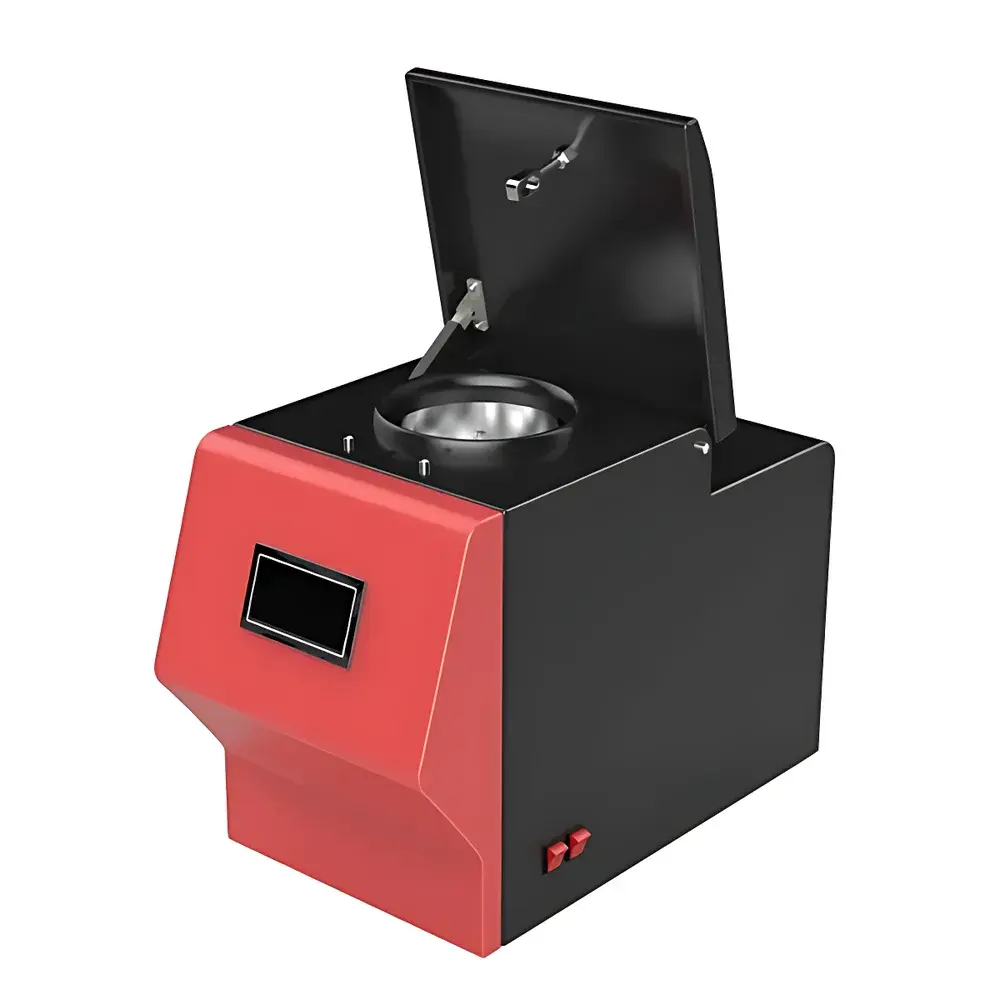
Top Cloud-agri YMY-240CL Multi-Sample Cryogenic Ball Mill
| Brand | Top Cloud-agri |
|---|---|
| Origin | Zhejiang, China |
| Manufacturer Type | Direct Manufacturer |
| Product Category | Domestic |
| Model Series | YMY |
| Instrument Type | Planetary Ball Mill |
| Sample Compatibility | Cryogenic (Frozen) Biological & Hard Materials |
| Maximum Throughput | 24 Samples Simultaneously |
| Final Particle Size | ~5 µm |
| Grinding Platform Count | >2 |
| Frequency Range | 0–70 Hz |
| Processing Time | 0–9999 min |
| Rotational Speed | 1000–7000 rpm |
| Grinding Media Diameter | 0.1–30 mm |
| Grinding Media Materials | Alloy Steel, Chrome Steel, Zirconia, Tungsten Carbide, Quartz Sand |
| Noise Level | <55 dB(A) |
| Temperature Control Range | −50 °C to +37 °C |
| Adapter Materials | PTFE or Alloy Steel |
| Standard Configuration | Main Unit, 2 mL Cryo-Adapter Set, 10 mL Steel Vial & Adapter Set, 3# & 5# Grinding Beads |
Overview
The Top Cloud-agri YMY-240CL Multi-Sample Cryogenic Ball Mill is an engineered solution for high-throughput, low-temperature mechanical disruption of biological and recalcitrant materials. Operating on the principle of planetary ball milling—where centrifugal forces generated by simultaneous rotation of grinding jars and a sun wheel induce intense impact, shear, and compression—the instrument achieves rapid cell lysis, tissue homogenization, and particle size reduction while preserving thermolabile biomolecules. Its integrated cryogenic cooling system maintains sample integrity during processing by suppressing enzymatic degradation, oxidation, and thermal denaturation. Designed for laboratories requiring reproducible, scalable sample preparation under controlled thermal conditions, the YMY-240CL supports workflows aligned with ISO/IEC 17025-compliant quality management systems and GLP-aligned documentation practices.
Key Features
- Intuitive 7-inch capacitive touchscreen interface with multi-language support (English default), enabling precise parameter entry and real-time status monitoring.
- Pre-programmed application-specific protocols—including optimized settings for heart, spleen, lung, kidney, bone, skin, and hair—reduce method development time and operator variability.
- Programmable cycling function allows sequential execution of up to ten user-defined protocols within a single run, minimizing manual intervention and enhancing inter-run consistency.
- Electromagnetic lid-locking mechanism ensures operational safety by preventing mill activation unless the grinding chamber is fully sealed and centered.
- Self-centering clamping system guarantees uniform force distribution across all adapters, eliminating vibration-induced misalignment and ensuring balanced load transmission.
- Dynamic acceleration/deceleration control achieves target rotational speed (1000–7000 rpm) within ≤2 seconds, supporting rapid protocol transitions and kinetic optimization studies.
- Flexible grinding mode selection: dry grinding, wet grinding (with solvents or buffers), and cryogenic grinding (using liquid nitrogen or built-in refrigeration).
- Modular adapter architecture accommodates interchangeable vial configurations—from 0.2 mL microtubes to 50 mL stainless-steel jars—enabling customization for diverse sample volumes and matrix types.
- Wide temperature regulation range (−50 °C to +37 °C) facilitates both deep-frozen embrittlement of tough tissues and ambient-temperature milling of polymers or ceramics.
Sample Compatibility & Compliance
The YMY-240CL processes heterogeneous sample types—including fibrous plant tissues, mineralized bone, frozen microbial pellets, and lipid-rich organs—without cross-contamination, thanks to its independent vial positioning and non-contact drive design. All contact surfaces comply with USP Class VI biocompatibility standards; PTFE adapters meet FDA 21 CFR §177.1550 requirements for repeated food-contact use. The system supports audit-ready operation through timestamped parameter logging and optional external data export (CSV/Excel), facilitating traceability in regulated environments governed by ISO 13485 (medical devices), ISO 17025 (testing labs), or ICH-GCP (clinical trial sample handling).
Software & Data Management
Onboard firmware stores up to ten complete method profiles with full parameter histories—including frequency, duration, temperature setpoint, ramp rates, and cycle counts. Each run generates a unique digital log file containing start/end timestamps, actual vs. setpoint temperatures, and real-time RPM deviation metrics. Export functionality enables integration with LIMS platforms via USB 2.0 or RS-232 interfaces. Optional software add-ons provide remote monitoring, automated report generation, and electronic signature compliance per FDA 21 CFR Part 11 Annex 11 requirements.
Applications
- RNA/DNA extraction from flash-frozen animal tissues where nuclease inhibition is critical.
- Homogenization of plant roots and seeds for metabolomic profiling and pesticide residue analysis (aligned with EN 15662:2018).
- Preparation of nano-dispersed catalysts and battery electrode materials requiring sub-10 µm particle distributions.
- Cell wall disruption of yeast and filamentous fungi for proteomic sample prep (compatible with downstream LC-MS workflows).
- Soil and sediment grinding for heavy metal speciation analysis (EPA Method 6010D/6020B).
- Pharmaceutical excipient milling under GMP Annex 1 environmental controls.
FAQ
What cooling methods does the YMY-240CL support?
It features an integrated semiconductor-based refrigeration unit capable of maintaining −50 °C to +37 °C. External liquid nitrogen feed ports are also available for ultra-low-temperature applications.
Can the instrument be validated for regulated laboratory use?
Yes—its parameter logging, user access levels, and electronic audit trail capabilities support IQ/OQ/PQ documentation frameworks required for GLP, GMP, and ISO 17025 accreditation.
Is cross-contamination prevented during multi-sample runs?
Each sample vial operates in an isolated position within the adapter block; no shared grinding media or fluid pathways exist between samples.
What maintenance intervals are recommended?
Annual calibration of temperature sensors and torque verification of clamping mechanisms are advised; grinding jar wear inspection should occur after every 500 operating hours.
Are custom adapters or vials available?
Top Cloud-agri offers OEM fabrication services for specialized vial geometries, material compositions (e.g., borosilicate glass, Hastelloy), and volume capacities up to 100 mL.



