
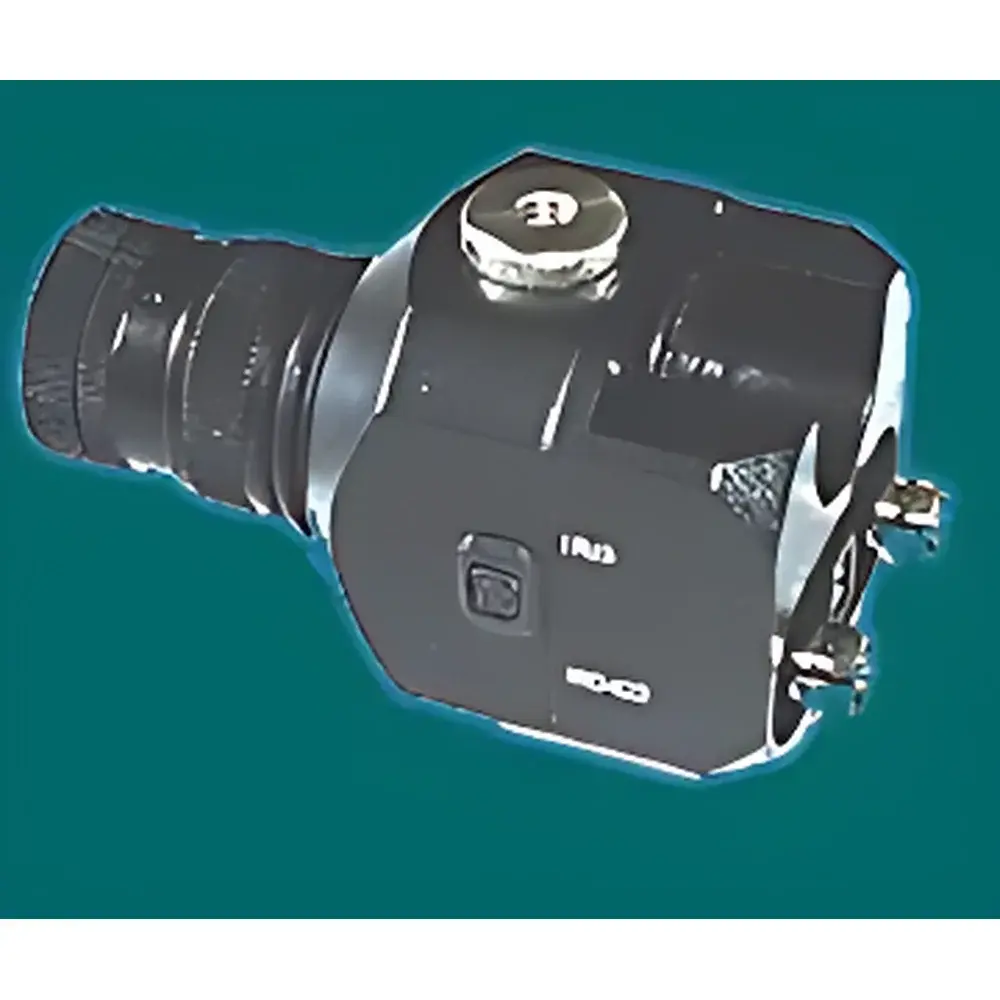
Rayscience CONTOUR-IR Near-Infrared CCD Camera
| Brand | Rayscience |
|---|---|
| Model | CONTOUR-IR |
| Sensor Type | Silicon-based CCD |
| Spectral Range | 400–1700 nm |
| Sensor Format | 1/3″ (582 × 752 pixels) |
| Resolution | 570 TV lines |
| Signal-to-Noise Ratio | 48 dB |
| Synchronization | Internal/External |
| Lens Mount | C-mount |
| Focal Length | 26 mm (f/1.4) |
| Field of View | 20° |
| Video Output | Standard Composite (CCIR) |
| Power Supply | DC 10–14 V, 150 mA |
| Weight | 0.3 kg |
| Dimensions | 56 × 110 mm |
| Mounting Interface | 1/4″-20 threaded base |
Overview
The Rayscience CONTOUR-IR Near-Infrared CCD Camera is a precision-engineered optical imaging instrument designed for quantitative visualization and documentation of near-infrared (NIR) radiation across a broad spectral band—from 400 nm in the visible edge to 1700 nm in the short-wave infrared (SWIR) region. Unlike standard visible-light CCD cameras, the CONTOUR-IR integrates a specially optimized silicon-based CCD sensor with extended quantum efficiency in the NIR domain, enabling high-fidelity detection of emissions from GaAs-based LEDs, laser diodes, and other IR-emitting components. Its operation is grounded in photon-to-electron conversion principles governed by the photoelectric effect, with signal amplification and readout conforming to CCIR-compliant analog video standards. The camera does not employ cooling or InGaAs sensors; instead, it leverages advanced anti-reflection coating, low-noise analog front-end circuitry, and precise spectral calibration to maximize responsivity and dynamic range within its designated wavelength window. This makes it particularly suitable for laboratory-based NIR alignment, optical system characterization, and non-destructive inspection where real-time imaging—rather than spectroscopic quantification—is the primary objective.
Key Features
- Extended spectral response from 400 nm to 1700 nm, optimized for GaAs and SWIR LED/laser source visualization
- High-sensitivity 1/3″ silicon CCD sensor with 582 × 752 active pixel array and 570 TV-line resolution
- Low-noise analog signal chain delivering 48 dB signal-to-noise ratio under nominal illumination conditions
- C-mount lens interface supporting interchangeable optics—including standard 26 mm f/1.4 lenses—for flexible field-of-view adjustment (e.g., 20° FOV with default configuration)
- Compact, lightweight mechanical design (56 × 110 mm, 0.3 kg) with integrated 1/4″-20 threaded mounting base for tripod, optical rail, or handheld deployment
- Flexible synchronization modes (internal or external trigger) for integration into pulsed illumination or time-gated measurement setups
- Standard CCIR-compliant composite video output for direct connection to oscilloscopes, frame grabbers, or legacy monitoring systems
- Wide-input DC power range (10–14 V, 150 mA) ensuring compatibility with battery packs, lab power supplies, and embedded platforms
Sample Compatibility & Compliance
The CONTOUR-IR is compatible with a wide range of NIR-emitting samples and configurations, including but not limited to: infrared laser beam profiling (e.g., 808 nm, 980 nm, or 1550 nm diodes), thermal emission mapping of heated semiconductor junctions, NIR fluorescence verification in security inks or biological markers, and passive night-vision-assisted optical alignment. It complies with CE electromagnetic compatibility (EMC) directives and meets IEC 61000-6-3 emission limits for industrial environments. While not certified for medical or aerospace-grade applications, its analog video architecture supports integration into GLP-aligned workflows when paired with validated acquisition software and timestamped logging protocols. It is not intended for radiometric calibration or absolute irradiance measurement; users requiring traceable photometric data should supplement with NIST-traceable reference sources and neutral density filters.
Software & Data Management
As an analog-output device, the CONTOUR-IR does not include onboard firmware-based image processing or storage. Instead, it interfaces seamlessly with third-party frame-grabbing hardware and software platforms—including MATLAB Image Acquisition Toolbox, LabVIEW Vision Development Module, and open-source tools such as OpenCV (via USB video class or composite capture cards). For regulated environments, the camera may be incorporated into FDA 21 CFR Part 11–compliant systems when used with audit-trail-enabled acquisition software that logs operator identity, timestamp, exposure settings (via external control), and raw frame metadata. No proprietary drivers or cloud services are required; all video streams adhere to industry-standard CCIR timing and voltage levels, ensuring long-term interoperability and archival stability.
Applications
- Alignment and collimation of NIR optical paths in fiber coupling, free-space communication, and LIDAR subsystem development
- Functional testing of infrared illuminators, night vision modules, and automotive driver-monitoring systems
- Non-contact inspection of silicon wafers, solar cells, and packaging materials exhibiting NIR transparency or reflectivity
- Educational demonstrations of IR transmission through polymers, glass types, and biological tissues
- Forensic document analysis using NIR-induced contrast in altered inks or erased markings
- Quality assurance of IR LED arrays in consumer electronics manufacturing lines
FAQ
Is the CONTOUR-IR suitable for quantitative radiometric measurements?
No. It is an imaging sensor optimized for relative intensity visualization—not calibrated photometry. For absolute irradiance or radiance values, a spectroradiometer or NIST-traceable IR camera is required.
Can this camera detect thermal emissions above 1700 nm?
No. Its silicon-based CCD has negligible quantum efficiency beyond ~1100 nm without upconversion; the stated 1700 nm upper limit reflects sensitivity to second-harmonic generation or nonlinear upconversion artifacts—not native thermal detection.
Does it support digital output (e.g., USB or GigE)?
No. It provides only analog composite video (CCIR standard) output. Digital acquisition requires an external frame grabber.
Is cooling available or recommended for low-light NIR work?
No integrated thermoelectric cooler is included. Dark current remains manageable at ambient temperatures due to short integration times typical in video-rate NIR imaging.
What lens options are validated for use with the C-mount interface?
Rayscience recommends lenses with focal lengths from 16 mm to 50 mm and f-numbers ≤ f/1.4 to maintain optimal NIR transmission and edge sharpness across the full 400–1700 nm band.




