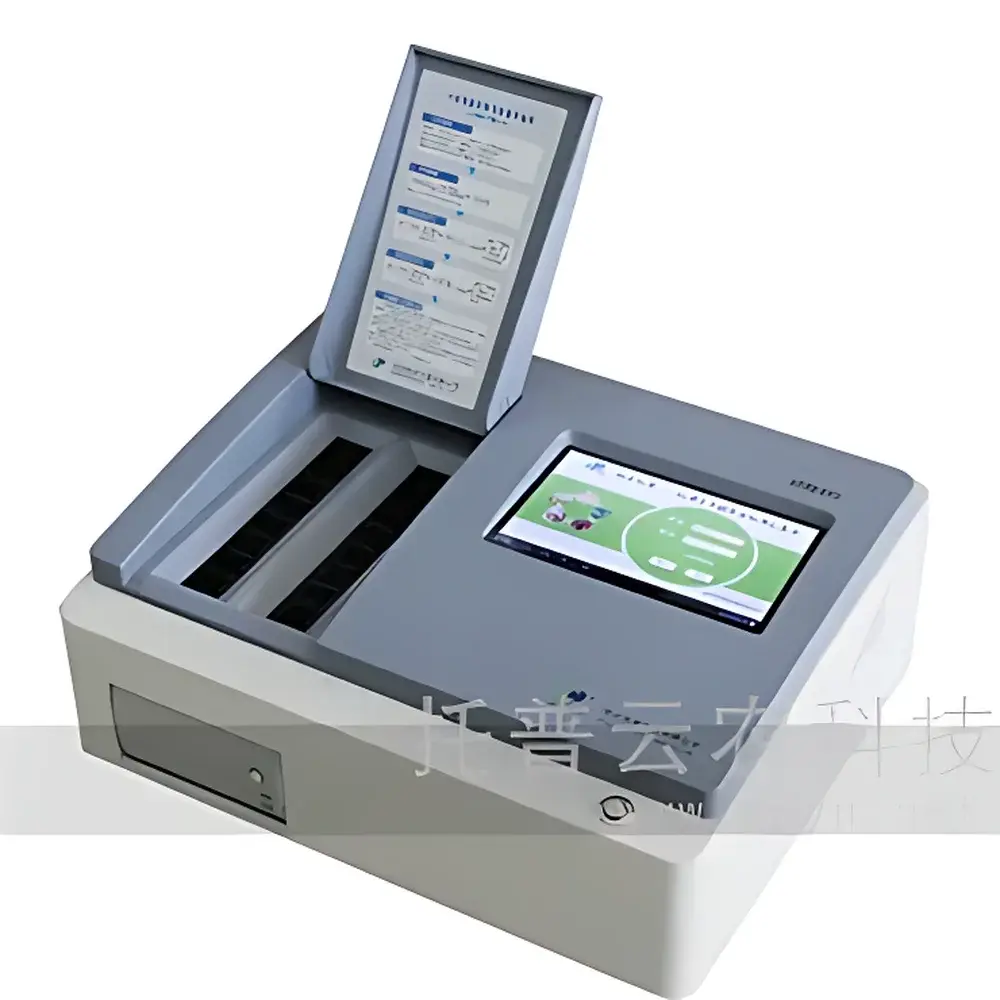
Top Cloud-agri NY-16DA Pesticide Residue Rapid Tester
| Brand | Top Cloud-agri |
|---|---|
| Origin | Zhejiang, China |
| Manufacturer Type | Manufacturer |
| Country of Origin | Domestic (China) |
| Model | NY-16DA |
| Detection Method | Enzyme Inhibition Assay |
| Measurement Range | 0–100% inhibition rate |
| Quantitative Range | 0–20 mg/kg |
| Number of Channels | 16 |
| Photometric Accuracy (Transmittance) | ≤ ±1.5% |
| Photometric Repeatability (Absorbance) | ≤ 0.005 A |
| Stability | ≤ 1.0% T drift (or ≤ 0.005 A) within 3 min after 20-min warm-up |
Overview
The Top Cloud-agri NY-16DA Pesticide Residue Rapid Tester is a field-deployable, multi-channel photometric analyzer engineered for the qualitative and quantitative screening of organophosphorus and carbamate pesticide residues in fresh agricultural commodities—primarily fruits and vegetables. It operates on the internationally standardized enzyme inhibition principle: acetylcholinesterase (AChE) activity is inhibited proportionally by residual anticholinesterase pesticides; the degree of inhibition is quantified via kinetic photometric measurement of chromogenic substrate hydrolysis (e.g., indoxyl acetate or 5,5′-dithiobis-(2-nitrobenzoic acid), DTNB) at 412 nm. This method aligns with national and international rapid screening protocols—including GB/T 5009.199–2003 (China), AOAC Official Method 2007.01, and ISO/IEC 17025-compliant validation frameworks—and serves as a primary triage tool prior to confirmatory analysis by GC-MS or LC-MS/MS.
Key Features
- 16 independent optical detection channels enable parallel analysis of up to 16 samples per run—ideal for high-throughput field screening at wholesale markets, origin farms, and regulatory checkpoints.
- Integrated Android-based operating system with 7-inch capacitive touchscreen, GPS module (positioning accuracy < 5 m), and real-time environmental sensing interface for concurrent acquisition of ambient temperature, relative humidity, dew point, and photosynthetically active radiation (PAR).
- Onboard thermal line printer supports barcode generation and auto-printing of full test reports—including sample name, inhibition rate (%), quantitative residue level (mg/kg), pass/fail status per preset thresholds, test timestamp, operator ID, geographic coordinates, and environmental metadata.
- Self-calibrating optical path: automatic light source self-diagnosis at startup eliminates manual blank calibration with shutter blocks; ensures long-term photometric stability without user intervention.
- Robust data architecture: ≥200,000 test records stored locally with non-volatile memory—retained during power loss; supports time-stamped search, bidirectional sorting, batch deletion, and conditional filtering by crop name, detection date, or result category.
- User access control with configurable login credentials prevents unauthorized parameter modification; supports role-based operation logs compliant with GLP documentation requirements.
Sample Compatibility & Compliance
The NY-16DA is validated for homogenized extracts from common horticultural commodities—including leafy greens (e.g., spinach, lettuce), solanaceous crops (tomato, pepper), cucurbits (cucumber, zucchini), and pome/stone fruits (apple, peach). Sample preparation follows standardized quenching and centrifugation protocols per GB 2763–2021 maximum residue limits (MRLs). The instrument meets electromagnetic compatibility (EMC) requirements per GB/T 18268.1–2010 and conforms to safety standards GB 4793.1–2007. Its enzyme inhibition methodology is referenced in national food safety monitoring programs and recognized by provincial-level market regulation bureaus for preliminary surveillance under China’s Food Safety Law (Article 112).
Software & Data Management
The device integrates seamlessly with the Top Cloud-agri Instrument Cloud Platform—a secure, browser- and mobile-accessible C/S architecture supporting multi-device data aggregation. All measurements synchronize automatically via Wi-Fi or GPRS to encrypted cloud storage. Platform capabilities include: time-series trend visualization (min/max/mean per parameter), dynamic threshold configuration, export-ready reporting (PDF, Excel, CSV), cross-dataset statistical comparison, and audit-trail-enabled data versioning. Software updates are delivered over-the-air (OTA); platform access supports multi-level user permissions, ensuring traceability per ISO/IEC 17025 Clause 7.11 and FDA 21 CFR Part 11 principles (electronic signatures, change control, and retention integrity).
Applications
- Field-level pre-harvest and post-harvest screening at cooperative farms and agri-parks
- Routine surveillance in municipal food safety inspection stations and county-level CDC laboratories
- Quality assurance workflows in supermarket supply chain hubs and wet market management offices
- Regulatory compliance verification for HACCP and ISO 22000-certified processors
- Epidemiological mapping of pesticide exposure hotspots using geotagged residue data
FAQ
What pesticides does the NY-16DA detect?
It detects organophosphorus (e.g., chlorpyrifos, dimethoate) and carbamate (e.g., carbaryl, methomyl) compounds that inhibit acetylcholinesterase. It does not detect neonicotinoids, pyrethroids, or glyphosate.
Can results be exported for regulatory submission?
Yes—raw data and formatted reports are exportable in PDF, Excel, and CSV formats; cloud platform exports include embedded timestamps, operator IDs, and GPS coordinates required for traceability in official submissions.
Is the enzyme reagent kit certified and stable?
Top Cloud-agri supplies lyophilized AChE kits with documented lot-specific activity validation and 12-month refrigerated shelf life (2–8°C); each kit includes calibration controls traceable to NIM reference materials.
How is instrument performance verified between calibrations?
Built-in photometric self-check at boot verifies LED intensity and detector response; daily verification uses supplied standard inhibitor solutions (e.g., dichlorvos at 0.5 mg/L) to confirm assay sensitivity and dynamic range.
Does the system support integration with LIMS?
Yes—the cloud API supports RESTful data ingestion into third-party Laboratory Information Management Systems (LIMS) via HTTPS POST; JSON schema documentation is provided upon request.