
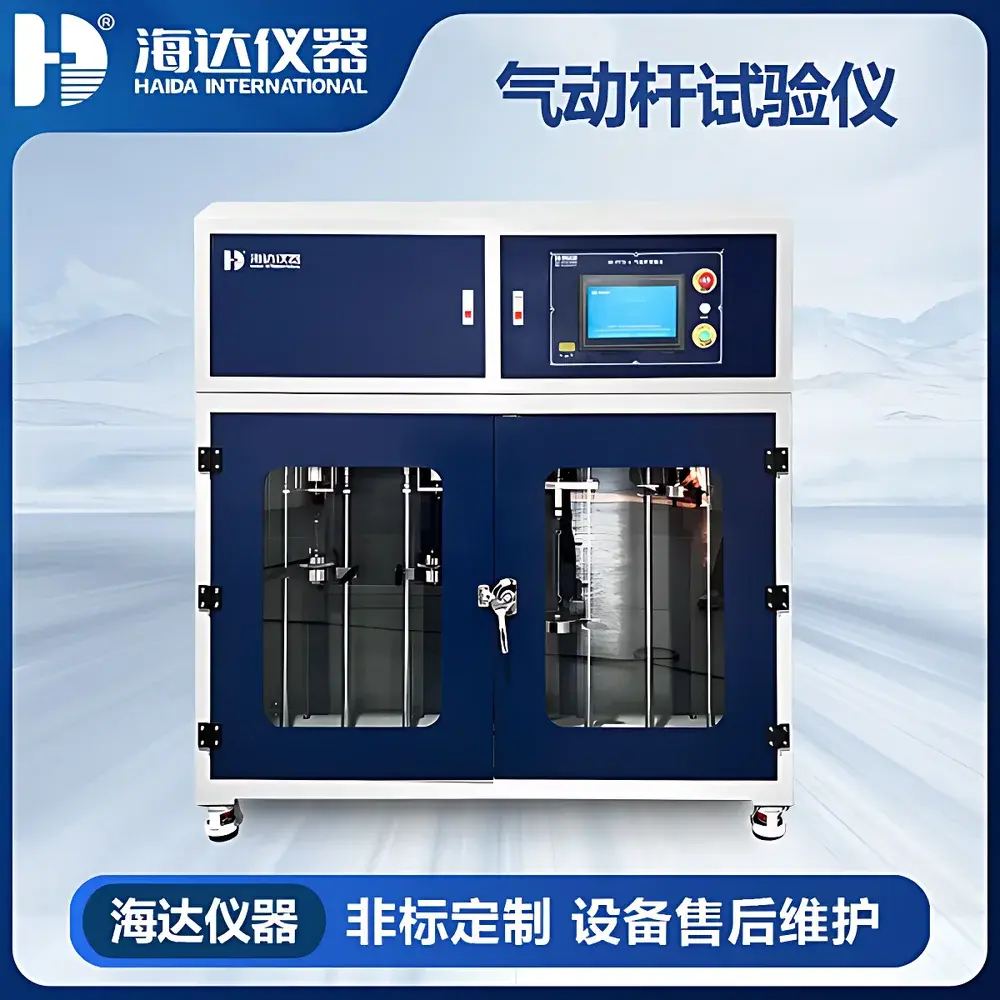
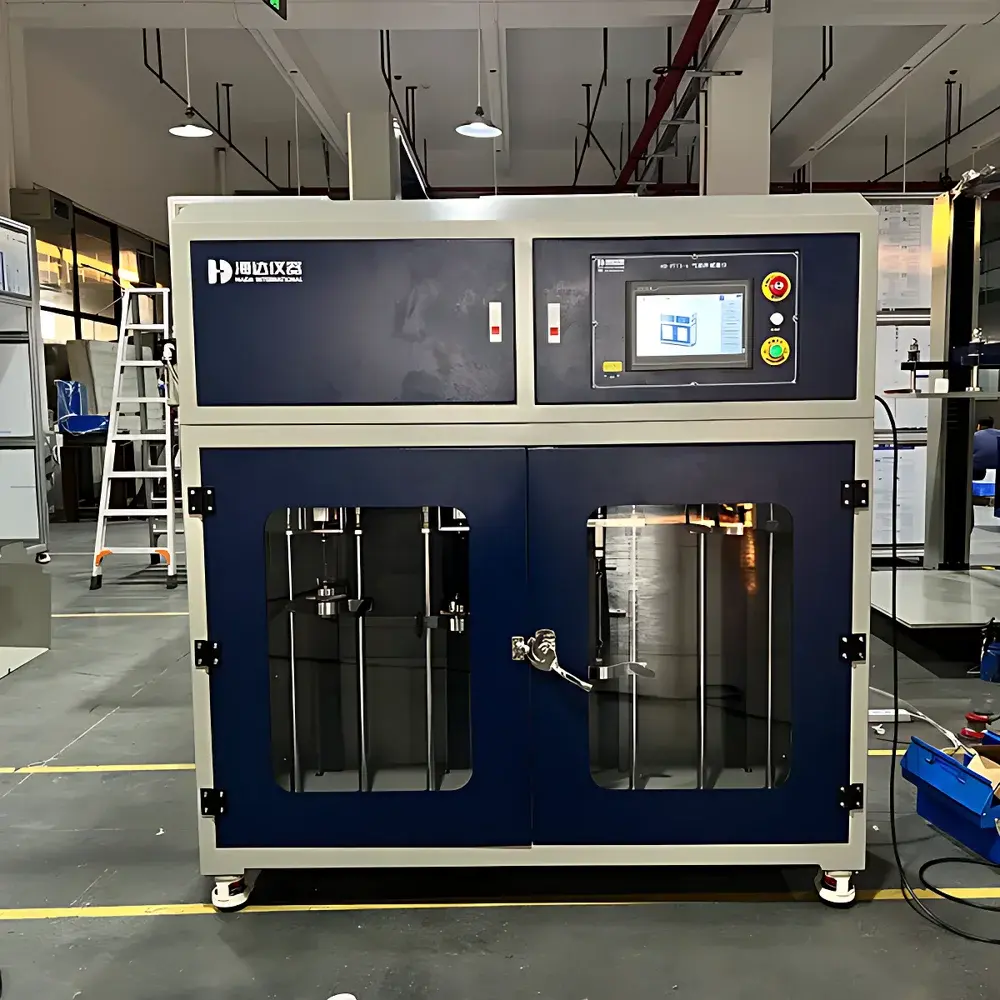
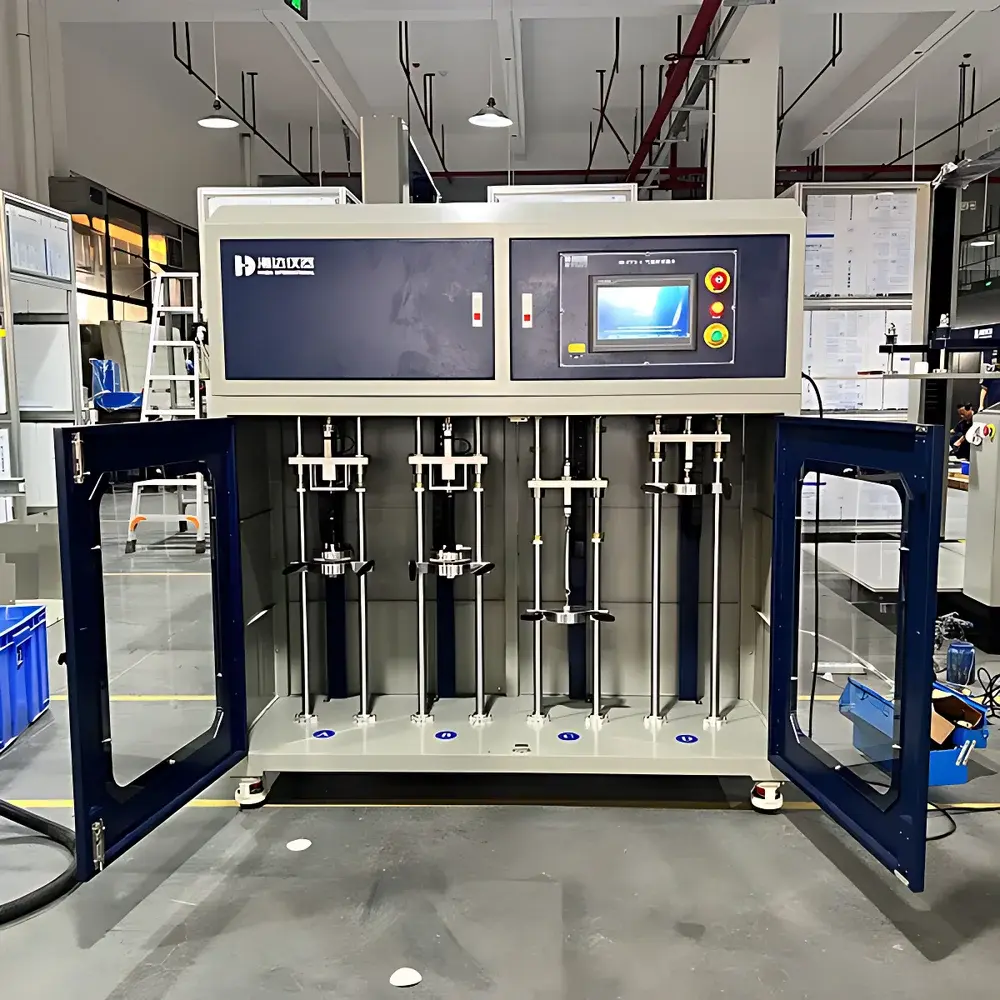
HAIDA HD-F773-4 Pneumatic Gas Spring Fatigue Testing Machine
| Brand | HAIDA INTERNATIONAL |
|---|---|
| Origin | Guangdong, China |
| Manufacturer Type | Direct Manufacturer |
| Model | HAIDA HD-F773-4 Pneumatic Gas Spring Fatigue Testing Machine |
| Max Test Force | 2 kN × 4 |
| Stroke (Pneumatic Cylinder) | 150 mm |
| Fatigue Test Frequency | 1–20 cycles/min |
| Test Positions | 2 for gas springs, 2 for tension/compression springs |
| Force Range | 50 N–1.7 kN |
| Cycle Count Setting Range | 1–999,999 |
| Control System | PLC + Touchscreen HMI |
| Data Output | USB interface |
| Power Supply | 1Ø AC 220 V, 500 W |
| Air Supply | 0.6 MPa |
| Dimensions (L×W×H) | 1500 × 540 × 1600 mm |
| Weight | ~400 kg |
| Max Specimen Size (Compression) | L500 × Ø30 × 100 mm |
Overview
The HAIDA HD-F773-4 Pneumatic Gas Spring Fatigue Testing Machine is an industrial-grade, multi-station electromechanical testing system engineered for high-reliability fatigue evaluation of pneumatic lift cylinders (gas springs), compression springs, and extension springs used in ergonomic seating systems—including office chairs, gaming chairs, and commercial seating assemblies. It operates on a closed-loop pneumatic actuation principle: precisely regulated compressed air drives dual synchronized cylinders to replicate real-world extension/retraction motion profiles, while integrated load cells continuously monitor force response throughout each cycle. The system is designed to execute standardized or customer-defined fatigue protocols up to 999,999 cycles, with programmable frequency (1–20 cycles/min), dwell timing, and stroke limits. Its architecture complies with fundamental mechanical safety principles per ISO 12100 and supports traceable test execution under GLP-aligned laboratory practices.
Key Features
- Quad-channel force capacity: Four independent 2 kN load channels—two dedicated to gas spring fatigue, two configurable for spring tensile/compressive fatigue—enabling concurrent parallel testing without cross-interference.
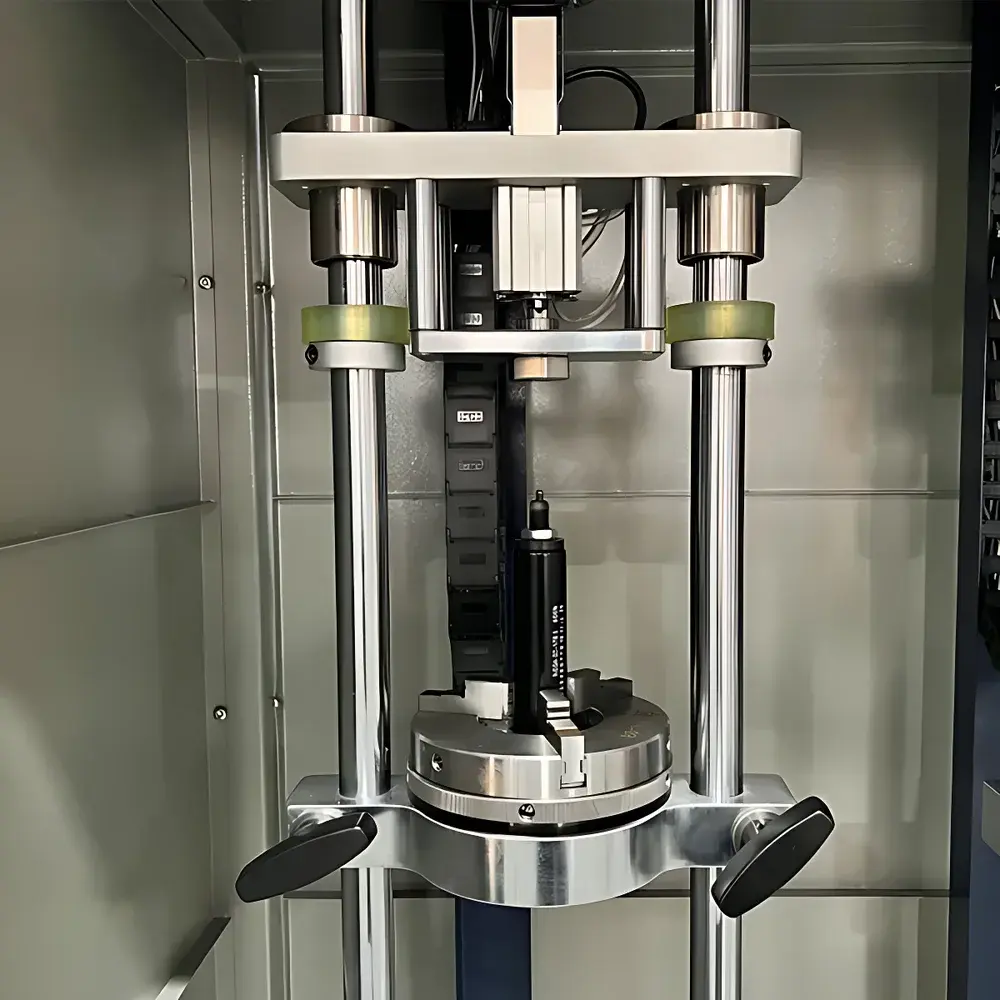
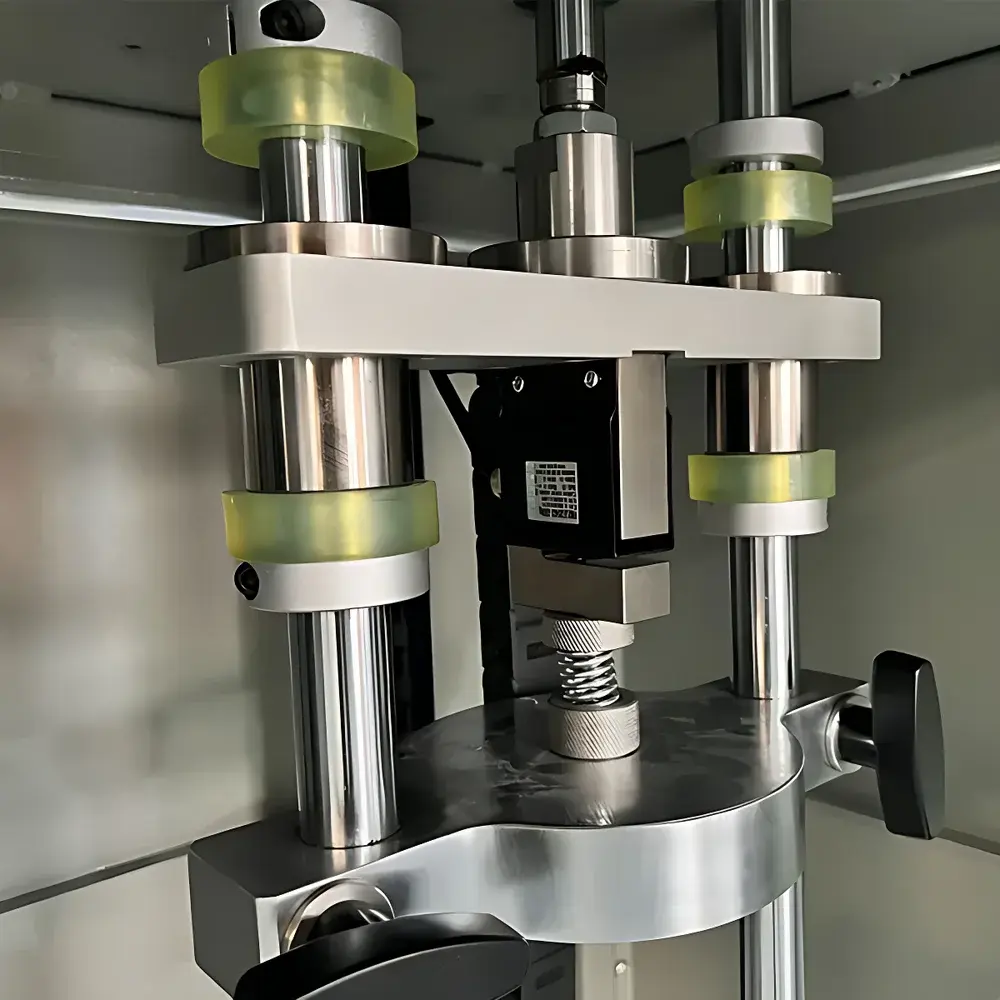
- Dual-axis pneumatic actuation: Precision-machined chrome-plated guide rods ensure low-friction, noise-free linear motion; cylinder stroke is fixed at 150 mm with repeatable positioning accuracy within ±0.3 mm.
- Robust mechanical frame: Structural framework constructed from welded square steel tubing and reinforced steel plates, delivering torsional rigidity and long-term dimensional stability under cyclic loading.
- Open-access test platform: Tool-free quick-clamp fixtures allow rapid specimen installation and removal; modular fixture interface supports customization for non-standard geometries (e.g., tapered seat mounts, eccentric rod ends).
- PLC-based control with HMI: Industrial-grade programmable logic controller paired with a 7-inch resistive touchscreen provides intuitive parameter configuration, real-time force/stroke visualization, emergency stop logic, and power-failure memory retention.
- Integrated data integrity safeguards: All test runs generate timestamped session logs; USB export enables CSV-formatted force-cycle datasets compatible with MATLAB, Excel, or LIMS platforms.
Sample Compatibility & Compliance
The HD-F773-4 accommodates cylindrical gas springs with outer diameters up to Ø30 mm and maximum compressed lengths of 100 mm—typical for Class 2 and Class 3 ergonomic chair actuators per EN 1335-1 and BIFMA X5.1. Tension and compression springs with wire diameters ≤5 mm and free lengths ≤500 mm are supported via adjustable end-fixtures. While the instrument does not embed preloaded standards, its programmable cycle count, force thresholding, and dwell logic enable full alignment with ASTM F1917 (Standard Practice for Determining Durability of Office Chairs), ISO 7174-1 (Furniture — Test Methods for Chairs — Part 1: Determination of Strength and Durability), and internal OEM specifications requiring 40,000+ cycles at 8–12 cpm. Optional calibration certificates (traceable to NIM or CNAS-accredited labs) and IQ/OQ documentation packages are available upon request.
Software & Data Management
Test parameters—including cycle count, frequency, upper/lower force limits, dwell time, and pass/fail criteria—are configured directly via the touch HMI. Each test session auto-generates a unique identifier, recording start/stop timestamps, total cycles completed, peak/mean force values per channel, and any fault events (e.g., over-force trip, air pressure drop). Raw force vs. cycle data is stored internally and exportable via USB 2.0 to FAT32-formatted flash drives. No proprietary software installation is required for data review; exported CSV files retain column headers compliant with ISO/IEC 17025 reporting conventions. For regulated environments, optional audit-trail firmware (meeting FDA 21 CFR Part 11 functional equivalence) supports user authentication, electronic signatures, and immutable session logging.
Applications
- Endurance validation of gas springs subjected to thermal preconditioning (e.g., post-thermal soak at −20 °C or +70 °C per ISO 11337).
- Functional life assessment of height-adjustment mechanisms in medical examination chairs and industrial operator seats.
- Comparative fatigue benchmarking between alternative spring materials (e.g., stainless vs. music wire) under identical displacement profiles.
- Root-cause analysis of premature failure modes—such as seal extrusion, nitrogen leakage, or piston rod scoring—via synchronized force decay trending.
- Verification of compliance with Tier-1 automotive seating supplier requirements (e.g., Ford WSS-M99P1111-A, GM GMW15301).
FAQ
What pneumatic supply specifications are required for stable operation?
A clean, dry, oil-free compressed air source delivering 0.6 MPa ±0.05 MPa at minimum 100 L/min flow rate is mandatory. Use of a 3 HP (or larger) refrigerated air dryer and coalescing filter is strongly recommended to prevent cylinder seal degradation.
Can the machine perform static load holding tests in addition to fatigue cycling?
Yes—the PLC control permits programmable dwell phases at any point in the cycle, enabling sustained load application (e.g., 10-minute hold at 1.2 kN) with continuous force monitoring and timeout-triggered safety shutdown.
Is third-party calibration support available for metrological traceability?
HAIDA provides factory calibration reports traceable to China National Institute of Metrology (NIM); for international accreditation, we coordinate with ILAC-MRA signatory labs (e.g., UKAS, DAkkS, A2LA) to deliver on-site or send-in calibration services.
How is specimen misalignment mitigated during high-cycle testing?
Each test station incorporates self-aligning spherical bearing interfaces at both top and bottom fixtures, accommodating angular deviations up to ±1.5° without inducing parasitic bending moments on the gas spring or spring body.
Does the system support remote monitoring or integration with MES/SCADA networks?
Standard configuration includes RS-485 Modbus RTU output for basic status polling; optional Ethernet/IP or OPC UA gateway modules enable real-time force/cycle streaming to enterprise manufacturing systems.



