
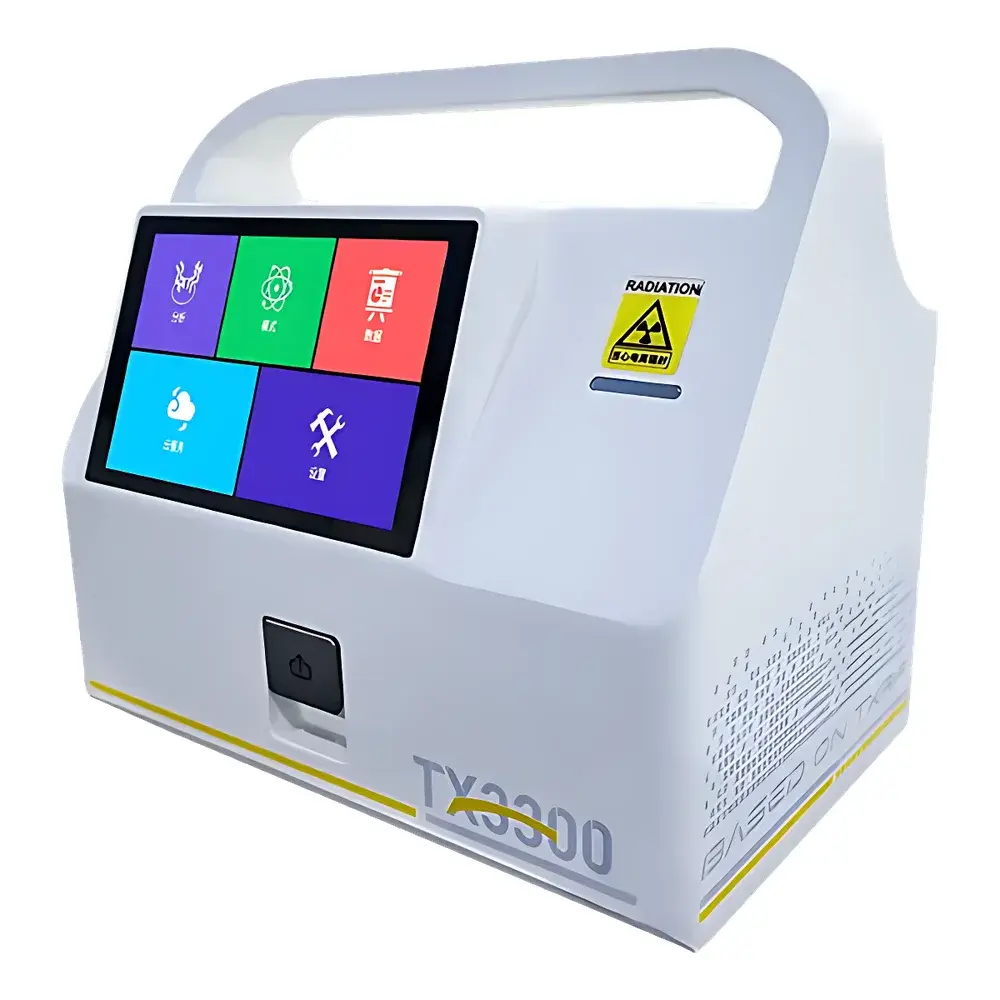
LANScientific TX3300TI Portable Trace Thallium (Tl) Analyzer
| Brand | LANScientific |
|---|---|
| Origin | Jiangsu, China |
| Manufacturer Type | Manufacturer |
| Country of Origin | Domestic (China) |
| Model | TX3300TI |
| Application | Handheld/Portable |
| Instrument Type | Total Reflection X-Ray Fluorescence (TXRF) Spectrometer |
| Industry-Specific Use | Energy & Chemical Engineering |
| Detection Limit | Sub-ppb (ng/L) for Thallium |
| Sample Volume | Microliter-scale (μL) |
| Analysis Time | ≤2 min per sample (no digestion, no calibration required) |
| Optical Design | High-efficiency TXRF geometry with ultra-low background |
| Compliance Support | Designed for ASTM D8139, ISO 17294-2, and China’s HJ 657–2013 |
Overview
The LANScientific TX3300TI Portable Trace Thallium (Tl) Analyzer is a purpose-built, field-deployable total reflection X-ray fluorescence (TXRF) spectrometer engineered for rapid, reliable quantification of thallium at sub-part-per-trillion (ng/L) concentrations in aqueous, leachate, and digested environmental matrices. Unlike conventional energy-dispersive XRF (EDXRF) systems, the TX3300TI employs a monochromatic, low-angle incident beam geometry—where the X-ray beam strikes the quartz carrier at an angle below the critical angle for total external reflection—resulting in near-zero background scattering from the substrate. This physical configuration suppresses matrix-induced continuum radiation and dramatically enhances signal-to-noise ratio (SNR), enabling direct analysis of trace Tl without chemical preconcentration or spectral deconvolution. The instrument operates on fundamental parameter-based quantification, eliminating dependence on matrix-matched standards while maintaining accuracy across heterogeneous samples such as high-salinity industrial effluents, soil pore water extracts, and groundwater filtrates.
Key Features
- Sub-ppb (ng/L) detection limit for thallium—validated per EPA Method 6020B equivalent protocols using certified reference materials (CRMs) including NIST SRM 1643f and ERM-CA713.
- Micro-volume analysis: Requires only 1–5 μL of liquid sample deposited onto a polished quartz reflector; no acid digestion, no derivatization, no carrier gas or vacuum pump.
- Real-time analysis: Full spectral acquisition and quantitative reporting completed within 120 seconds—ideal for time-critical field response during environmental incidents.
- Integrated TXRF optics: Patented collimated Mo-target X-ray source (50 kV, 1 mA), Peltier-cooled silicon drift detector (SDD) with <135 eV Mn Kα resolution, and motorized precision goniometer for automated angle optimization.
- Ruggedized handheld form factor: Weighs <1.8 kg; IP54-rated enclosure; operable at –10 °C to +50 °C ambient; battery life ≥6 hours (Li-ion, hot-swappable).
- Onboard data integrity: Automatic timestamping, operator ID logging, and audit trail generation compliant with FDA 21 CFR Part 11 requirements when paired with optional LANScientific SecureLink software.
Sample Compatibility & Compliance
The TX3300TI accepts clarified aqueous samples—including raw wastewater, acid-leached soil extracts (per TCLP or SPLP protocols), drinking water, and biological fluid supernatants—without filtration beyond 0.45 µm membrane. It is validated for use with standard regulatory matrices defined in China’s HJ 657–2013 (Determination of Metals in Ambient Air Particulates by TXRF), ASTM D8139–22 (Standard Test Method for Determination of Trace Elements in Water by TXRF), and ISO 17294-2:2016 (Water Quality — Inductively Coupled Plasma Mass Spectrometry — Part 2: Determination of Selected Elements). While not a replacement for laboratory ICP-MS in ultra-trace certification, the TX3300TI meets screening-level compliance thresholds for China’s “14th Five-Year Plan” Heavy Metal Pollution Control Program, where discharge limits for Tl in new industrial effluents are set at 0.005 mg/L (5 µg/L)—a concentration readily resolved with ≤5% RSD across triplicate field measurements.
Software & Data Management
Pre-installed LANScientific TXRF Suite v3.2 provides intuitive touchscreen control via a 7-inch capacitive display with glove-compatible interface. Quantitative algorithms apply fundamental parameter (FP) correction for absorption and enhancement effects, referencing internal Rh Kα scatter peak for automatic intensity normalization. All spectra and results are stored in encrypted SQLite databases with SHA-256 hashing; export options include CSV, PDF reports (with embedded spectral plots), and XML formatted for LIMS integration. Optional cloud synchronization enables secure remote review via TLS 1.3–secured API endpoints, supporting multi-site QA/QC oversight and centralized method validation tracking. Audit logs record every instrument state change, spectrum acquisition, and user action—retained for ≥36 months unless purged under documented retention policy.
Applications
- Industrial Effluent Monitoring: Real-time verification of Tl removal efficiency in activated carbon, ion exchange, or coagulation-flocculation units across lead-zinc smelters, sulfuric acid plants, and phosphate fertilizer facilities.
- Emergency Response: Rapid deployment to spill sites or pipeline breaches to map plume extent within minutes—not hours—supporting dynamic decision-making for containment and remediation prioritization.
- Drinking Water Surveillance: On-site verification of Tl levels in distribution systems, wells, and bottled water production lines, aligning with WHO provisional guideline value (0.001 mg/L) and China’s GB 5749–2022 standard.
- Soil & Agricultural Screening: Direct analysis of CaCl₂ or EDTA-extractable Tl fractions from farmland and orchard soils to assess bioavailability risk and inform phytoremediation strategies.
- Epidemiological Field Studies: Quantification of urinary or serum Tl in population health surveys, leveraging microsample compatibility to minimize invasiveness and logistical burden.
FAQ
Does the TX3300TI require daily calibration with standards?
No. The instrument uses internal Rh Kα scatter peak normalization and FP-based quantification, eliminating routine standardization. A single annual performance verification using NIST SRM 1643f is recommended for QA/QC documentation.
Can it analyze solid powders directly?
Not without preparation. Solid samples must be homogenized and extracted into aqueous phase using standardized leaching protocols (e.g., HJ/T 299–2007) prior to deposition.
Is spectral interference from lead (Pb) or mercury (Hg) corrected automatically?
Yes. The software applies iterative peak deconvolution using Gaussian-Lorentzian mixed functions and accounts for Pb M-lines overlapping Tl L-lines via theoretical line intensity ratios derived from WinXray database.
What maintenance is required in field operation?
Routine cleaning of quartz carriers with ultrapure water and lint-free wipes; annual SDD detector energy calibration and X-ray tube output verification by authorized service technician.
Is remote firmware update supported?
Yes—via Wi-Fi or USB-C connection using signed binary packages authenticated through public-key infrastructure (PKI) to ensure integrity and prevent unauthorized modification.
Related Products





