
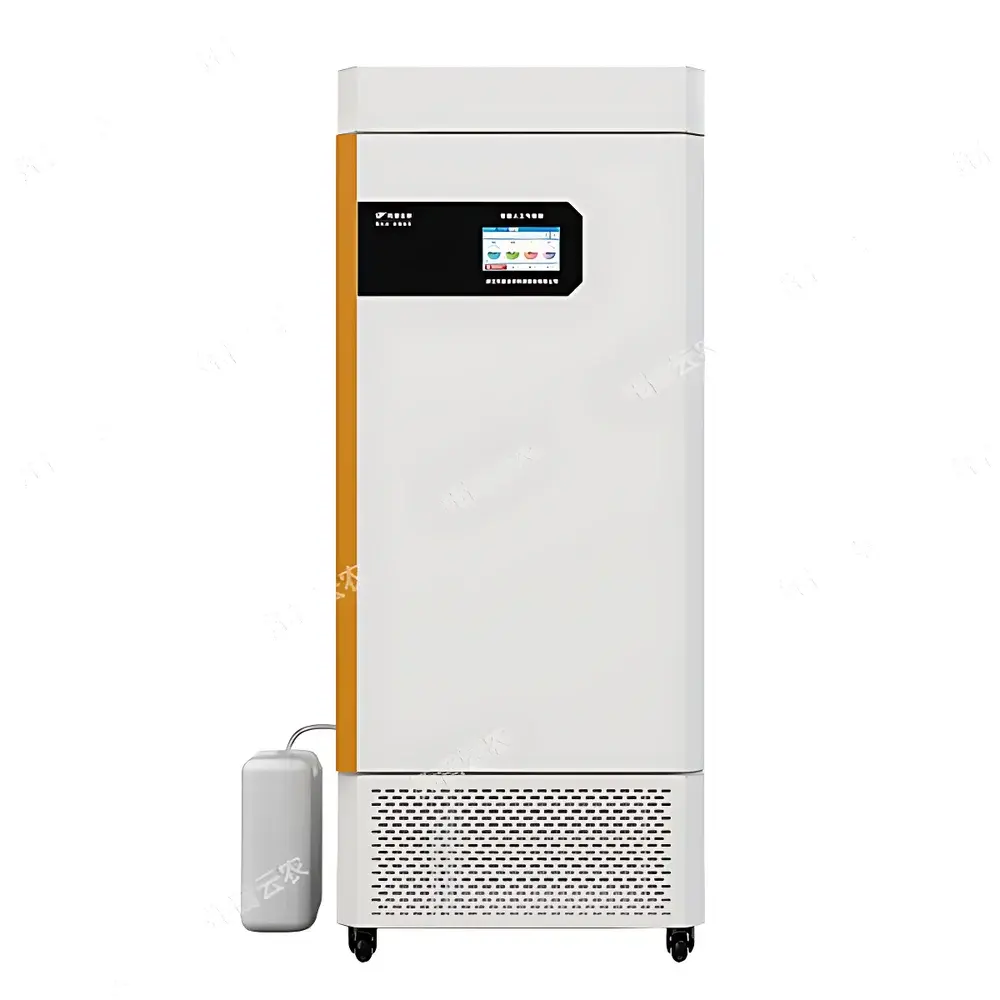
TopCloud-agri TP-R-Y High-Throughput Plant Environmental Regulation & Live Imaging Platform
| Brand | TopCloud-agri |
|---|---|
| Origin | Zhejiang, China |
| Manufacturer Type | OEM/ODM Producer |
| Country of Origin | China |
| Model | TP-R-Y |
| Pricing | Available Upon Request |
| Temperature Range | 0–65 °C (±0.1 °C stability at 25 °C/50% RH) |
| Humidity Range | 50–95% RH (±2% RH stability at 25 °C/50% RH) |
| Illumination | 0–22,000 lx, continuously adjustable (0–100% intensity scale) |
| Airflow Control | 30–100% stepless regulation |
| Imaging Configuration | Dual visible-light imaging modules (top + side mounting) |
| Internal Volume Options | 420 L or 1000 L |
| Power Input | AC 220 V / 50 Hz (10 A or 16 A) |
| Interface Ports | CO₂ inlet ×1, USB ×1, fresh-air inlets ×2, Ethernet ×1 |
Overview
The TopCloud-agri TP-R-Y High-Throughput Plant Environmental Regulation & Live Imaging Platform is an integrated controlled-environment incubation system engineered for longitudinal, non-invasive phenotyping of plant specimens under dynamically programmable abiotic conditions. It operates on a dual-principle architecture: precise environmental regulation via closed-loop feedback control of temperature, relative humidity, photosynthetically active radiation (PAR)-compatible illumination, and laminar airflow—combined with synchronized multi-angle visible-light imaging for time-resolved morphological quantification. Unlike conventional growth chambers or static imaging cabinets, this platform enables concurrent manipulation and observation across hundreds of individual samples—supporting experimental designs aligned with FAO crop resilience protocols, OECD plant biotechnology guidelines, and ISO 17025-compliant laboratory workflows. Its modular chamber design accommodates standardized growth vessels (e.g., Petri dishes, Magenta boxes, hydroponic trays), while its structural integrity meets IEC 61000-6-3 EMC emission standards and UL 61010-1 safety requirements for laboratory equipment.
Key Features
- Precision climate control: Temperature regulated from 0 °C to 65 °C with ±0.1 °C stability (measured at 25 °C/50% RH reference point); humidity maintained between 50–95% RH with ±2% RH repeatability; illumination calibrated up to 22,000 lx using spectrally balanced white LED arrays.
- Dual-axis visible-light imaging: Two synchronized CMOS imaging units mounted orthogonally (top-down and lateral) capture high-resolution (≥2048 × 1536 px) images at user-defined intervals. All image metadata—including timestamp, environmental setpoints, and hardware status—are embedded in EXIF headers.
- Automated germination analysis: Proprietary computer vision algorithms classify seed morphology, detect radicle emergence, and compute germination rate metrics (T50, GR50, uniformity index) per container without manual annotation.
- Intuitive human-machine interface: 10-inch capacitive touchscreen (1024 × 600 resolution) provides real-time visualization of environmental trajectories, program progress, and alarm logs. Supports up to 30 independent experiment protocols, each configurable with up to 99 segments and infinite cycling.
- Thermal and mechanical robustness: Double-wall construction with cyclopentane-blown polyurethane insulation (R-value ≈ 3.2 m²·K/W); interior chamber lined with electropolished 304 stainless steel with radius ≥15 mm corners; 6-mm tempered glass inner door enables observation without thermal perturbation.
- Uniform air distribution: Back-mounted perforated diffuser grid coupled with variable-speed axial fans ensures horizontal airflow homogeneity (±0.5 °C / ±1.5% RH deviation across working volume per ASTM E145-22 Annex A4 validation).
Sample Compatibility & Compliance
The TP-R-Y platform accommodates standard plant science sample formats including agar plates (90–150 mm), multi-well culture trays (6–96-well), tissue culture vessels (e.g., Magenta GA-7 boxes), hydroponic rafts, and small potted seedlings (up to 30 cm height). Its internal dimensions (635 × 560 × 1165 mm for TP-R420D-Y; 1415 × 560 × 1165 mm for TP-R1000D-Y) allow flexible rack configurations. The system complies with GLP documentation requirements through built-in audit trail functionality—recording operator ID, parameter changes, alarm events, and firmware version history. All environmental logging data are time-stamped with NTP-synchronized UTC clocks and exportable in CSV/JSON formats compatible with LIMS integration. Optional CO₂ inlet supports atmospheric modulation experiments per ISO 16221-2:2021 for controlled atmosphere studies.
Software & Data Management
Embedded firmware implements role-based access control (RBAC) with three privilege tiers: Operator, Supervisor, and Administrator. Each session generates a unique experiment identifier encoded as a scannable QR code, linked to encrypted local storage (≥32 GB eMMC). Data export options include direct USB mass-storage transfer and secure HTTPS upload to a browser-accessible web dashboard (HTTPS/TLS 1.2+). Remote monitoring is supported via RESTful API endpoints compliant with OpenAPI 3.0 specifications, enabling integration with Python-based analysis pipelines (e.g., PlantCV, DeepPlant). Audit logs conform to FDA 21 CFR Part 11 electronic record requirements, including digital signature support for critical parameter locks and electronic signatures for protocol approvals. Over-the-air (OTA) firmware updates preserve configuration integrity during deployment.
Applications
- Quantitative phenotyping of mutant libraries under stress gradients (drought, heat, light quality shifts)
- High-resolution germination kinetics assays for seed quality certification (ISTA Rule 5B)
- Time-lapse morphometric analysis of root architecture in response to nutrient gradients
- Non-destructive assessment of chlorophyll fluorescence proxies via RGB-derived vegetation indices (e.g., GNDVI, ExG)
- Standardized insect rearing under photoperiod-controlled conditions (e.g., Drosophila circadian entrainment)
- Pre-clinical botanical drug stability testing per ICH Q1A(R2) guidelines
- Microbial co-culture dynamics under defined abiotic parameters (e.g., rhizosphere simulation)
FAQ
Does the system support spectral customization of illumination beyond white light?
No—the current TP-R-Y series uses fixed-spectrum warm-white LEDs optimized for broad PAR coverage (400–700 nm). Spectral tuning modules are available as optional add-ons under the TP-G-Y variant line.
Can imaging data be exported in raw Bayer format for custom processing?
Yes—raw sensor frames (12-bit linear output) are accessible via USB host mode or network share when enabled by administrator credentials.
Is remote access limited to Wi-Fi, or does it support cellular/LTE fallback?
Ethernet connection is required for primary remote operation. Optional 4G LTE dongle support (USB-based) is available upon request for off-grid deployments.
How is calibration traceability maintained for temperature and humidity sensors?
Each unit ships with factory calibration certificates traceable to NIM (China National Institute of Metrology). On-site recalibration kits and procedures comply with JJF 1101-2019 environmental test chamber verification standards.
Are third-party LIMS integrations supported out-of-the-box?
Yes—preconfigured HL7 and ASTM E1384-compliant message templates are included. Custom middleware development assistance is provided under TopCloud-agri’s Professional Services agreement.




