
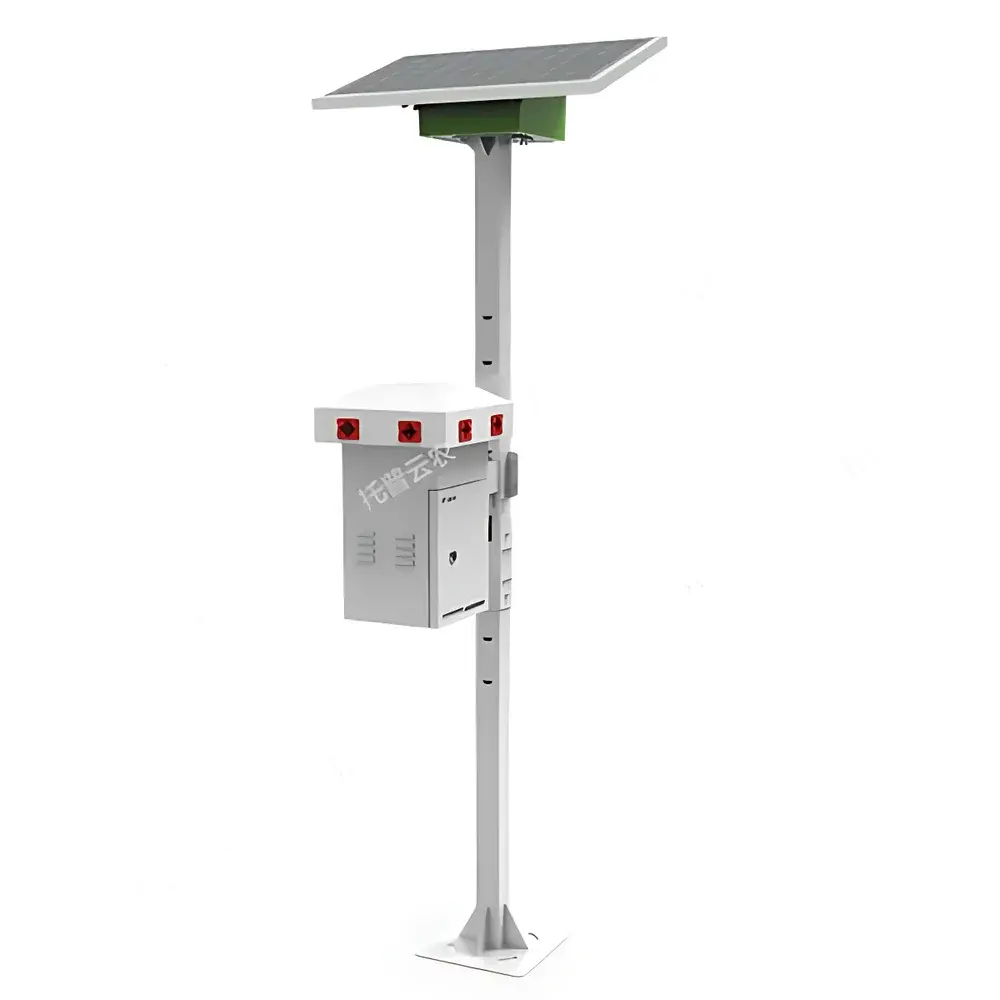
Top Cloud-agri TPSC6 PLUS Intelligent Pheromone-Based Pest Monitoring and Forecasting System
| Brand | Top Cloud-agri |
|---|---|
| Origin | Zhejiang, China |
| Manufacturer Type | Direct Manufacturer |
| Country of Origin | China |
| Model | TPSC6 PLUS |
| Instrument Category | Pest Surveillance System |
| Power Supply | 12 V DC (4 W Solar Panel) |
| Rated Power | ≤5 W |
| Standby Power | ≤0.3 W |
| Target Pest Size Range | 3–18 mm |
| Trap Inlet Height Above Ground | Adjustable from 0.8–1.6 m |
| Data Transmission Intervals | Configurable (0.5 h, 1 h, 2 h, or 24 h) |
| Counting Accuracy | >90% |
| Operating Temperature Protection | Auto-standby below 5°C |
| GPS Integration | Built-in for geolocation and anti-theft tracking |
| Lightning Protection | Integrated surge protection circuitry |
Overview
The Top Cloud-agri TPSC6 PLUS Intelligent Pheromone-Based Pest Monitoring and Forecasting System is an integrated field-deployable instrument engineered for automated, real-time surveillance of lepidopteran and coleopteran pest populations in agricultural, forestry, and stored-grain ecosystems. It operates on the principle of species-specific pheromone attraction—utilizing synthetic sex pheromones to lure adult male insects into a monitored capture zone—followed by optical imaging and edge-based image recognition for taxonomic identification and enumeration. Unlike passive trapping methods, the TPSC6 PLUS incorporates active environmental sensing (temperature, photoperiod), adaptive power management, and bidirectional wireless telemetry to support long-term unattended operation in remote agro-ecological zones. Its design aligns with FAO-recommended integrated pest management (IPM) frameworks and supports early-warning decision-making in accordance with national phytosanitary protocols.
Key Features
- Pheromone-Driven Target Specificity: Interchangeable lure cartridges enable selective monitoring across multiple pest species—including Spodoptera frugiperda, Helicoverpa armigera, Lymantria dispar, and Tribolium castaneum—without hardware modification.
- Multi-Angle Capture Architecture: Dual-entry trap geometry (lateral and basal inlets) increases interception probability across diverse flight behaviors and microclimatic conditions.
- Adaptive Operational Modes: Three configurable duty cycles—photocell-triggered (night-only high-voltage grid activation), time-scheduled (user-defined ON/OFF windows), and ultra-low-power hibernation mode—optimize energy use under variable solar insolation.
- Environmental Resilience: Embedded thermal management suspends operation below 5°C and resumes automatically upon ambient temperature recovery above 12°C, preventing condensation-related sensor drift and mechanical failure.
- Geospatial Integrity: Integrated GPS module provides precise device location metadata for GIS-layered pest density mapping and enables tamper alerts via geofence violation detection.
- Lightning & Surge Hardening: Industrial-grade transient voltage suppression (TVS) diodes and grounded chassis design meet IEC 61000-4-5 Level 3 immunity requirements for outdoor deployment in thunderstorm-prone regions.
Sample Compatibility & Compliance
The TPSC6 PLUS is validated for use with commercially available EAG- or GC-MS-verified pheromone lures conforming to ISO 8587:2021 (Sensory analysis — Methodology — General guidance for selection, training and monitoring of assessors) standards for volatile compound stability. Its capture efficacy has been verified against target pests ranging from 3 mm (e.g., Plutella xylostella) to 18 mm (e.g., Anoplophora glabripennis) body length under field trials conducted per GB/T 24689.1–2021 (Pest monitoring equipment — Technical requirements for insect traps). The system supports regulatory reporting formats aligned with China’s National Agricultural Biosafety Monitoring System (NABMS) and is compatible with international pest data exchange schemas including EPPO QR Code standards and FAO’s ePhyto platform.
Software & Data Management
Data acquisition, processing, and visualization are managed through the proprietary Top Cloud-agri AgriSense™ cloud platform (v4.2+), accessible via web browser or native iOS/Android applications. All image captures, timestamped count logs, GPS coordinates, and environmental metadata are encrypted (AES-256) during transmission using TLS 1.3. Audit trails comply with GLP principles: every configuration change, firmware update, or manual override is logged with user ID, timestamp, and IP address. Role-based access control (RBAC) supports multi-tier permissions for field technicians, agronomists, and regulatory reviewers. Raw image archives are retained for ≥18 months to support retrospective validation—a requirement under China’s Crop Protection Regulation (Ministry of Agriculture Decree No. 22, 2023).
Applications
- Regional-scale pest phenology mapping for provincial plant protection stations
- Pre-harvest risk assessment in high-value orchards and vegetable greenhouses
- Post-harvest infestation monitoring in grain silos and seed storage facilities
- Border quarantine surveillance at ports and transshipment hubs
- Longitudinal resistance monitoring via temporal correlation of trap catch density with pesticide application records
- Validation of biological control agent release timing using pheromone-trap-derived population thresholds
FAQ
What communication protocols does the TPSC6 PLUS support for data transmission?
It uses NB-IoT and LTE-M cellular modules (with fallback to 2G where required), supporting MQTT over TLS for secure, low-bandwidth telemetry in rural coverage zones.
Can the system operate without cellular connectivity?
Yes—local data is buffered on-board (8 GB eMMC) for up to 90 days and automatically syncs when network connectivity resumes.
Is firmware upgrade supported remotely?
Yes, over-the-air (OTA) updates are signed and verified using ECDSA-P256 cryptographic signatures to prevent unauthorized code injection.
How is counting accuracy validated in mixed-species environments?
Validation is performed using ground-truth calibration sets of pinned voucher specimens imaged under identical lighting and focal conditions; classification confidence thresholds are adjustable per taxon.
Does the system meet international export certification requirements?
It carries CE marking (EN 62368-1, EN 61000-6-2/6-4), RoHS 2011/65/EU compliance, and has undergone third-party EMC testing per CISPR 32:2015.
Related Products





