Top Cloud-agri TPKZ-3-L Smart Seed Phenotyping & Counting System
| Brand | Top Cloud-agri |
|---|---|
| Origin | Zhejiang, China |
| Manufacturer Type | Direct Manufacturer |
| Product Category | Domestic |
| Model | TPKZ-3-L |
| Instrument Type | Benchtop |
| Sample Types | Maize, Soybean, Rice, Wheat, Rapeseed, and other cereal and legume seeds |
| Measurable Parameters | Grain count, thousand-grain weight (TGW), hundred-grain weight (HGW), length, width, length-to-width ratio, area, equivalent diameter, perimeter, color distribution, standard deviation of morphometric parameters |
| Counting Speed | 1,200–20,000 grains/min (species-dependent |
| maize | 1,500–3,000 grains/min) |
| TGW Accuracy | ≤ ±0.3% (typical), ≤ ±0.5% (max under specified calibration conditions) |
| Weighing Range | 0–5 kg |
| Weight Display | Integrated 2.1″ OLED screen on weighing platform |
| Imaging Resolution | 22 MP (4896 × 3672), A3-format backlit imaging station with auto-calibrating transparent seed tray, dual illumination (ambient + high-CRI LED backlight) |
| Software Features | Deep learning–enabled classification (shape/color), manual correction tools (split/merge), ROI-based counting, image zoom/pan, Excel export, cloud data synchronization, dynamic QR + hardware dongle encryption, optional barcode scanner integration |
Overview
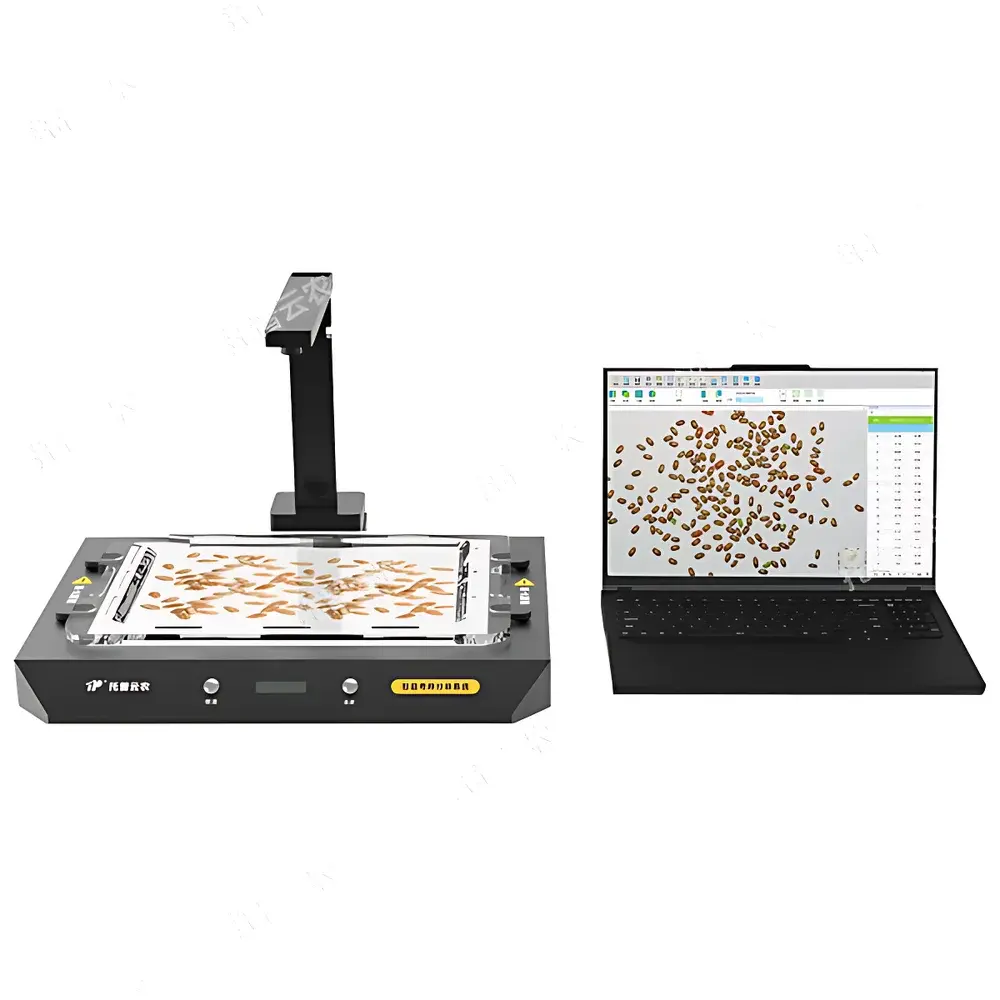
The Top Cloud-agri TPKZ-3-L Smart Seed Phenotyping & Counting System is a benchtop, integrated optical–gravimetric instrument engineered for high-throughput, standardized seed quality assessment in agricultural research, breeding programs, and seed certification laboratories. It operates on a dual-modality principle: high-resolution digital imaging combined with precision mass measurement—enabling simultaneous acquisition of morphometric, volumetric, and gravimetric seed traits without physical sample partitioning. Unlike conventional grain analyzers relying solely on sieving or single-sensor weight estimation, the TPKZ-3-L captures full-field top-down images under controlled backlighting while concurrently recording total sample mass via an embedded load cell. This synchronized acquisition allows deterministic calculation of per-grain metrics—including length, width, aspect ratio, projected area, perimeter, and equivalent diameter—as well as population-level statistics (mean, standard deviation, coefficient of variation) and regulatory-grade weight-derived indices such as thousand-grain weight (TGW) and hundred-grain weight (HGW). The system complies with foundational methodological expectations outlined in ISO 5725 (accuracy and precision of measurement methods), ISTA Rules (International Seed Testing Association), and GB/T 3543.3–1995 (Chinese national standard for seed purity and germination testing), supporting traceable, auditable seed evaluation workflows.
Key Features
- Integrated Optical–Gravimetric Architecture: Co-aligned high-resolution imaging (22 MP, 4896 × 3672) and 0–5 kg precision weighing module within a single A3-format stage—eliminating inter-device alignment drift and enabling real-time mass–morphology correlation.
- Auto-Calibrating Illumination System: Ultra-thin, uniform LED backlight panel with CRI >90 and ambient light compensation; paired with an optically transparent, self-referencing seed tray that suppresses shadow artifacts and enables pixel-accurate segmentation.
- Real-Time Visual Feedback Loop: Dedicated 2.1″ OLED display on the weighing platform provides immediate mass readout during sample loading—allowing operators to adjust grain quantity pre-analysis to meet target TGW replication requirements (e.g., ≥1,000 grains).
- Deep Learning–Driven Classification Engine: Trained on multi-species seed libraries (maize, soybean, rice, wheat, rapeseed); supports supervised retraining for novel genotypes or abnormally shaped mutants using user-annotated image sets.
- Interactive Image Correction Suite: Pixel-level manual intervention tools—including region-of-interest (ROI) selection, seed splitting (for adhered grains), and merging (for fragmented kernels)—ensuring analytical validity prior to report generation.
- Modular Data Export & Integration: Native Excel (.xlsx) export with columnar metadata (sample ID, timestamp, operator, instrument serial); supports CSV batch ingestion into LIMS environments; optional barcode scanner integration for GLP-compliant sample tracking.
Sample Compatibility & Compliance
The TPKZ-3-L is validated for intact, dry, non-cohesive seeds with nominal dimensions between 2 mm (e.g., mustard) and 15 mm (e.g., large maize kernels). It accommodates heterogeneous mixtures (e.g., F₂ breeding populations) and supports species-specific parameter thresholds (e.g., minimum area filters to exclude chaff or broken fragments). All measurements adhere to the repeatability criteria defined in ISTA Rule 5.3 (seed counting) and ISO 6637 (thousand-kernel weight determination). The system’s software architecture supports audit trails compliant with GLP (Good Laboratory Practice) and GMP (Good Manufacturing Practice) documentation requirements—including user login logs, analysis history timestamps, and immutable raw image archiving. While not FDA 21 CFR Part 11–certified out-of-the-box, its encryption framework (dynamic QR code + hardware dongle) and export integrity checks enable validation pathways for regulated seed certification labs.
Software & Data Management
The proprietary SeedPheno™ v4.x software suite provides a unified interface for acquisition, processing, visualization, and reporting. Image preprocessing includes adaptive thresholding, noise suppression, and edge enhancement optimized for low-contrast seed boundaries. Morphometric outputs are computed using sub-pixel centroid detection and convex hull algorithms per grain. Statistical summaries include confidence intervals for mean TGW (based on t-distribution for n < 30 replicates) and color histogram quantification (CIELAB space). Data persistence options include local encrypted SQLite storage, network-mapped drive backup, and optional secure HTTPS upload to Top Cloud-agri’s agro-cloud platform (TLS 1.3 encrypted, role-based access control). All exported reports contain embedded instrument metadata (model, firmware version, calibration date) and comply with FAO’s Minimum Data Standards for Seed Health Monitoring.
Applications
- Quantitative trait locus (QTL) mapping studies requiring high-fidelity seed size/weight phenotyping across recombinant inbred lines (RILs).
- Seed lot release testing in certified seed production—verifying compliance with national TGW thresholds (e.g., ≥250 g for elite maize hybrids).
- Post-harvest quality monitoring in grain elevators and cooperatives—tracking varietal drift or mechanical damage-induced shape variance.
- Phenotypic screening of gene-edited lines (e.g., CRISPR-Cas9 knockouts affecting starch biosynthesis or cell expansion).
- Teaching laboratories demonstrating seed morphology–physiology relationships in plant science curricula.
FAQ
What calibration standards are required for TGW accuracy verification?
Traceable stainless-steel test weights (Class M2, ±0.05% tolerance) and certified reference seed lots (e.g., ISTA-certified maize TGW standards) are recommended for quarterly verification.
Can the system analyze seeds with surface moisture or dust contamination?
Optimal performance requires seeds at equilibrium moisture content (≤13% wb) and free of adherent debris; excessive dust may impair segmentation accuracy and necessitate pre-cleaning.
Is remote software update supported?
Yes—firmware and application updates are delivered via secure OTA (over-the-air) channels through the agro-cloud portal, with version rollback capability.
How is data integrity ensured during power interruption?
The system implements atomic write operations and journaling file I/O; unsaved image buffers are retained in non-volatile RAM until graceful shutdown or recovery.
Does the software support multi-language UI (e.g., Spanish, French)?
English and Simplified Chinese interfaces are included; additional language packs can be deployed via custom configuration files upon request.