
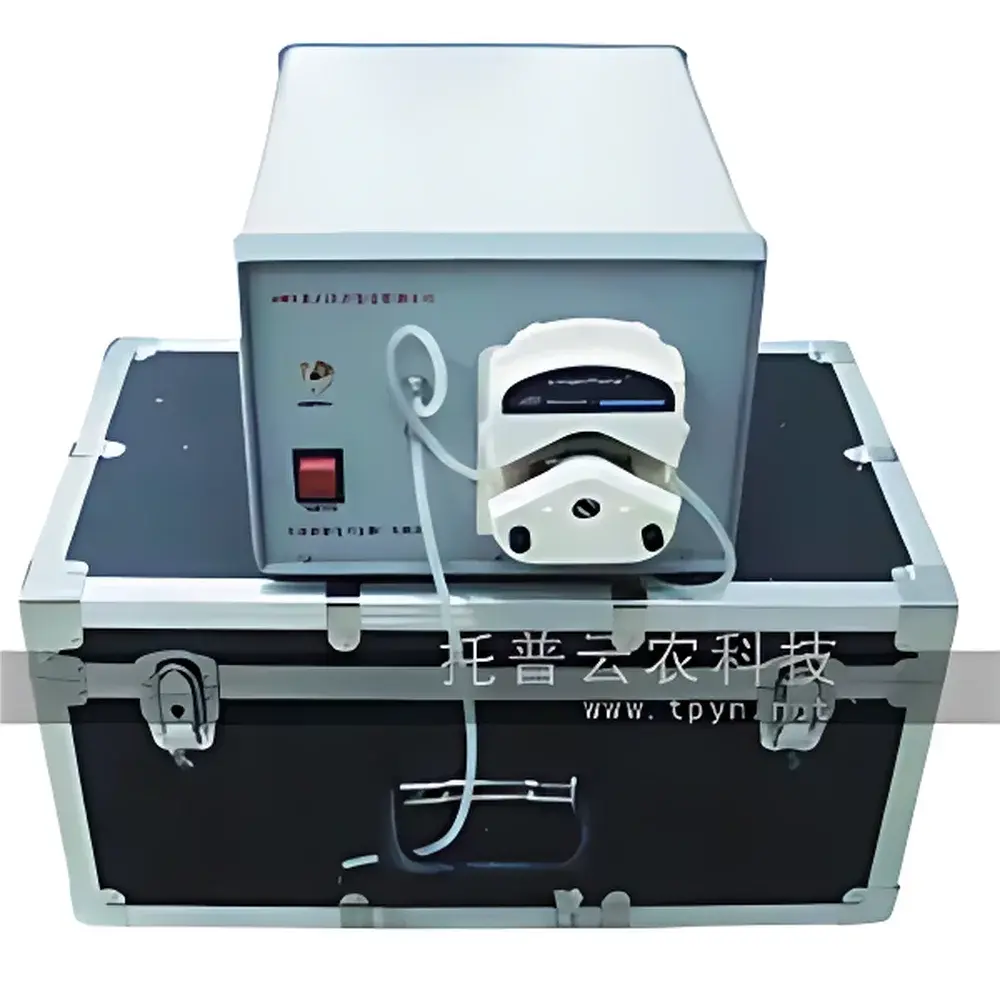
Top Cloud-agri DPCZ-II Amylose Content Analyzer
| Brand | Top Cloud-agri |
|---|---|
| Origin | Zhejiang, China |
| Manufacturer Type | Direct Manufacturer |
| Country of Origin | China |
| Model | DPCZ-II |
| Detection Wavelength | 650 nm |
| Measurement Accuracy | ±0.001 (absorbance unit) |
| Sample Types | Rice, Corn, Wheat, and other cereal grains |
| Measurement Time | ~60 seconds per sample |
| Operating Temperature Range | 20–30 °C |
| Power Supply | 220 ±1 V AC |
| Software Platform | Windows-based proprietary control software |
| Compliance | Designed for routine QC in food-grade laboratories compliant with GB/T 15683-2008 (Chinese national standard for amylose determination in rice) |
Overview
The Top Cloud-agri DPCZ-II Amylose Content Analyzer is a dedicated photometric instrument engineered for the quantitative determination of amylose concentration in milled cereal grains—including rice, maize (corn), and wheat—using the iodine colorimetric method. It operates on the principle that amylose forms a stable blue-colored complex with iodine, the absorbance intensity of which at 650 nm correlates linearly with amylose concentration within defined calibration ranges. This method is standardized in multiple national and regional food quality specifications, including GB/T 15683-2008 for rice and AOAC Official Method 978.14 (modified) for cereal starch composition. The DPCZ-II integrates optical path stabilization, temperature-controlled cuvette positioning, and digital signal processing to deliver reproducible, operator-independent results suitable for high-throughput grain quality assessment in regulatory, procurement, and production environments.
Key Features
- Optimized optical system featuring a precision 650 nm LED light source and matched photodetector, minimizing spectral drift and ensuring long-term photometric stability.
- Integrated temperature management maintaining ambient sample chamber conditions between 20–30 °C—critical for consistent iodine-amylose complex formation kinetics and absorbance linearity.
- Dedicated Windows-based control software with intuitive GUI, supporting method storage, calibration curve generation (linear or polynomial), and automatic concentration calculation from raw absorbance data.
- Single-button workflow automation: auto-zeroing, sample measurement, data logging, and report export (CSV, PDF) with embedded timestamp and operator ID fields.
- Robust mechanical architecture with anti-vibration base and shielded optical path, reducing environmental interference during rapid (<60 s/sample) sequential analysis.
- Compliance-ready design: audit trail capability (via optional software module), user access levels, and electronic record retention aligned with GLP principles for food quality laboratories.
Sample Compatibility & Compliance
The DPCZ-II accepts homogenized, defatted, and gelatinized cereal flour extracts prepared according to GB/T 15683-2008 or equivalent protocols. Sample volume requirement is 1.0–2.0 mL per test in standard 10 mm pathlength quartz or high-transmission plastic cuvettes. Instrument validation adheres to ISO/IEC 17025:2017 general requirements for competence of testing and calibration laboratories. While not FDA 21 CFR Part 11–certified out-of-the-box, the software architecture supports configuration for electronic signature and audit trail functionality required under GMP-aligned food safety systems (e.g., BRCGS Food Safety Issue 9, FSSC 22000 v5.1). Routine verification includes daily blank calibration and quarterly linearity checks using NIST-traceable amylose reference standards.
Software & Data Management
The proprietary Windows application provides full local control without cloud dependency. Key modules include: (1) Calibration Manager for multi-point standard curve setup with R² monitoring; (2) Sample Batch Processor enabling up to 96 samples per session with auto-sequencing; (3) Data Review Console with outlier detection (Grubbs’ test), trend plotting, and batch statistics (mean, SD, CV%); (4) Export Engine generating ISO-compliant reports containing instrument ID, method version, analyst name, environmental logs, and raw absorbance values. All data files are stored in encrypted SQLite format with SHA-256 hash integrity verification. Backup and restore functions support external USB drives or network shares, satisfying internal document control SOPs.
Applications
- Rice breeding programs: rapid screening of amylose content (typically 0–30% w/w) to classify varieties as waxy, low-, intermediate-, or high-amylose—directly correlating with cooking texture and glycemic index.
- Grain procurement QA: verification of contractual amylose specifications prior to mill intake, reducing rejection rates and supply chain disputes.
- Food product development: optimization of starch functionality in noodles, snacks, and gluten-free formulations where amylose:gellulose ratio governs viscosity, retrogradation, and freeze-thaw stability.
- Regulatory compliance testing: supporting submissions under China’s GB 1354–2018 (milled rice standard) and export documentation for ASEAN, GCC, and African markets requiring amylose certification.
- Educational use in food science curricula: hands-on instruction in spectrophotometric assay development, standardization, and statistical evaluation of analytical precision (repeatability ≤1.2% RSD, n=10).
FAQ
What extraction protocol is required prior to analysis?
Standardized alkaline digestion followed by iodine reagent addition per GB/T 15683-2008; detailed SOPs are included in the instrument manual and validated against reference materials from the China National Institute of Metrology.
Can the DPCZ-II measure amylopectin directly?
No—it quantifies amylose via selective iodine complexation; amylopectin content is inferred by difference (total starch minus amylose) when total starch is measured separately (e.g., AOAC 996.11).
Is method validation support available from the manufacturer?
Yes—Top Cloud-agri provides IQ/OQ documentation templates, performance qualification protocols, and on-site installation qualification services upon request.
How often must the optical system be recalibrated?
Factory calibration is valid for 12 months; users perform daily blank verification and biweekly linearity checks using supplied reference solutions; annual traceable recalibration is recommended.
Does the software support LIMS integration?
Native HL7 and ASTM E1384-compliant ASCII export is supported; custom API integration (RESTful JSON) can be commissioned for enterprise LIMS environments.





