
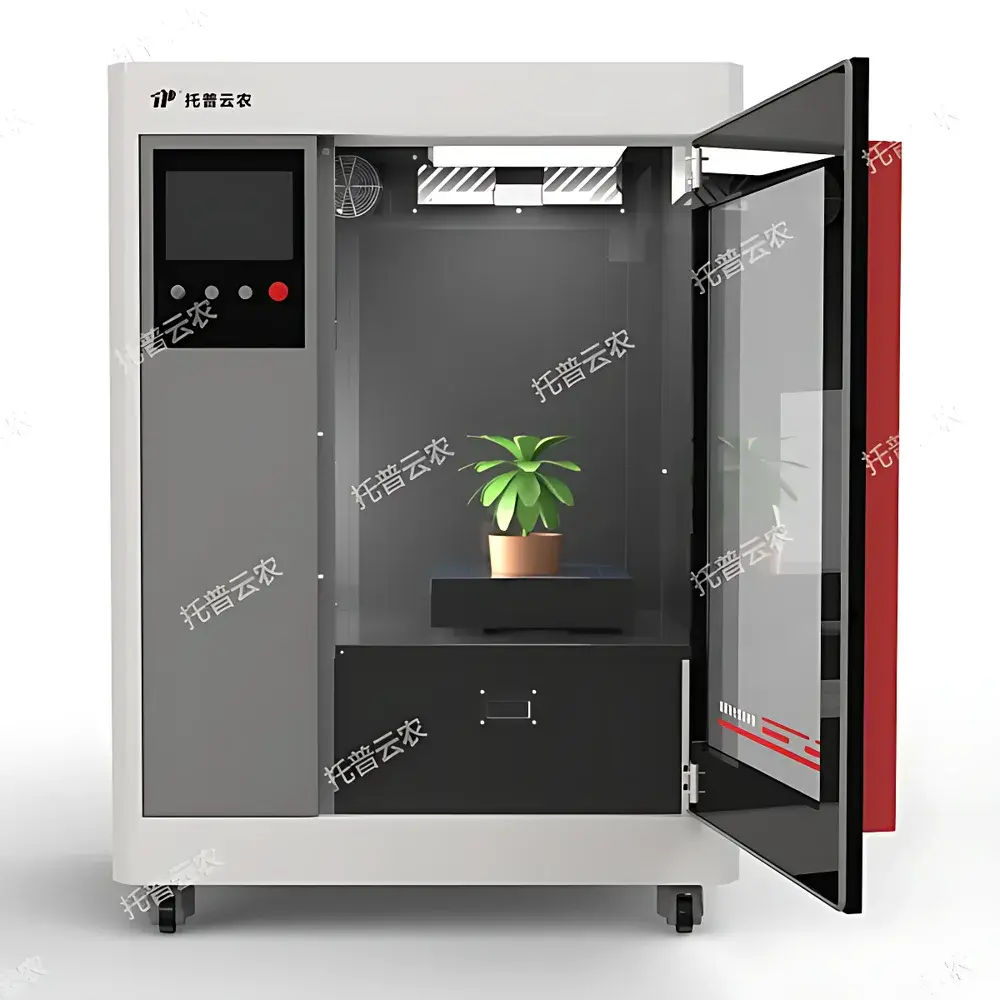
Top Cloud-agri TP-plant-VL2 2D Digital Phenotyping System for Potted Plants
| Brand | Top Cloud-agri |
|---|---|
| Origin | Zhejiang, China |
| Manufacturer Type | Direct Manufacturer |
| Country of Origin | China |
| Model | TP-plant-VL2 |
| Pricing | Available Upon Request |
Overview
The Top Cloud-agri TP-plant-VL2 2D Digital Phenotyping System for Potted Plants is an engineered solution for non-invasive, high-throughput morphological and visual trait quantification in controlled-environment plant science. Designed specifically for potted specimens, the system employs dual-axis visible-light imaging—comprising top-down and side-view acquisition—combined with a motorized 360° rotation stage to capture multi-angle 2D projections of plant architecture. Unlike 3D laser scanning or hyperspectral systems, the TP-plant-VL2 leverages calibrated RGB imaging physics and geometric projection modeling to derive reproducible phenotypic descriptors—including canopy geometry, leaf distribution symmetry, colorimetric indices (e.g., RGB-based chlorophyll proxy), and texture-derived senescence metrics—without physical contact or radiative exposure. Its operational principle centers on pixel-level segmentation, contour analysis, and spatial moment computation applied to registered top/side image pairs, enabling robust estimation of structural parameters under standardized lighting conditions (uniform diffuse LED illumination, CIE D65 spectral approximation). The system is optimized for use in growth chambers, phytotrons, and greenhouse laboratories where rapid, repeatable, and audit-ready phenotyping is required for genetic screening, abiotic/biotic stress response profiling, and developmental time-series analysis.
Key Features
- Dual-axis visible-light imaging: High-resolution industrial cameras (5120 × 5120 pixels) mounted at zenith and lateral positions enable synchronized top-view and side-view acquisition.
- Motorized 360° precision rotation stage: Enables continuous angular sampling and automated pose alignment for consistent multi-view reconstruction.
- Integrated diffuse LED illumination: Uniform, spectrally stable white-light panel ensures minimal shadowing and chromatic consistency across acquisition cycles.
- Real-time touch interface: 10.1-inch full-color capacitive touchscreen supports direct control of lighting intensity, rotation angle, exposure settings, and live preview.
- Barcode-linked sample tracking: QR code scanning binds each potted plant to its metadata (genotype, treatment, timepoint), ensuring traceability throughout experimental workflows.
- Automated processing pipeline: AI-driven software performs background subtraction, plant segmentation, contour extraction, convex hull computation, and morphometric feature derivation—all within ≤10 seconds per plant post-capture.
- Portable modular enclosure: Self-contained cabinet (1400 × 935 × 1840 mm) with casters and internal power conditioning allows deployment in ISO Class 7–8 lab environments without infrastructure modification.
Sample Compatibility & Compliance
The TP-plant-VL2 accommodates standard horticultural pots (diameters 8–25 cm; height ≤45 cm) and supports monocotyledonous (e.g., rice, maize), dicotyledonous (e.g., Arabidopsis, tomato, soybean), and rosette- or upright-growth-form species. Sample handling adheres to GLP-aligned documentation practices: all image acquisitions are timestamped, geotagged (if GPS-enabled lab network), and stored with embedded EXIF metadata including camera model, lens focal length, exposure time, and illumination intensity. Software-generated reports include audit trails compliant with ISO/IEC 17025 requirements for measurement traceability. While not FDA 21 CFR Part 11-certified out-of-the-box, the system supports export of raw images and structured CSV/JSON trait tables compatible with validated LIMS and ELN platforms used in academic and industrial breeding programs.
Software & Data Management
The proprietary TopPheno™ v3.2 software suite provides a unified interface for acquisition scheduling, batch processing, trait visualization, and statistical export. Core modules include: (i) Acquisition Manager for defining multi-timepoint protocols; (ii) Segmentation Engine using U-Net-derived CNN architecture trained on >50k manually annotated plant images; (iii) Morphometrics Dashboard displaying real-time computed traits (e.g., projected area, convexity ratio, eccentricity, green pixel density, edge roughness index); and (iv) Comparative Analytics module supporting ANOVA, PCA, and hierarchical clustering across genotype × treatment matrices. All processed data are saved in FAIR-compliant format: images retain original TIFF-6.0 encoding; trait tables follow MIAPPE 1.1 metadata schema; and session logs record operator ID, instrument calibration status, and environmental sensor readings (optional integration with external temperature/humidity probes). Export options include Excel (.xlsx), HDF5, and PlantCV-compatible JSON.
Applications
This system serves as a primary phenotyping tool in forward and reverse genetics pipelines—enabling rapid identification of morphological mutants from TILLING or CRISPR-Cas9 libraries through quantitative deviation scoring. In stress physiology, it supports longitudinal monitoring of drought-induced wilting kinetics, salt-stress–mediated chlorosis progression, thermal injury thresholds via hue-saturation-value (HSV) trajectory modeling, and pathogen lesion expansion rates following inoculation. It further facilitates QTL mapping studies by generating high-density phenotypic vectors for linkage analysis and supports breeding program decision support through selection index calculation (e.g., combining compactness score with delayed senescence metric). Validated use cases span Arabidopsis thaliana rosette analysis, Solanum lycopersicum fruit-set morphology, Oryza sativa tillering dynamics, and Glycine max nodulation pattern quantification.
FAQ
What plant growth stages can be analyzed?
The system is validated for vegetative stages (cotyledon to pre-flowering) and early reproductive phases (inflorescence emergence), with optimal performance for plants ≤120 cm tall and occupying ≤70% of the imaging field of view.
Is calibration required before each experiment?
A single spatial calibration (using printed checkerboard pattern) is performed during installation; subsequent runs auto-compensate for lens distortion and perspective shift via embedded homography matrices.
Can raw images be exported for third-party analysis?
Yes—unprocessed TIFF files, segmented binary masks, and coordinate-transformed point clouds (in .xyz format) are fully accessible via USB or network share.
Does the system support integration with environmental control systems?
It offers Modbus TCP and MQTT interfaces for synchronization with chamber controllers (e.g., Conviron, Snijders), enabling time-locked acquisition triggered by humidity ramp events or light-cycle transitions.
What is the minimum detectable leaf area change?
Under standard illumination, the system resolves area differences ≥0.15 cm² with CV <3.2% (n=48 replicates, Arabidopsis Col-0, 21-day-old plants).






