
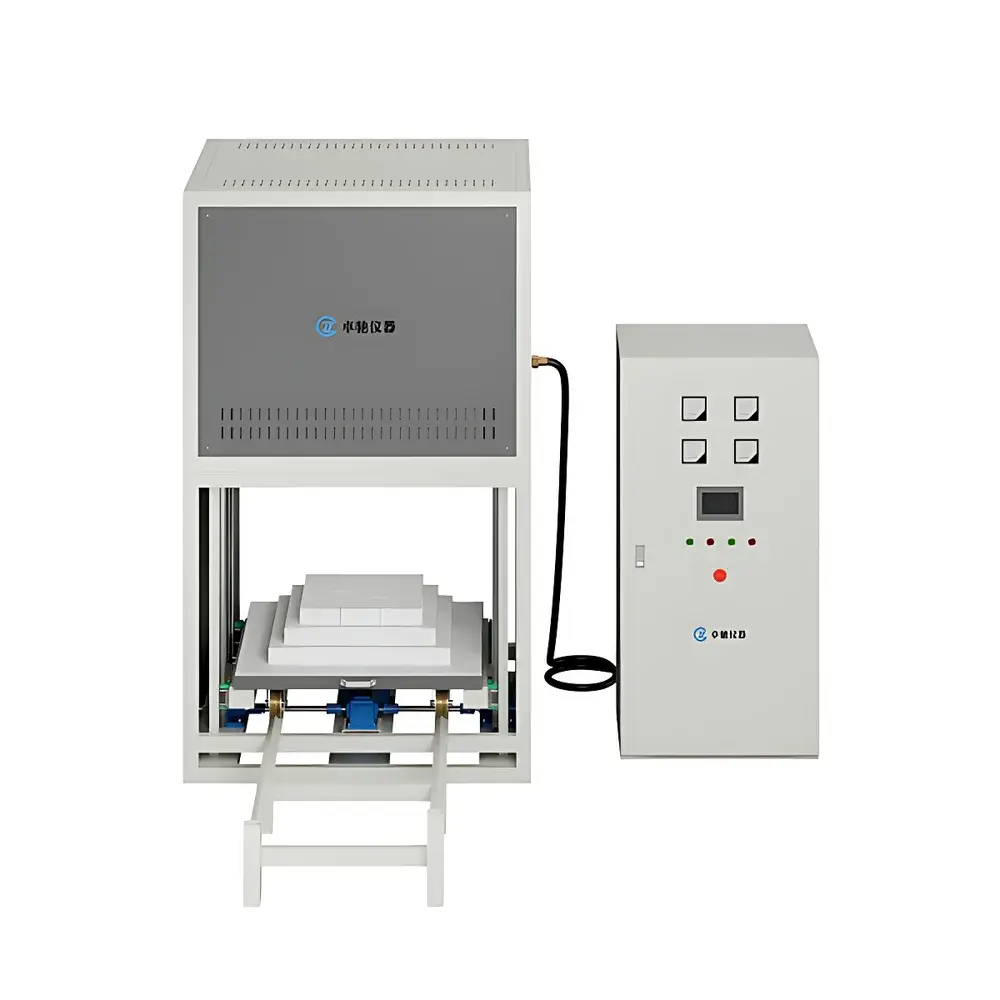
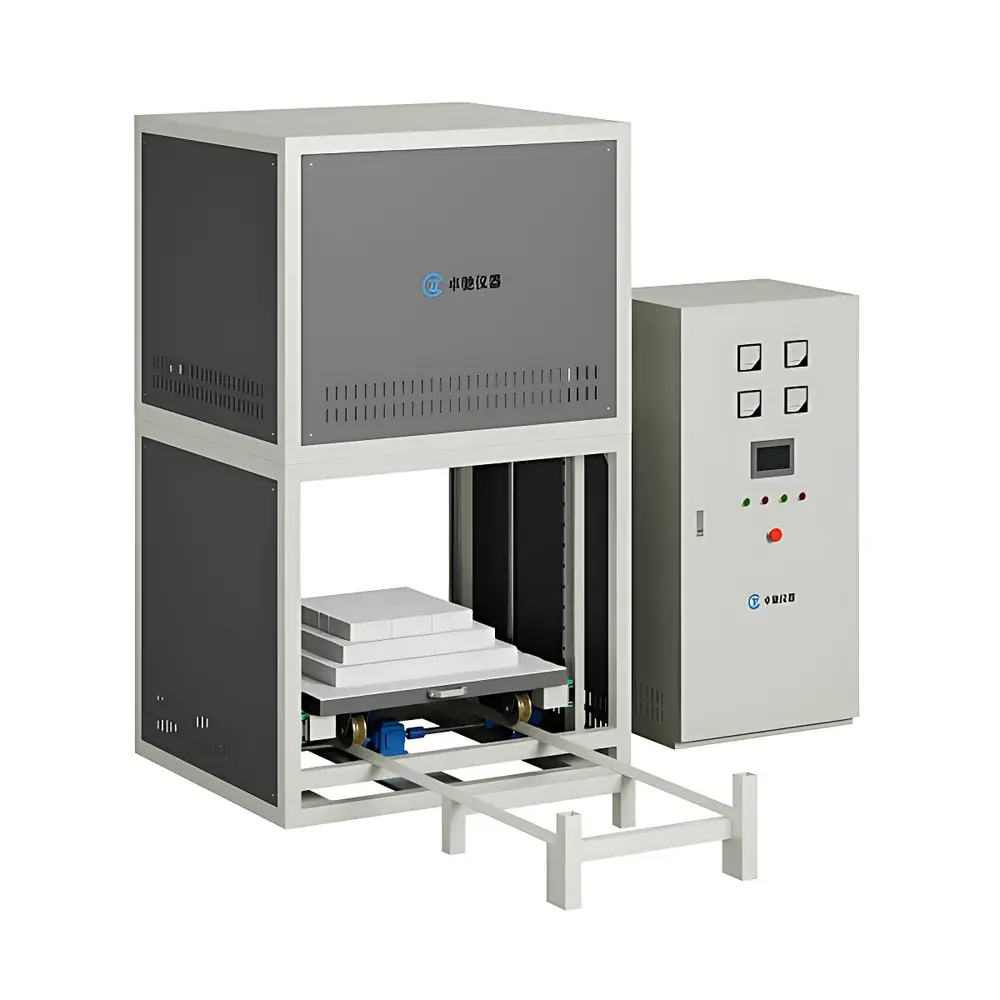
Zhuochi SJ-30-16 High-Temperature Lift-Type Muffle Furnace
| Brand | Zhuochi |
|---|---|
| Origin | Zhejiang, China |
| Model | SJ-30-16 |
| Max Temperature | 1600 °C |
| Temperature Uniformity | ±1 °C |
| Rated Power | 30 kW |
| Heating Element | Silicon Molybdenum (MoSi₂) Rods |
| Internal Chamber Dimensions | 500 × 500 × 500 mm (L×W×H) |
| Effective Volume | 125 L |
| Lift Mechanism | Precision Lead-Screw Drive |
| Thermocouple Type | Type B (Platinum–Rhodium 30/6) |
| Voltage Supply | 380 V AC, 3-Phase |
| Ramp Rate Range | 1 °C/h to 20 °C/min (programmable) |
| Control System | 50-Stage Programmable PID Controller with Dual-Circuit Protection |
| Cooling | Forced-Air Dual-Layer Shell with Integrated Blower |
Overview
The Zhuochi SJ-30-16 High-Temperature Lift-Type Muffle Furnace is an industrial-grade thermal processing system engineered for precise, repeatable, and safe operation in materials science laboratories, ceramic R&D centers, metallurgical testing facilities, and advanced powder processing environments. Designed around a vertical lift architecture with bottom-opening configuration, the furnace employs a robust lead-screw actuation mechanism to lower and raise the load platform—enabling safe, ergonomic loading and unloading of heavy or high-temperature samples without manual handling inside the hot zone. Its core heating technology utilizes vertically mounted silicon molybdenum (MoSi₂) rods, delivering stable radiant heat up to 1600 °C within a fully insulated chamber lined with high-purity alumina–zirconia composite fiber. The furnace operates on a 380 V, three-phase supply and integrates a dual-circuit control architecture with real-time thermal feedback, ensuring compliance with fundamental safety and repeatability requirements for ISO/IEC 17025-accredited labs.
Key Features
- Lead-screw lift mechanism with precision positioning: Provides smooth, backlash-free vertical motion of the sample platform; enables full external access to the hot zone while maintaining structural rigidity and thermal isolation.
- High-stability MoSi₂ heating elements: Vertically arranged around the chamber perimeter for uniform radial heat distribution; rated for continuous operation at 1500 °C with peak capability to 1600 °C.
- Dual-layer forced-air cooled steel shell: Outer casing constructed from CNC-machined cold-rolled steel with high-temperature phosphating finish; integrated axial fans between inner and outer shells accelerate cooling cycles and reduce ambient surface temperature during operation.
- 50-segment programmable PID controller: Features dual-line LED display, auto-tuning capability, deviation alarm, over-temperature cut-off, and power output monitoring (voltage, current, % duty cycle).
- Multi-tier insulation system: Inner lining of lightweight alumina–zirconia fiber (≥1700 °C rated); intermediate layer of high-alumina ceramic fiber; outer thermal barrier of nano-porous insulation board—achieving <35 W/m² surface heat loss at 1200 °C.
- Comprehensive protection suite: Dual-loop independent temperature monitoring, phase-loss detection, over-current/over-voltage tripping, soft-start circuitry, and fail-safe relay interlock on door position and thermocouple integrity.
Sample Compatibility & Compliance
The SJ-30-16 accommodates standard crucibles (alumina, zirconia, graphite), sintering boats, and custom fixtures up to 450 mm in diameter and 400 mm in height. Its 125 L cavity supports batch processing of refractory powders, battery cathode precursors, rare-earth oxides, and advanced ceramics. The furnace meets baseline mechanical and electrical safety requirements per IEC 61000-6-2 (EMC immunity) and IEC 61000-6-4 (EMC emission). While not certified to UL or CE as a complete system, its component-level design—including Type B thermocouples (ASTM E230), MoSi₂ elements (ISO 18434-1 compliant), and programmable controller logic—supports integration into GLP/GMP workflows requiring audit-ready thermal validation. Optional calibration certificates (as-per ASTM E988 or ISO/IEC 17025) are available upon request.
Software & Data Management
The built-in controller logs time-stamped temperature profiles, ramp rates, hold durations, and power modulation data to non-volatile memory. All parameters—including segment setpoints, dwell times, and alarm thresholds—are exportable via RS485 Modbus RTU interface for integration with LabVIEW, MATLAB, or enterprise LIMS platforms. The system supports 21 CFR Part 11-compliant electronic recordkeeping when paired with validated third-party SCADA software; audit trails include operator ID, timestamped parameter changes, and event-triggered alarms (e.g., thermocouple break, over-temperature). Firmware updates are performed via USB port using signed binaries to ensure traceability and integrity.
Applications
- Sintering and densification of technical ceramics (Al₂O₃, SiC, ZrO₂) under controlled atmosphere (N₂, Ar, air)
- Heat treatment of metal alloys and superalloys for phase transformation studies
- Thermal gravimetric analysis (TGA) pre-conditioning and ashing protocols (ASTM D3175, ISO 1171)
- Calcination of catalyst precursors and battery electrode materials (e.g., LiCoO₂, NMC)
- Fire resistance testing of construction materials (ASTM E119, ISO 834)
- Crucible-based melting and homogenization of refractory metals and intermetallics
FAQ
What is the maximum recommended continuous operating temperature?
The furnace is rated for continuous operation at 1500 °C. Operation at 1600 °C is permissible for short-duration processes (≤2 hours) with prior thermal soak and strict adherence to ramp/soak/cool protocols.
Can inert or reducing atmospheres be introduced?
Yes—the chamber features two 12 mm diameter gas inlet/outlet ports compatible with standard Swagelok fittings; optional quartz viewing window and atmosphere purge kit are available.
Is remote monitoring supported?
Standard RS485 Modbus RTU allows integration with building management systems (BMS) or centralized lab monitoring dashboards; Ethernet/WiFi gateway modules are offered as accessories.
What maintenance intervals are recommended?
Inspect MoSi₂ elements and thermocouple seating every 100 operational hours; replace ceramic fiber insulation if visible cracking or shrinkage exceeds 5% depth; verify lead-screw lubrication and alignment quarterly.
Does the system support temperature uniformity mapping per AMS2750E?
Yes—its five thermocouple input channels (including four auxiliary inputs) enable multi-point uniformity profiling; optional NIST-traceable calibration kits facilitate SAT and TUS qualification.
Related Products



