
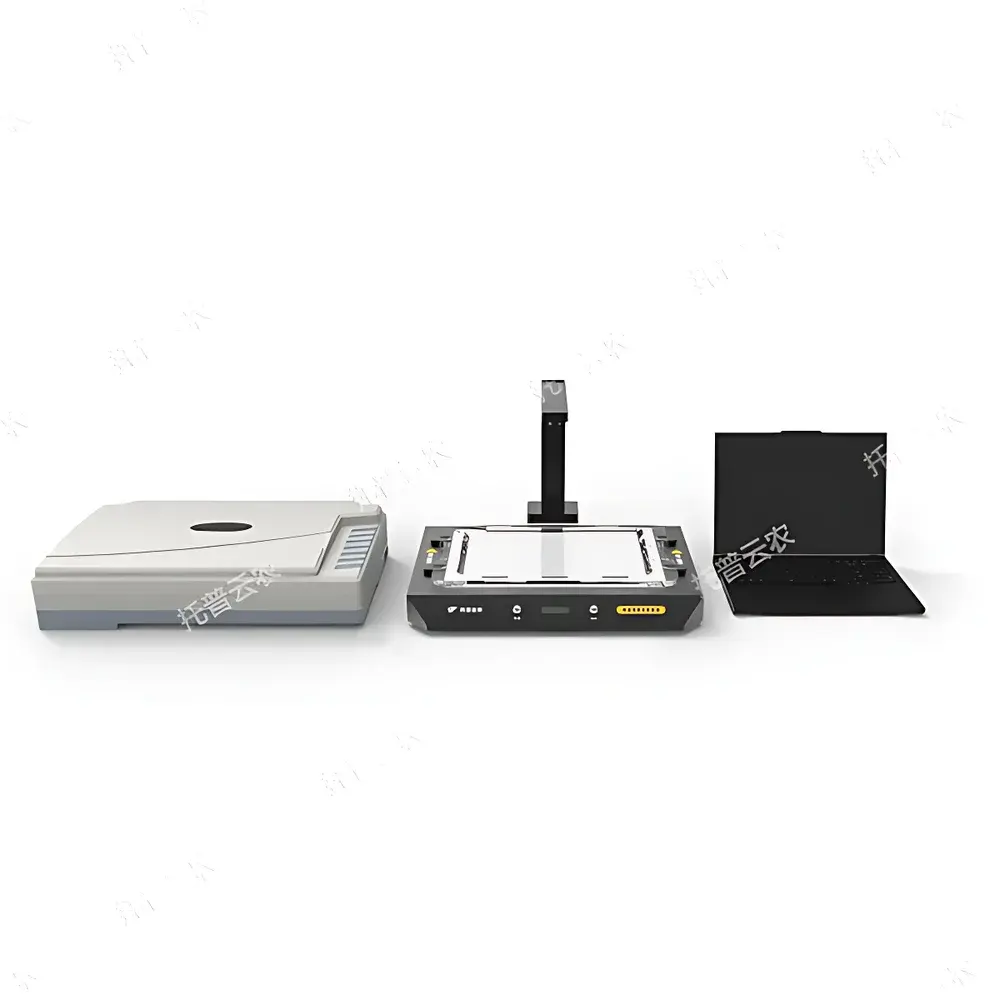
TopCloud-agri TPKZ-1-G Automated Seed Morphometric Analyzer
| Brand | TopCloud-agri |
|---|---|
| Origin | Zhejiang, China |
| Manufacturer Type | Direct Manufacturer |
| Product Type | Benchtop Grain Analyzer |
| Model | TPKZ-1-G |
| Sample Compatibility | Maize, rice, wheat, soybean, rapeseed, vegetable seeds (uniform-size granular seeds) |
| Counting Speed | 1,200–20,000 seeds/min (varies by seed type) |
| Imaging Capacity | Simultaneous analysis of up to 10 maize ears, 35 maize cross-sections, or 1,000–3,000 maize kernels per scan |
| Accuracy | ≤ ±0.5% for seed counting and 1,000-seed weight measurement |
| Weighing Range | 0–5 kg |
| Imaging Sensor | 22 MP A3-format high-resolution scanner (4896 × 3672 px), 1600 dpi × 1600 dpi optical resolution |
| Illumination | Dual-mode backlight panel with uniform LED illumination + ambient light compensation |
| Software | Embedded Android OS tablet interface + Windows desktop application with cloud synchronization (TopCloud-agri Seed Analytics Platform) |
| Compliance | Designed for GLP-aligned seed phenotyping workflows |
Overview
The TopCloud-agri TPKZ-1-G Automated Seed Morphometric Analyzer is a benchtop-grade imaging-based phenotyping instrument engineered for high-throughput, non-destructive morphological characterization of agricultural seeds. It operates on the principle of calibrated digital image analysis—leveraging high-resolution top-down imaging under controlled backlighting to extract geometric, dimensional, and chromatic features from static seed arrangements. Unlike traditional manual or semi-automated methods, the TPKZ-1-G integrates hardware-level metrological traceability (via auto-calibrating transparent seed trays and embedded reference markers) with software-driven segmentation algorithms trained on common cereal and leguminous seed morphologies. Its primary application domain includes seed quality assessment, varietal purity verification, breeding program support, and regulatory compliance testing in national seed certification laboratories, agronomic research institutes, and commercial seed enterprises.
Key Features
- High-fidelity A3 imaging platform: Equipped with a 22-megapixel CMOS sensor (4896 × 3672 px native resolution) and dual-illumination backlight system—featuring ultra-thin, uniformly diffused LED panels with automatic brightness compensation—to eliminate shadow artifacts and ensure consistent contrast across heterogeneous seed batches.
- Integrated weighing module: A precision load cell (0–5 kg range, 0.01 g resolution) is mechanically and electronically co-located beneath the imaging tray, enabling concurrent mass acquisition during image capture. The system automatically computes 1,000-seed weight (TSW) and 100-seed weight (HSW) using real-time particle count data.
- OLED-integrated weighing display: A dedicated 2.1-inch OLED screen mounted on the weighing base provides immediate visual feedback during sample loading—allowing operators to adjust seed quantity prior to analysis without switching interfaces.
- Modular scanning capability: Supports three standardized acquisition modes: single-kernel analysis (up to 3,000 maize kernels per frame), multi-ear imaging (10 ears per scan), and cross-sectional analysis (35 ear sections per 2-minute session), all within a single A3 field-of-view.
- Adaptive image segmentation engine: Combines edge-detection, watershed partitioning, and deep learning–enhanced classification (CNN-based training on >15 crop species) to distinguish overlapping or abutting seeds. Users may manually correct misclassified objects via mouse-driven merge/split tools with pixel-level precision.
- Region-of-interest (ROI) quantification: Enables arbitrary polygonal or rectangular selection within the preview window for targeted counting and metric extraction—critical for analyzing sub-samples, damaged kernels, or heterogenous mixtures.
- Dynamic calibration & traceability: Each imaging session embeds an auto-detected scale bar derived from the calibrated tray grid, ensuring dimensional reproducibility across instruments and timepoints per ISO 5725-2 guidelines.
Sample Compatibility & Compliance
The TPKZ-1-G is validated for morphometric analysis of small-to-medium granular seeds with defined convex hulls and minimal translucency—including but not limited to Zea mays (maize), Oryza sativa (rice), Triticum aestivum (wheat), Glycine max (soybean), Brassica napus (rapeseed), and selected horticultural species. It does not support highly irregular, fibrous, or strongly translucent samples (e.g., cotton lint, orchid dust seeds). All measurement outputs—including length, width, aspect ratio, projected area, perimeter, color histograms (CIELAB space), and statistical summaries (mean, SD, CV%)—are generated in accordance with ISO 20245:2019 (Seed testing—Image analysis methods) and align with FAO/WHO seed quality protocol frameworks. Data files retain full metadata (timestamp, operator ID, instrument serial, environmental conditions) and support GLP/GMP audit trails when deployed with the optional TopCloud-agri Seed Analytics Platform.
Software & Data Management
The analyzer ships with dual-interface software: an embedded Android tablet application for standalone operation and a Windows desktop client for advanced batch processing and report generation. Both interfaces support direct export to CSV and Excel (.xlsx) formats with column headers compliant with OECD Bioinformatics Standards v3.2. Image datasets are stored with embedded EXIF tags containing spatial calibration parameters, exposure settings, and user annotations. Cloud synchronization occurs over TLS 1.2–secured HTTPS connections; uploaded records include immutable SHA-256 checksums and are retained for ≥7 years per default retention policy. Optional 21 CFR Part 11 compliance packages provide electronic signature workflows, role-based access control, and automated audit log generation for regulated environments.
Applications
- High-throughput screening of segregating populations in maize and rice breeding programs
- Verification of certified seed lot conformity against national varietal standards (e.g., USDA FGIS, EU Regulation (EU) No 2016/2031)
- Quantitative trait locus (QTL) mapping of kernel morphology traits (e.g., length-width ratio, roundness index)
- Post-harvest quality monitoring—including detection of shriveled, cracked, or discolored kernels
- Seed storage stability studies tracking morphometric drift over time and humidity exposure
- Regulatory submission support for DUS (Distinctness, Uniformity, Stability) testing documentation
FAQ
What seed types are supported for fully automated analysis?
Maize, rice, wheat, soybean, rapeseed, peanut, sesame, and other uniformly sized, opaque, convex seeds. Irregular or highly translucent seeds require manual ROI definition.
Is external calibration required before each use?
No—the system performs automatic optical calibration using its embedded reference grid and self-luminous backlight; no user intervention is needed beyond initial setup.
Can raw images and processed data be archived locally without cloud upload?
Yes. All image files (TIFF/RAW), measurement tables (CSV), and summary reports (PDF) are saved directly to internal SSD or connected USB storage.
Does the software support multi-user environments with permission tiers?
The desktop client supports configurable user roles (Administrator, Analyst, Viewer) with granular access to data export, method editing, and audit log review functions.
How is measurement uncertainty quantified and reported?
Per ISO/IEC 17025:2017 Annex A, the system reports expanded uncertainty (k=2) for counting (±0.5%) and TSW (±0.5%), derived from repeated inter-laboratory validation studies across five independent test sites.






