
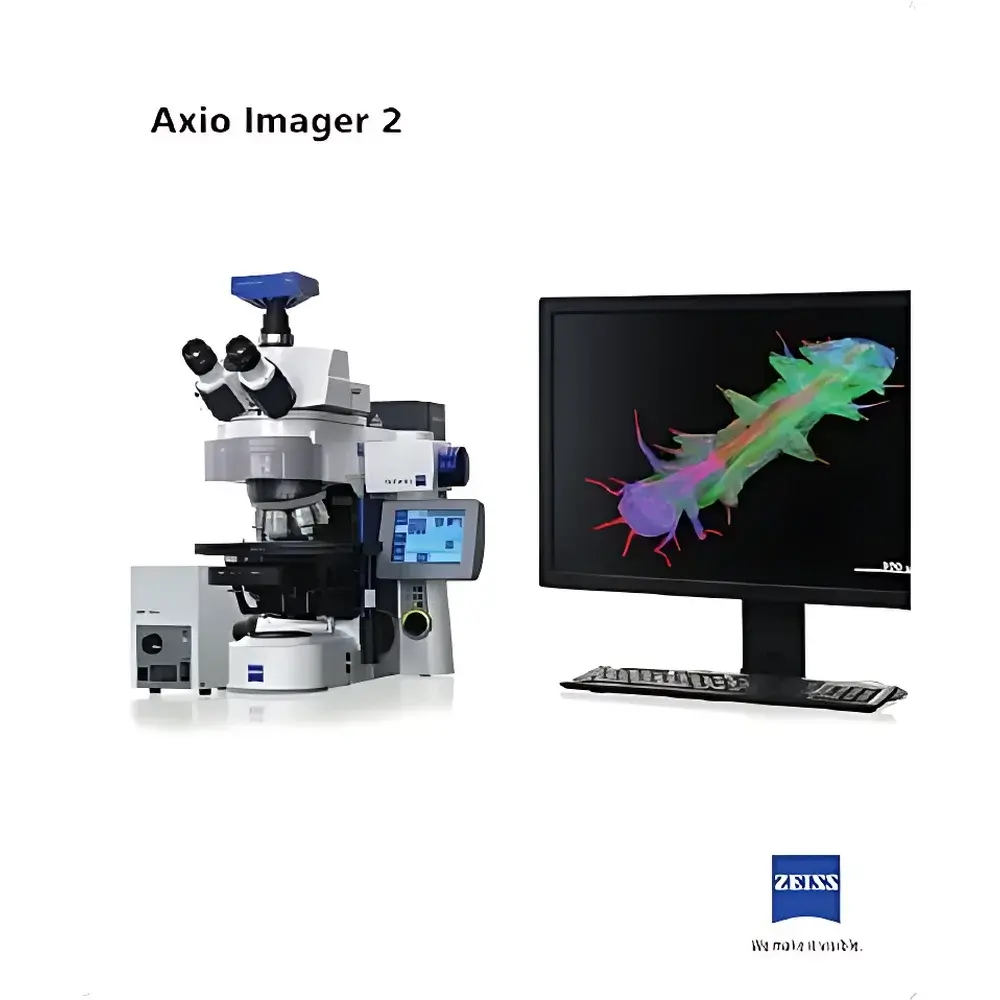
ZEISS Axio Imager MAT&POL Research-Grade Upright Materials Microscope
| Brand | ZEISS |
|---|---|
| Origin | Germany |
| Model | Axio Imager MAT&POL |
| Objective Turret | 6- or 7-position encoded turret (HD/POL/DIC, manual/electric/ACR) |
| Reflected Light Turret | 6- or 10-position encoded turret (manual/electric/ACR) |
| Objectives | 5×, 10×, 20×, 50×, 100× (optional: 1.25×, 2.5×, 150× |
| Eyepieces | 10× widefield (FOV 23 mm |
| optional | 16×, 25× |
| Illumination | 12 V / 100 W halogen lamp with intelligent light path manager, auto-adjustable intensity and color temperature |
| Stage Travel | 75 × 50 mm to 225 × 85 mm (X–Y) |
| sample height clearance | 0–63 mm (adjustable) |
| Stage Type | Manual or motorized (including automated scanning stage) |
| Contrast Modules (Reflected Light) | Brightfield (H), Darkfield (D/ADF), Polarized Light (Pol), Differential Interference Contrast (DIC), Circular DIC (C-DIC), Transmission Interference Contrast (TIC), Fluorescence (FI, multi-band) |
| Imaging System | Compatible with high-resolution scientific cameras and digital SLR systems |
| Software Modules | Grain size analysis, quantitative metallography, graphite rating (ASTM E1245, ISO 9276), comparative rating, thin-film thickness measurement, NMI (Non-Metallic Inclusion) analysis, particle sizing, 3D surface profiling |
| Optional Accessories | Motorized focus drive, transmitted light module, heating/cooling stages, spectrophotometric modules |
Overview
The ZEISS Axio Imager MAT&POL is a modular, research-grade upright materials microscope engineered for rigorous metallurgical, geological, ceramic, and advanced materials characterization. Designed specifically for reflected-light microscopy applications—including polarized light (POL), differential interference contrast (DIC), darkfield (ADF), and multi-band fluorescence—the system implements ZEISS’s precision optical architecture based on apochromatic correction, infinity-corrected optics, and Köhler illumination principles. Its dual-turret configuration—separately optimized for objective lenses and reflected-light contrast modules—enables rapid, repeatable switching between imaging modalities without mechanical realignment. The platform supports both qualitative microstructural evaluation and quantitative image-based metrology under standardized laboratory conditions compliant with ASTM E3, ISO 643, and EN 10365. As a core instrument in QC/QA labs and academic materials science facilities, the Axio Imager MAT&POL delivers high spatial fidelity, long-term optical stability, and full traceability across imaging sessions.
Key Features
- Modular encoded turrets: 6- or 7-position objective turret and independent 6- or 10-position reflected-light contrast turret—both fully encoded for software-controlled recall of optical configurations.
- High-performance objective portfolio: Standard magnifications (5×–100×) include LD (long working distance) and ACR (apochromat correction for reflectance) variants; optional ultra-low (1.25×) and ultra-high (150×) objectives extend analytical flexibility.
- Intelligent illumination management: 12 V / 100 W halogen source with dynamic light path manager ensures consistent color temperature and intensity across magnifications and contrast modes—critical for spectral consistency in quantitative analysis.
- Large-format motorized stage options: X–Y travel up to 225 × 85 mm with Z-clearance up to 63 mm accommodates oversized samples (e.g., cross-sectioned turbine blades, large-area coatings, geological thin sections).
- Multi-contrast capability: Simultaneous integration of polarized light, DIC, C-DIC, TIC, and multi-band FI enables correlative microstructural interpretation—e.g., distinguishing strain-induced birefringence from crystallographic orientation in deformed alloys.
- Robust mechanical architecture: Precision-machined cast aluminum frame with vibration-damped base ensures stability during extended acquisition sequences and automated scanning routines.
Sample Compatibility & Compliance
The Axio Imager MAT&POL accommodates opaque, semi-opaque, and reflective specimens ranging from polished metallographic mounts to uncoated semiconductor wafers, geological thin sections, and composite laminates. Sample height adaptability (0–63 mm) supports bulk specimens, mounted arrays, and in-situ environmental stages. All optical paths comply with ISO 10934-1 (microscopy terminology) and DIN EN ISO 1302 (surface texture notation). When paired with ZEISS ZEN software and certified calibration standards, the system meets audit requirements for GLP and GMP environments—including full electronic record retention, user access control, and 21 CFR Part 11–compliant audit trails for regulated QA workflows (e.g., aerospace material certification per AMS 2300, automotive casting inspection per VW 60300).
Software & Data Management
ZEN Core and ZEN Blue software provide unified control of hardware, image acquisition, and quantitative analysis. The platform natively supports TIFF, CZI, and OME-TIFF formats with embedded metadata (objective ID, illumination mode, stage coordinates, exposure parameters). Preconfigured analysis modules—validated against ASTM E112 (grain size), ASTM E1245 (inclusion rating), and ISO 9276 (particle size distribution)—include statistical reporting, batch processing, and customizable report templates exportable to PDF or Excel. Raw data and processed results are stored in hierarchical project structures with version history, enabling reproducible re-analysis and cross-laboratory method transfer. Integration with LIMS via REST API allows automated result injection into enterprise quality databases.
Applications
- Metallographic analysis: Phase identification, grain boundary delineation, inclusion quantification (ASTM E45, ISO 4967), and coating thickness measurement on ferrous/non-ferrous alloys.
- Geological petrography: Optical mineral identification using interference figures, extinction angles, and birefringence mapping in thin sections.
- Failure analysis: Crack propagation path reconstruction, corrosion product layer differentiation (via polarization contrast), and intergranular embrittlement assessment.
- Advanced materials R&D: Domain structure visualization in ferroelectrics (using Pol + DIC), graphene layer counting (via contrast modulation), and thermal barrier coating integrity evaluation.
- Quality assurance in manufacturing: Automated defect detection on machined surfaces, solder joint inspection, and additive manufacturing powder morphology screening.
FAQ
Does the Axio Imager MAT&POL support transmitted light imaging?
Yes—transmitted light modules (including Köhler illumination condensers and aperture diaphragms) can be integrated as optional accessories, enabling dual-mode (reflected + transmitted) analysis of semi-transparent materials such as thin films or polymer composites.
Is motorized focus standard or optional?
Motorized focus is an optional upgrade, available with hardware-triggered autofocus algorithms optimized for high-NA objectives and low-contrast reflective surfaces.
Can the system be validated for ISO/IEC 17025 compliance?
Yes—ZEISS provides documented verification protocols, traceable calibration certificates (NIST-traceable reference standards), and IQ/OQ documentation packages supporting laboratory accreditation under ISO/IEC 17025:2017.
What camera interfaces are supported?
The system supports USB 3.0, Camera Link, and GigE Vision interfaces; compatibility extends to ZEISS Axiocam series, third-party sCMOS/CCD sensors, and DSLR adapters with live HDMI output.
Are software licenses perpetual or subscription-based?
ZEN software licenses are perpetual with optional annual maintenance contracts covering updates, technical support, and regulatory compliance assistance.




