
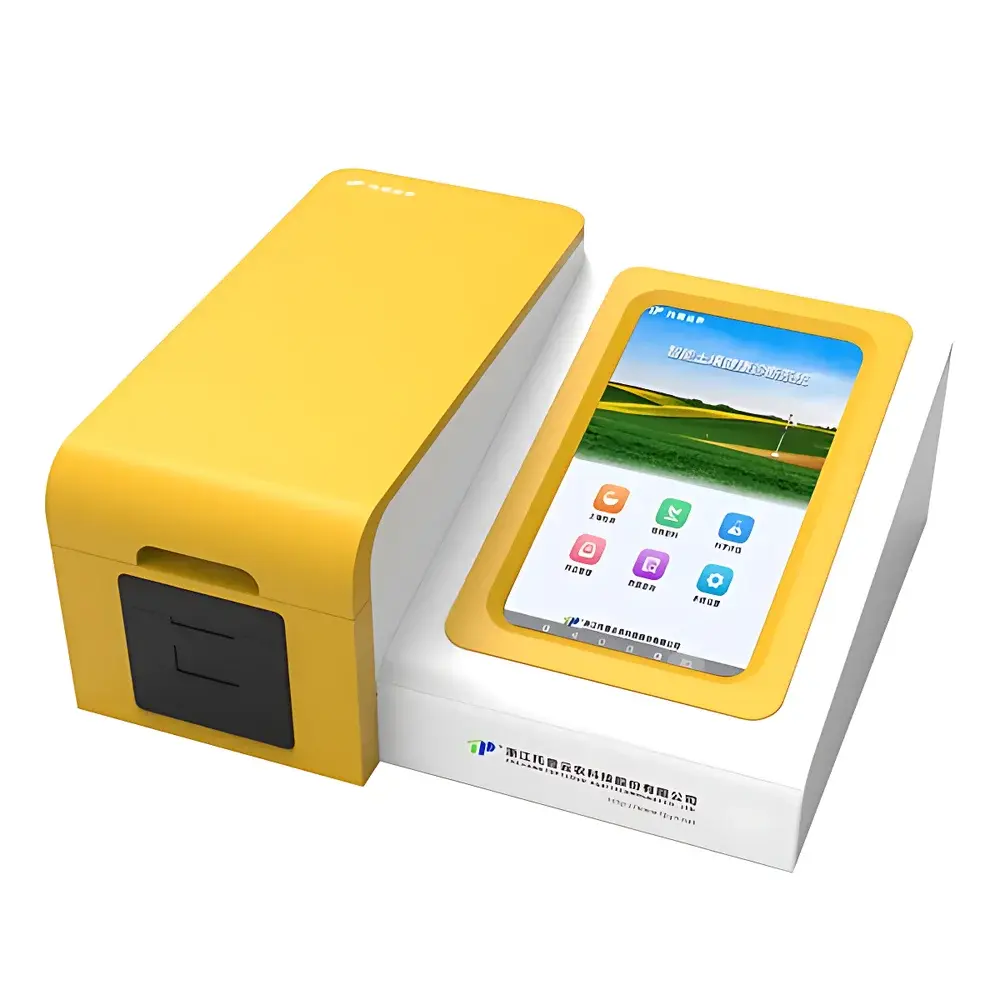
Top Cloud-agri TP-SJ-12A Multi-Mode Food Safety Analyzer (Colloidal Gold Immunoassay + Enzyme Inhibition Method)
| Brand | Top Cloud-agri |
|---|---|
| Origin | Zhejiang, China |
| Manufacturer Type | OEM/ODM Manufacturer |
| Country of Origin | China |
| Model | TP-SJ-12A |
| Detection Channels | 12 photometric + 3 colloidal gold |
| Absorbance Range | 0.000–4.000 A |
| Transmittance Range | 0.00–100.00% T |
| Transmittance Resolution | 0.01% T |
| Absorbance Resolution | 0.001 A |
| Photometric Accuracy | ±2.0% T |
| Photometric Repeatability | ≤0.2% T |
| Dark Current Drift | ≤0.2% (3 min) |
| Overall Measurement Accuracy | ±5% |
| Display | 10.1″ capacitive touchscreen (1024×600), IP65-rated front panel |
| OS | Android 7.0 with handwriting support and digital signature capture |
| Connectivity | Wi-Fi, RJ45 Ethernet, Bluetooth 4.2, optional 3G/4G module |
| Storage | 2 GB RAM + expandable internal storage |
| USB Ports | 3 × USB 2.0 |
| Integrated Thermal Printer | supports label printing (e.g., compliance certificates) and A4 report export |
Overview
The Top Cloud-agri TP-SJ-12A Multi-Mode Food Safety Analyzer is an integrated benchtop instrument engineered for rapid, on-site screening of pesticide residues and other targeted food contaminants in agricultural and processing environments. It combines two complementary analytical principles: enzymatic inhibition assay—based on acetylcholinesterase (AChE) activity suppression by organophosphate and carbamate pesticides—and lateral-flow colloidal gold immunochromatography for qualitative/semi-quantitative detection of specific analytes including aflatoxin B1, chlorpyrifos, and others. This dual-method architecture enables concurrent testing across heterogeneous sample matrices (e.g., vegetable extracts, fruit homogenates, grain rinsates, and dairy preparations) without cross-platform reconfiguration. Designed to meet field-deployable performance requirements, the analyzer delivers trace-level sensitivity while maintaining operational robustness under variable ambient conditions—supporting decentralized quality control workflows aligned with national food safety surveillance protocols.
Key Features
- 10.1-inch industrial-grade capacitive touchscreen with IP65 front-panel protection, 1024×600 resolution, and 400 cd/m² brightness for reliable operation in high-humidity or dusty environments.
- Quad-core ARM-based processor (1.8 GHz), 2 GB RAM, and Android 7.0 OS with native handwriting recognition, digital signature capture, and multi-input method support—enabling auditable operator authentication per GLP-compliant workflows.
- Dual optical detection system: 12-channel photometric module for enzyme inhibition quantification (absorbance range: 0.000–4.000 A; resolution: 0.001 A) and 3 independent colloidal gold strip readers with automatic line intensity calibration and background correction.
- Built-in thermal printer supporting three output formats: real-time test reports, peel-off compliance labels (e.g., “Qualified Product” stickers per China’s Commitment-Based Certification framework), and exportable PDFs for A4 archival printing.
- Preloaded national standard reference database (GB 2763–2021, GB/T 5009.x series) with intelligent fuzzy search and barcode-assisted sample ID entry—reducing manual transcription errors and accelerating throughput.
- Multi-modal connectivity stack: IEEE 802.11 b/g/n Wi-Fi, 10/100 Mbps RJ45 Ethernet, Bluetooth 4.2 for peripheral pairing, and optional 3G/4G LTE module for cellular data offloading in remote deployment zones.
Sample Compatibility & Compliance
The TP-SJ-12A accommodates liquid-phase extracts prepared from solid food matrices using standardized pre-treatment kits (e.g., QuEChERS-compatible homogenization and centrifugation). Validated sample types include leafy vegetables (spinach, cabbage), fruits (apple, tomato), cereals (rice, wheat), and animal-derived products (milk, egg washes). All optical measurements conform to ISO 7027 for turbidimetric absorbance and follow ASTM E2919-13 guidelines for lateral-flow immunoassay reader validation. Instrument firmware supports audit trail logging compliant with China’s Regulations on Supervision and Administration of Food Safety Sampling and Testing (SAMR Order No. 15), and data export formats (CSV, XML) are structured for interoperability with provincial food safety information platforms and third-party LIMS systems.
Software & Data Management
Embedded software provides end-to-end data integrity: each test record includes timestamp, GPS coordinates (when enabled), operator ID, instrument serial number, reagent lot tracking, and raw optical signal traces. Data synchronization occurs automatically via HTTPS-encrypted channels to Top Cloud-agri’s secure cloud platform (ISO/IEC 27001 certified), enabling real-time dashboard visualization, batch-level statistical analysis (CV%, recovery rate trends), and automated alerting for out-of-spec results. All user actions—including parameter edits, calibration resets, and report generation—are logged with immutable timestamps, satisfying traceability requirements under GB/T 22239–2019 (Information Security Technology – Basic Requirements for Cybersecurity Level Protection).
Applications
- Routine screening of organophosphate and carbamate pesticide residues in fresh produce at farm gates, wholesale markets, and supermarket QA labs.
- Verification of aflatoxin B1 contamination in maize, peanuts, and rice during post-harvest handling and storage.
- On-site verification of veterinary drug residues (e.g., sulfonamides) in aquaculture samples using compatible colloidal gold test strips.
- Supporting municipal food safety supervision campaigns through portable deployment with battery-powered operation (optional external power bank).
- Integration into traceability systems for origin labeling and blockchain-backed certification schemes (e.g., “Green Food” and “Organic” product verification).
FAQ
Does the TP-SJ-12A require external calibration standards for daily use?
No—built-in self-diagnostic routines verify LED stability, detector linearity, and baseline drift before each measurement cycle. Reference standards are only required during initial installation or after major optical component replacement.
Can the instrument store test records offline if network connectivity is unavailable?
Yes—local storage retains ≥50,000 test entries with full metadata. Synchronization resumes automatically upon network restoration, with conflict resolution logic preventing duplicate uploads.
Is the thermal printer compatible with third-party label stock?
The printer accepts standard 58 mm thermal rolls (max 80 mm diameter) and supports custom label templates via CSV import; however, adhesive-backed compliance stickers must meet ISO/IEC 15416 print quality specifications for scannable QR codes.
How does the system ensure data integrity during cloud transmission?
All payloads are encrypted using TLS 1.2+ with device-specific X.509 certificates; data-at-rest on the cloud platform employs AES-256 encryption and adheres to China’s PIPL data localization mandates.
Are consumables (e.g., test strips, cuvettes) supplied exclusively by Top Cloud-agri?
While optimized performance is guaranteed with OEM strips and calibrated cuvettes, the instrument accepts any CE-marked colloidal gold strips meeting ISO 15197:2013 dimensional tolerances and photometric response curves.





