
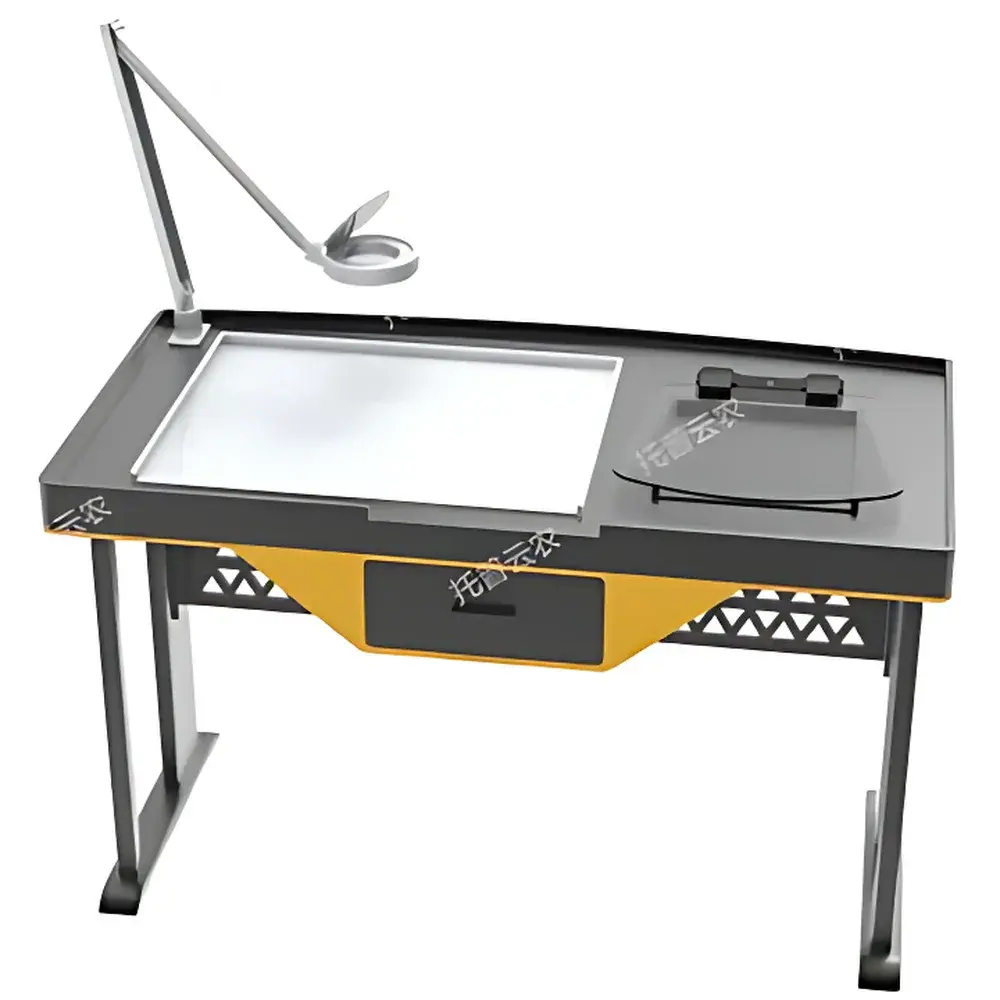
Top Cloud-agri TJD-1300A Seed Purity Inspection Workstation
| Brand | Top Cloud-agri |
|---|---|
| Origin | Zhejiang, China |
| Manufacturer Type | Direct Manufacturer |
| Product Category | Horizontal Laminar Flow Clean Bench |
| Cleanliness Class | ISO Class 5 (100-level) |
| Noise Level | ≤58 dB(A) |
| User Capacity | Single Operator |
| Work Surface Dimensions | 1200 × 580 × 770 mm |
| Observation Area | 560 × 300 mm |
| Polarized Light Stage | 250 × 250 mm |
| Power Supply | 220 V, 50 Hz |
| White Light Illumination Power | 18 W |
| Polarized Light Power | 15 W |
| Magnifier Lamp Power | 12 W |
| Magnification | 10× |
Overview
The Top Cloud-agri TJD-1300A Seed Purity Inspection Workstation is a purpose-built horizontal laminar flow clean bench engineered for precision visual analysis of botanical and agricultural specimens under controlled illumination conditions. Unlike general-purpose biosafety cabinets or standard clean benches, this workstation integrates three optically distinct observation modalities—broad-spectrum white light transmission, polarized light transmission, and high-fidelity 10× magnification—into a single ergonomic platform. Its core function is to support standardized seed purity testing in accordance with international seed testing protocols (ISTA, AOSA, and GB/T 3543.3–1995), enabling accurate separation, identification, and classification of pure seed, inert matter, and other crop seeds within a sample. The unit operates on the principle of unidirectional, low-turbulence airflow (≥0.3 m/s at work surface), maintaining an ISO Class 5 (100-level) environment that minimizes airborne particulate contamination during manual seed sorting and morphological evaluation. Designed specifically for non-hazardous, non-volatile samples—including viable seeds, germinating embryos, leaf tissues, fungal colonies, and milled rice grains—the workstation prioritizes thermal neutrality and optical fidelity over containment, making it unsuitable for microbiological or chemical hazard applications.
Key Features
- Triple-mode optical observation system: independently controllable white-light transilluminator (18 W), polarized-light stage (15 W), and articulating 10× magnifier lamp (12 W), each optimized for contrast enhancement in different specimen types;
- Articulated boom arm assembly allowing full positional freedom of the magnifier and auxiliary lighting across the entire 560 × 300 mm observation zone;
- Cold-cathode fluorescent light sources with color rendering index (CRI) ≥85 and correlated color temperature (CCT) ~5000 K, eliminating infrared thermal load that could compromise seed viability or induce premature germination during extended inspection;
- Polarized light module featuring rotatable linear polarizers for birefringence visualization—critical for detecting starch granule orientation in rice kernels, cellulose microfibril alignment in seed coats, and crystalline structures in fungal hyphae;
- Stainless steel and anodized aluminum construction with seamless epoxy-coated work surface for chemical resistance and ease of decontamination between batches;
- Integrated airflow monitoring indicator (visual LED status) and adjustable fan speed control to maintain consistent laminar velocity under varying ambient pressure conditions.
Sample Compatibility & Compliance
The TJD-1300A is validated for use with intact and processed plant-based materials including cereal grains (wheat, rice, maize), legume seeds (soybean, pea), oilseeds (rapeseed, sunflower), vegetative tissues (cotyledons, true leaves), fungal cultures (agar plate isolates), and milled rice fractions (whole grain, broken kernels, chalky endosperm). It complies with ISO 14644-1:2015 Class 5 air cleanliness requirements for particle concentration (≤3,520 particles/m³ ≥0.5 µm), and meets electromagnetic compatibility standards per EN 61326-1:2013. While not certified for GLP or GMP environments requiring formal validation documentation, its design supports traceable seed testing workflows aligned with ISTA Rule 5 (Purity Analysis) and AOSA Rules for Testing Seeds. The absence of UV germicidal lamps or HEPA filtration upstream of the work surface reflects its classification as a horizontal flow inspection tool—not a sterile processing device.
Software & Data Management
This workstation operates as a hardware-only analytical platform with no embedded firmware, network interface, or proprietary software. All operational controls are tactile and analog: individual rocker switches for each light mode, manual magnifier positioning, and mechanical airflow adjustment. This architecture ensures deterministic behavior, eliminates cybersecurity vulnerabilities, and facilitates long-term maintenance without software obsolescence. Users may integrate external digital imaging systems (e.g., DSLR or industrial USB cameras mounted on optional C-mount adapters) for documentation; image metadata (time stamp, operator ID, sample ID) must be managed externally via laboratory information management systems (LIMS) or electronic lab notebooks (ELN) compliant with 21 CFR Part 11 audit trail requirements. Calibration of illumination uniformity and magnification accuracy is recommended annually using NIST-traceable photometric and dimensional standards.
Applications
- Seed purity analysis per ISTA Method 5.1: separation and quantification of pure seed, other crop seeds, and inert matter;
- Rice grain quality assessment: detection of chalkiness, translucency, fissuring, and embryo integrity via polarized transillumination;
- Pathological diagnosis: visualization of fungal hyphal growth patterns, bacterial ooze distribution, and necrotic lesion boundaries on infected leaf discs;
- Germination monitoring: non-invasive tracking of radicle emergence and coleoptile elongation under thermally neutral lighting;
- Micro-morphological documentation: high-resolution macrophotography of seed coat sculpturing, trichome architecture, and stomatal patterning;
- Educational demonstration: comparative optics training for undergraduate botany and plant breeding laboratories.
FAQ
Is the TJD-1300A suitable for sterile tissue culture work?
No. It lacks vertical downflow HEPA filtration, negative pressure containment, and UV sterilization capability—features required for aseptic manipulation of explants.
Can the polarized light stage be upgraded to include quarter-wave plates for circular polarization?
Not natively. The current configuration supports only linear polarization; third-party optical accessories may be mounted externally but void factory calibration.
Does the unit include certification documentation for ISO Class 5 compliance?
Factory-installed airflow velocity and particle count verification reports are available upon request, but formal ISO 14644-3 certification requires on-site testing by an accredited body.
What maintenance intervals are recommended for the lighting system?
Cold-cathode lamps should be replaced every 12,000 operating hours or biannually under typical lab usage (8 h/day, 250 days/year); ballasts require no scheduled service.
Is the 10× magnifier parfocal with the transillumination plane?
Yes—the optical axis is pre-aligned to the center of the 560 × 300 mm observation area, minimizing refocusing when switching between lighting modes.



