
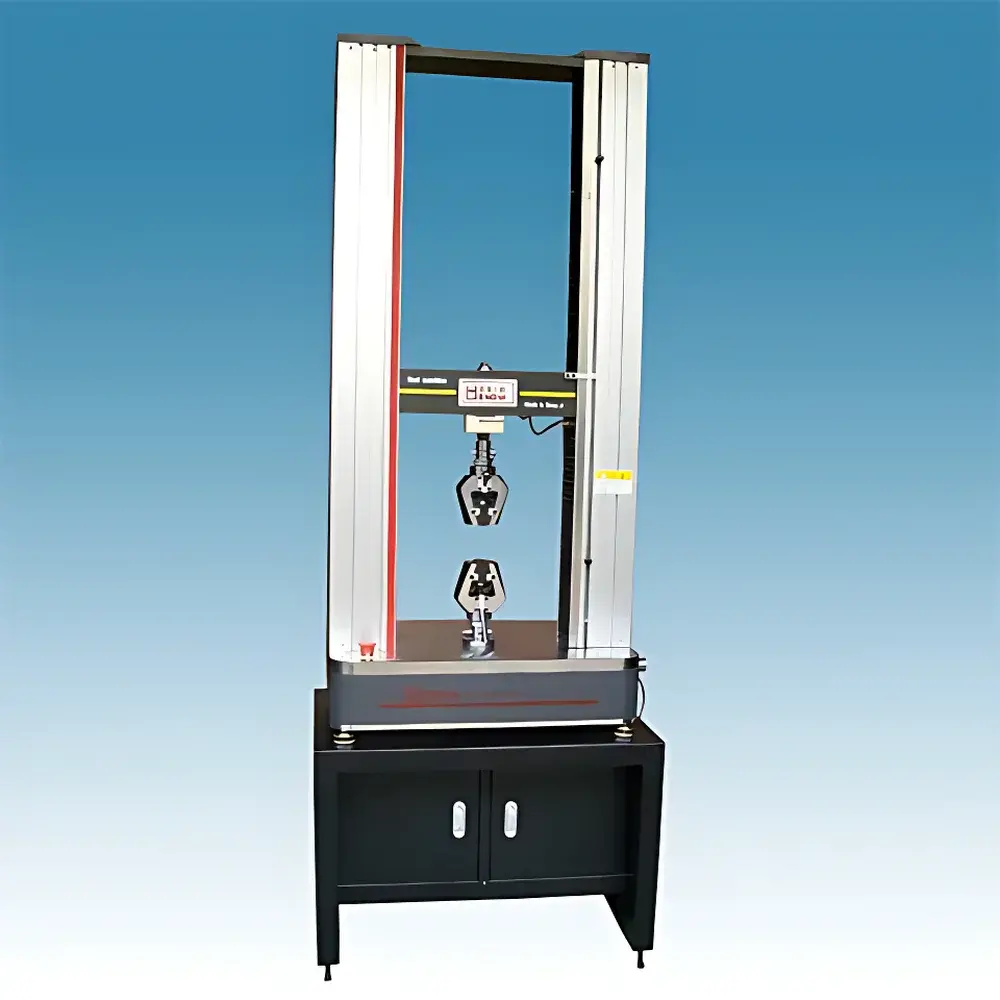
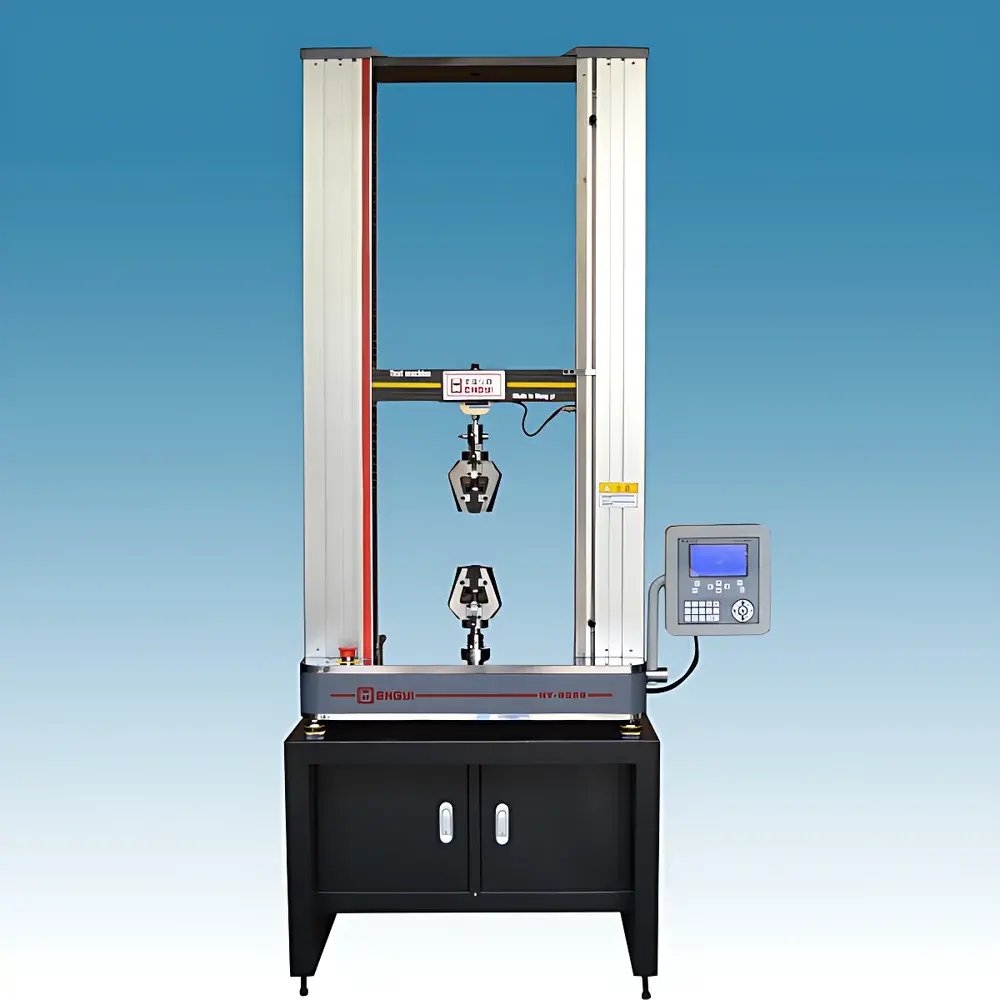
Hengyi HY-3080 Pneumatic Parallel-Grip Tensile Fixture for Universal Testing Machines
| Brand | Hengyi |
|---|---|
| Origin | Shanghai, China |
| Manufacturer Type | OEM Manufacturer |
| Country of Origin | China |
| Model | HY-3080YJJSDF |
| Max Test Force | 5 kN |
| Force Range | 5 N – 5000 N |
| Force Accuracy | ±0.5% of reading |
| Stroke | 800 mm |
| Displacement Resolution | 0.001 mm |
| Test Speed Range | 0.001–500 mm/min (adjustable) |
| Frame Type | Dual-column, rigid龙门-style frame |
| Load Cell | High-precision bidirectional load sensor |
| Control System | Digital open/closed-loop controller with multilingual & unit switching capability |
| Drive System | Maintenance-free servo motor and driver |
| Transmission | Precision preloaded ball screws (dual) |
| Safety | Electronic limit protection, overload protection (110% FS), auto-diagnostic monitoring |
Overview
The Hengyi HY-3080 Pneumatic Parallel-Grip Tensile Fixture is a precision-engineered auxiliary module designed for integration with universal testing machines (UTMs) compliant with ISO 6892-1, ASTM E8/E21, and GB/T 228.1 standards. Unlike conventional wedge or manual screw grips, this fixture employs pneumatically actuated parallel jaw motion to ensure uniform clamping pressure across the specimen cross-section—minimizing edge stress concentration and slippage during high-accuracy tensile characterization. Its core function is to deliver repeatable, zero-slip gripping for low-stiffness, thin, or highly extensible materials where axial alignment and consistent preload are critical to valid modulus, yield strength, and elongation-at-break measurements. The fixture is fully compatible with both open-loop and closed-loop UTM control architectures and supports real-time synchronization of force, displacement, and strain data acquisition at up to 1 kHz sampling rates.
Key Features
- Pneumatically driven parallel jaw mechanism ensures constant clamping force and perfect jaw alignment—eliminating specimen tilt and premature failure at grip interfaces.
- Modular mounting interface conforms to standard UTM crosshead configurations (M12–M16 threaded holes, center-to-center spacing ≤ 120 mm), enabling rapid installation without mechanical modification.
- Interchangeable jaw faces available in serrated steel, rubber-coated, and soft-faced elastomer variants—optimized for films, fibers, foams, biomedical wires, and brittle substrates.
- Integrated pressure regulation system (0.2–0.7 MPa adjustable) allows fine-tuning of clamping force to match specimen compliance—preventing crushing of soft polymers or slippage of high-strength metallic ribbons.
- Zero-backlash transmission design with dual preloaded ball screws guarantees sub-micron positional repeatability over extended duty cycles.
- Digital controller supports SI/imperial unit switching, 12-language UI (English, German, French, Spanish, Japanese, Korean, Russian, Arabic, Portuguese, Italian, Polish, Chinese), and configurable I/O for external extensometers or environmental chambers.
Sample Compatibility & Compliance
The HY-3080 fixture accommodates specimens ranging from 0.05 mm diameter ultrafine tungsten wire to 50 mm wide polymer sheets, with thicknesses from 0.01 mm (e.g., PVDF piezoelectric film) to 3 mm (e.g., aluminum busbar). It meets ISO 527-2 (plastics), ISO 37 (rubber), ASTM D882 (thin plastics), ASTM D3822 (yarns/fibers), and YY/T 0681.13 (medical packaging) dimensional requirements. Jaw opening range: 0–35 mm; maximum specimen length under load: 800 mm. All structural components are machined from 6061-T6 aluminum and hardened stainless steel, anodized to ISO 8502-3 for corrosion resistance in laboratory and QC environments. The system complies with CE Machinery Directive 2006/42/EC, RoHS 2011/65/EU, and supports GLP/GMP audit trails when paired with validated software platforms.
Software & Data Management
The fixture operates seamlessly with Hengyi’s proprietary TestMaster Pro v5.2 software (Windows 10/11 x64), which implements FDA 21 CFR Part 11-compliant electronic signatures, role-based access control, and full audit logging of test parameters, calibration events, and raw data exports (CSV, XML, PDF). Real-time curve rendering supports dual-axis scaling, automatic yield point detection per ISO 6892-1 Annex B, tangent modulus calculation, and user-defined rupture criteria (load drop >15%, strain rate >5%/s, or absolute displacement threshold). Raw ASCII data streams include synchronized timestamps, filtered force (±0.5% FS), displacement (±0.5% FS), and optional extensometer strain channels—enabling post-hoc reanalysis in MATLAB, Python (NumPy/Pandas), or Minitab. Calibration certificates traceable to NIM (National Institute of Metrology, China) are supplied with each unit.
Applications
This fixture is routinely deployed in metrology labs for certified reference material validation, in R&D departments for structure–property correlation studies of novel hydrogels and shape-memory alloys, and in production QA for 100% lot-release testing of photovoltaic interconnect ribbons (e.g., tinned copper weld tapes per IEC 61215-2 MQT 17), surgical suture monofilaments (ISO 10993-12), lithium-ion battery electrode coatings (thickness <100 µm), and biodegradable packaging films (PLA, PHA). It is also specified in internal test methods at Tier-1 automotive suppliers for tensile evaluation of airbag fabric seams, EV battery module thermal interface pads, and composite battery cell casings per SAE J2276.
FAQ
Is the HY-3080 compatible with non-Hengyi testing systems?
Yes—it supports standard analog ±10 V force/displacement signals and RS-232/USB TTL communication protocols, enabling integration with Instron, ZwickRoell, Shimadzu, and MTS frames via optional signal conditioning modules.
What maintenance is required for the pneumatic system?
Annual inspection of air filter regulators and replacement of PU tubing every 24 months under continuous operation; no lubrication required for the pneumatic cylinder or guide rails.
Can the fixture be used for compression or peel testing?
No—it is mechanically optimized for uniaxial tension only; compression or shear applications require dedicated fixtures conforming to ASTM D695 or D1876 specifications.
Does it support high-temperature testing?
Not natively—the base aluminum structure is rated for ambient operation (10–35°C); for elevated temperature work, users must integrate externally heated environmental chambers with custom adapter plates.
How is traceability ensured for calibration?
Each load cell ships with a NIM-traceable certificate (uncertainty ≤ 0.15% FS at 23°C ±2°C), and the controller’s internal ADC is verified using NIST-traceable voltage references during factory acceptance testing.



