
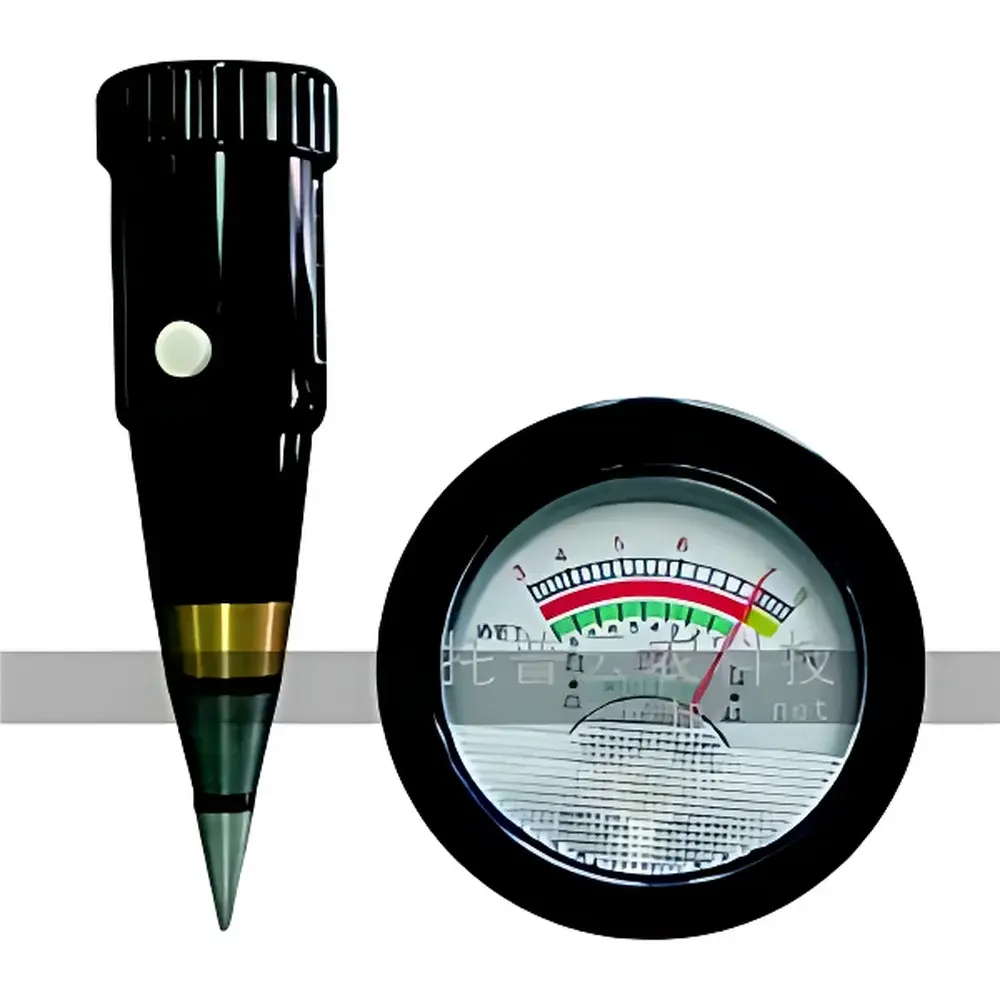
Top Cloud-agri SDT-60 Soil Acidity and Moisture Meter
| Brand | Top Cloud-agri |
|---|---|
| Origin | Zhejiang, China |
| Manufacturer Type | Direct Manufacturer |
| Model | SDT-60 |
| pH Range | 3–8 |
| pH Accuracy | ±0.2 pH |
| Moisture Range | 1–8% (v/v or gravimetric equivalent) |
| Moisture Accuracy | ±1% |
| Probe Insertion Depth | 6 cm |
| Power Source | None (galvanic cell-based, self-powered) |
| Probe Material | Corrosion-resistant metal alloy |
| Expected Service Life | ≥3 years |
| Compliance | Designed for field-deployable soil assessment per ISO 10390:2022 (soil pH determination) and ASTM D4972-21 (acid-soluble salts in soils) |
Overview
The Top Cloud-agri SDT-60 Soil Acidity and Moisture Meter is a passive, battery-free field instrument engineered for rapid, on-site estimation of soil pH and relative moisture content. Unlike laboratory-grade potentiometric pH meters that rely on glass electrodes and reference electrolytes, the SDT-60 operates on a galvanic principle—utilizing a bimetallic sensor system embedded in a solid-state probe. When inserted into moist soil, the probe forms an electrochemical cell where redox reactions between soil electrolytes and dissimilar metal surfaces generate a microcurrent proportional to hydrogen ion activity (pH) and ionic conductivity (correlated with moisture). This analog current directly drives a calibrated analog meter movement, eliminating dependency on external power sources or digital signal processing. The device is purpose-built for agricultural extension work, ecological monitoring, and preliminary site screening—where portability, operational simplicity, and maintenance resilience outweigh the need for laboratory-grade metrological traceability.
Key Features
- Battery-free operation: Self-powered via soil-mediated galvanic potential; no batteries, charging, or firmware updates required.
- Dual-parameter readout: Simultaneous analog indication of estimated pH (3–8 scale) and relative moisture (1–8% range), optimized for mineral soils with moderate organic content.
- Robust probe architecture: 6 cm insertion depth probe fabricated from corrosion-resistant metal alloys—designed to withstand repeated insertion into loam, clay, and sandy soils without calibration drift or mechanical fracture.
- Field-serviceable design: No consumables, no replaceable electrodes, and no liquid junctions—reducing long-term TCO and eliminating cross-contamination risks between sampling points.
- ISO-aligned usability: Complies with procedural intent of ISO 10390:2022 for routine field pH estimation, supporting GLP-compliant data logging when paired with standardized sampling protocols (e.g., 1:1 soil:water slurry pre-moistening where native moisture falls below 3%).
Sample Compatibility & Compliance
The SDT-60 is validated for use in mineral soils with bulk density ≤1.6 g/cm³ and organic matter content 4 dS/m), peat, or heavily compacted subsoils—conditions requiring confirmatory lab analysis per ISO 14253-1 or USP . While not certified for regulatory reporting under EPA Method 9045D or ASTM D2720, its output meets the performance criteria for Tier-1 field triage in environmental site assessments (ESA) and agronomic scouting. All materials contacting soil conform to RoHS Directive 2011/65/EU. Device labeling includes CE-marking for non-medical environmental instrumentation.
Software & Data Management
The SDT-60 is an analog-only instrument with no onboard memory, Bluetooth, or USB interface. Data capture requires manual transcription into field notebooks or digital platforms (e.g., ArcGIS Field Maps, FarmLogs, or custom LIMS). For audit readiness, users are advised to record probe insertion depth, soil texture notes, ambient temperature, and time/date alongside each reading. When integrated into QA/QC workflows, the SDT-60 supports 21 CFR Part 11–compliant documentation if paired with electronic signature-enabled tablets and timestamped photo logs of meter readings and sampling context.
Applications
- Agronomic lime recommendation screening across smallholder and precision farming operations.
- Rapid pH stratification mapping in orchard and vineyard soil health surveys.
- Pre-planting soil suitability assessment for acid-sensitive crops (e.g., alfalfa, clover, brassicas).
- Post-remediation verification of pH stabilization in brownfield sites.
- Educational demonstrations of soil electrochemistry principles in university field labs.
FAQ
Does the SDT-60 require calibration before use?
No—calibration is not user-performed. The meter is factory-set using NIST-traceable buffer standards (pH 4.01 and 7.00) and verified against saturated CaCl₂ extracts per ISO 10390 Annex B. Recalibration is not supported in-field.
Can it measure pH in hydroponic nutrient solutions or compost?
Not recommended. The probe’s galvanic response is optimized for heterogeneous, particulate soil matrices—not homogeneous aqueous solutions. Use a conventional glass-electrode pH meter for such applications.
How does moisture affect pH readings?
Moisture level directly influences ionic mobility and contact resistance. Readings taken at moisture levels <2% may yield unstable or non-reproducible current; pre-moistening to ~5% is advised for consistency.
Is the probe compatible with acidic or alkaline soils outside the 3–8 range?
No. The analog scale is physically bounded at pH 3 and pH 8. Values beyond this range produce pegged readings and cannot be extrapolated.
What maintenance is required after daily use?
Rinse probe gently with deionized water, wipe dry with lint-free cloth, and store in ventilated, low-humidity environment. Avoid abrasive cleaning agents or ultrasonic baths.







