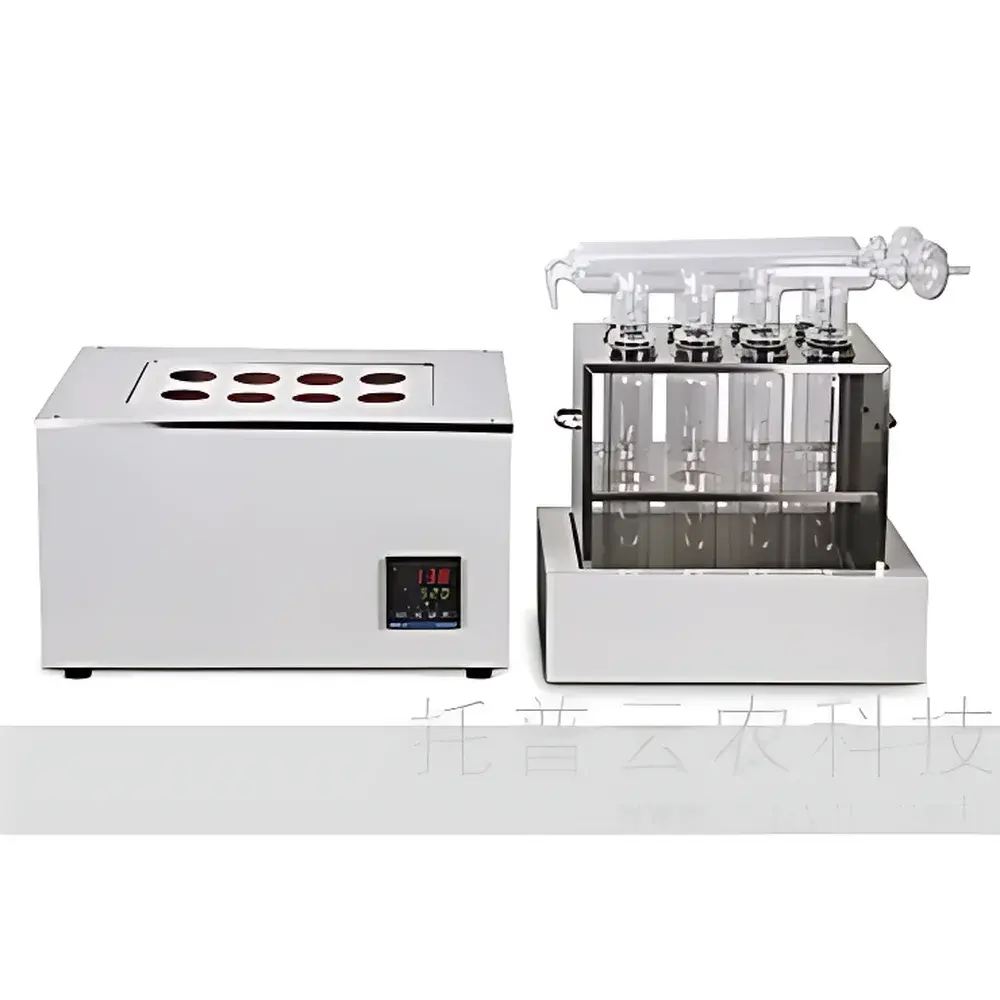
Top Cloud-agri KDN-04C Infrared Smart Digestion Block
| Brand | Top Cloud-agri |
|---|---|
| Origin | Zhejiang, China |
| Manufacturer Type | Direct Manufacturer |
| Country of Origin | China |
| Model | KDN-04C |
| Heating Method | Infrared Radiation with Auxiliary Air Conduction |
| Temperature Control | Digital PID, Programmable Multi-Stage |
| Temperature Range | Ambient to 600 °C |
| Temperature Accuracy | ±1 °C |
| Ramp Rate | Up to 30 °C/min |
| Digestion Capacity | 4 × 300 mL Tubes |
| Power Rating | 1000 W |
| Input Voltage/Frequency | AC 220 V, 50 Hz |
| Construction | Powder-Coated Steel Enclosure + Acid-Resistant Stainless Steel Work Surface |
| Insulation | Dual-Layer (Air Gap + Alumina-Silicate Ceramic Board) |
| Safety Protections | Over-Temperature, Over-Current, and Over-Voltage Cut-Off |
| Nitrogen Determination Range | 0.1–200 mg N per sample |
| Typical Digestion Time | 60–90 min per batch |
| Compliance | Designed for Kjeldahl digestion workflows per ISO 8585, AOAC 981.10, and ASTM D1317 |
Overview
The Top Cloud-agri KDN-04C Infrared Smart Digestion Block is an engineered solution for controlled, reproducible sample mineralization in Kjeldahl nitrogen analysis workflows. Unlike conventional hot plates or open-flame digesters, this unit employs focused infrared radiation—supplemented by convective air conduction—to deliver rapid, uniform thermal energy across the digestion block surface. The system is purpose-built for laboratories processing high-fat, high-protein, or viscous matrices such as dairy products, animal feed, cereals, and environmental sludges. Its design directly addresses two critical operational hazards: (1) foam-over during initial acid digestion of lipid-rich samples, and (2) uncontrolled release of corrosive and toxic fumes—including SO₂, NOₓ, and HBr—generated during sulfuric acid–catalyzed decomposition. By integrating a precisely controllable heating profile, dual-layer thermal insulation, and robust mechanical containment, the KDN-04C ensures sample integrity, operator safety, and analytical consistency throughout the digestion phase—the most variable and failure-prone step in total nitrogen quantification.
Key Features
- Infrared heating module with auxiliary air conduction delivers rapid, spatially uniform thermal transfer—achieving up to 30 °C/min ramp rates while maintaining ≤±1 °C temperature stability across all four digestion positions.
- Digital PID temperature controller supports multi-stage programmable profiles (e.g., low-temperature pre-digestion → ramp → hold), enabling method optimization for diverse sample types without manual intervention.
- Dual thermal insulation architecture: an outer air-gap barrier minimizes surface heat loss, while an inner layer of high-purity alumina-silicate ceramic board provides structural integrity and sustained thermal retention at 600 °C.
- Integrated safety circuitry includes independent over-temperature cutoff (activated >620 °C), current-limiting protection, and voltage surge suppression—meeting IEC 61010-1 requirements for laboratory electrical equipment.
- Corrosion-resistant construction: powder-coated steel chassis and electropolished 316 stainless steel work surface withstand repeated exposure to concentrated H₂SO₄, H₂O₂, and catalyst mixtures (e.g., CuSO₄/K₂SO₄).
Sample Compatibility & Compliance
The KDN-04C is validated for use with standard 300 mL borosilicate digestion tubes (e.g., Pyrex® or equivalent) and compatible with classical Kjeldahl reagents including 95–98% sulfuric acid, selenium or copper catalysts, and hydrogen peroxide enhancers. It supports digestion protocols aligned with ISO 8585:2022 (Foodstuffs — Determination of nitrogen content), AOAC Official Method 981.10 (Crude Protein in Feed), and ASTM D1317 (Total Nitrogen in Coal and Coke). While not intrinsically certified for GLP or 21 CFR Part 11 compliance, its digital temperature logging capability (via optional RS-232/USB interface) permits integration into validated LIMS environments where audit trails and electronic signature requirements apply.
Software & Data Management
The KDN-04C operates via an embedded microcontroller with a backlit LCD interface displaying real-time setpoint, actual temperature, elapsed time, and active stage. Optional firmware upgrade enables serial data output (ASCII format) for external recording via PC-based software or PLC systems. Logged parameters include timestamped temperature readings at 10-second intervals, stage transition events, and fault codes—facilitating retrospective process verification and deviation investigation. No proprietary software is required; raw data streams are compatible with common spreadsheet, SCADA, and ELN platforms.
Applications
- Routine nitrogen determination in dairy quality control labs (raw milk, whey, infant formula)
- Feed formulation and nutritional labeling for livestock and aquaculture industries
- Environmental monitoring of wastewater sludge, compost, and soil extracts
- Research-scale method development for alternative digestion catalysts or acid mixtures
- Teaching laboratories requiring safe, repeatable demonstrations of wet-ashing principles
FAQ
Is the KDN-04C suitable for mercury-catalyzed digestion methods?
Yes—its stable temperature control and corrosion-resistant surface support mercury oxide or mercury sulfate protocols, though users must implement additional fume extraction per OSHA 1910.1200 due to Hg volatility.
Can the unit be integrated into an automated Kjeldahl system with distillation and titration modules?
It features standard 0–5 V analog output and TTL-compatible trigger signals for synchronization with third-party distillers (e.g., Büchi, Gerhardt, or UDK series) using relay-based interlock logic.
What maintenance is required for long-term infrared heater performance?
Annual visual inspection of quartz IR emitters for discoloration or microfractures is recommended; replacement heaters are field-swappable without calibration recalibration.
Does the KDN-04C meet CE marking requirements for export to the EU?
It complies with EN 61010-1:2010+A1:2019 and EN 61326-1:2013 for EMC and safety—CE documentation is available upon request for customs clearance.
How does the dual-layer insulation affect energy consumption compared to single-layer units?
Independent testing shows ~22% reduction in steady-state power draw during 4-hour 420 °C holds, translating to lower operational cost and reduced ambient heat load in climate-controlled labs.
Related Products