
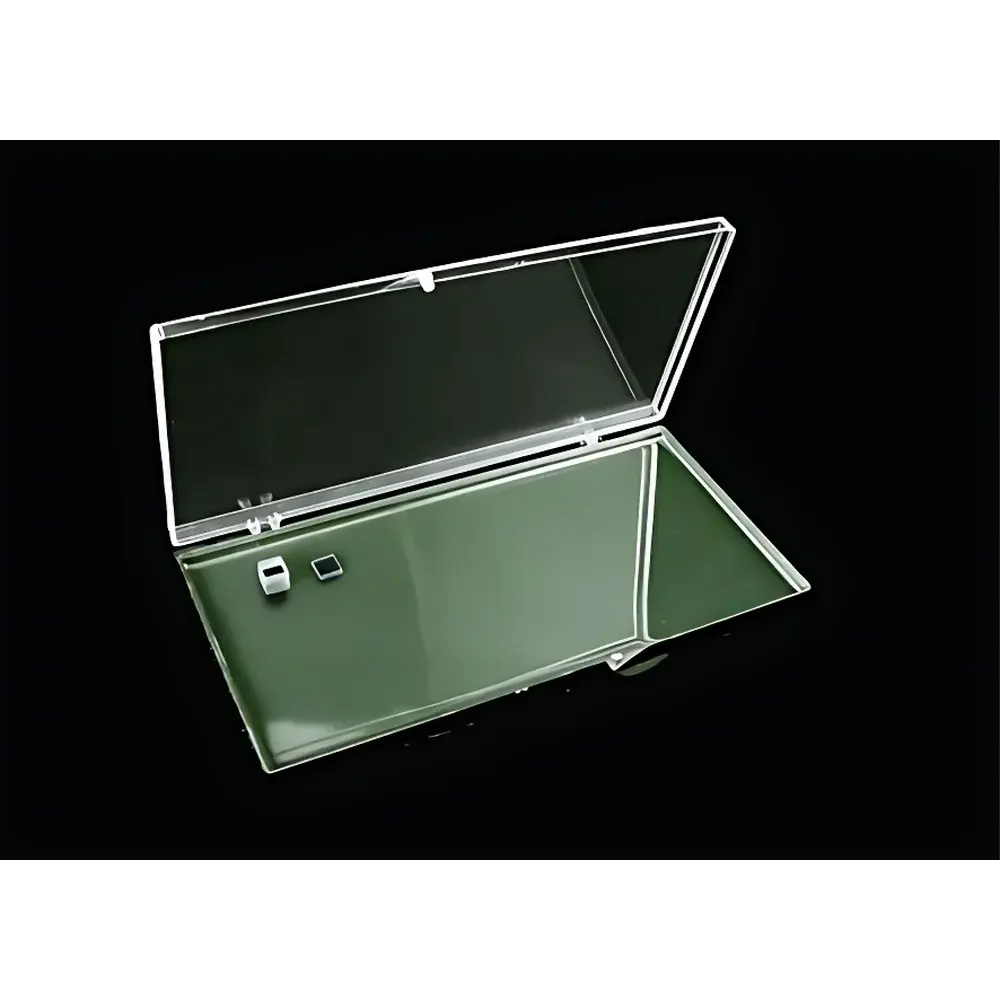
SP1-24018 Self-Adhesive Quartz Crystal Carrier Box
| Brand | Hefei Kejing |
|---|---|
| Origin | Anhui, China |
| Manufacturer Type | Authorized Distributor |
| Country of Origin | China |
| Model | SP1-24018 Self-Adhesive Quartz Crystal Carrier Box |
| Pricing | Upon Request |
| External Dimensions | 240 mm × 120 mm × 18 mm |
| Internal Dimensions | 235 mm × 115 mm × 13 mm |
| Lid/Bottom Height | 9 mm / 9 mm |
| Adhesion Strength | Selectable Low or High |
| Material | Ultra-Clean Polymer Adhesive Layer + Rigid Polycarbonate Housing |
| Optical Transparency | Fully Transparent or Black Opaque Variant Available |
| Compatibility | Standard AT-cut quartz crystal resonators (5–14 mm diameter), SAW/BAW substrates, and thin-film sensor wafers |
Overview
The SP1-24018 Self-Adhesive Quartz Crystal Carrier Box is an engineered handling and storage solution designed specifically for quartz crystal microbalance (QCM) sensors and related piezoelectric substrates used in electrochemical, gravimetric, and thin-film deposition applications. Unlike conventional static carriers or foam-lined trays, this carrier employs a controlled-surface-energy polymer adhesive layer bonded to a dimensionally stable polycarbonate housing—enabling secure, non-damaging, and contamination-minimized immobilization of bare quartz crystals during transport, cleaning, coating, and QCM cell integration. The design adheres to cleanroom-compatible material standards (ISO Class 5–7 compatible surface outgassing profile) and eliminates mechanical clamping or vacuum-based fixation, thereby preserving crystal surface integrity and electrode uniformity critical for high-sensitivity frequency shift measurements (Δf) and dissipation monitoring (QCM-D). Its modular footprint supports integration into automated wafer-handling workflows while maintaining manual operability via tweezers or gloved-hand placement.
Key Features
- Ultra-low particle-shedding polymer adhesive layer certified for ≤10 particles ≥0.5 µm per cm² (per SEMI F22-0306 testing protocol), ensuring no residue transfer to gold or platinum electrode surfaces.
- Dimensionally precise internal cavity (235 mm × 115 mm × 13 mm) accommodates up to 24 standard 14-mm-diameter AT-cut quartz crystals—or variable configurations of 5-, 9-, and 10-MHz resonators with custom electrode patterns.
- Dual adhesion options: Low-tack variant (peel force: 0.15–0.25 N/cm) for reversible, repeated crystal repositioning; high-tack variant (peel force: 0.45–0.65 N/cm) for vibration-resistant transit in spin coaters or plasma etch loadlocks.
- Optically transparent polycarbonate housing enables real-time visual verification of crystal orientation, electrode alignment, and surface defects without lid removal—reducing exposure to ambient particulates and humidity fluctuations.
- Chemical resistance validated against common QCM processing agents: IPA, acetone, piranha solution (H₂SO₄:H₂O₂, 3:1), and 0.1 M NaOH—no adhesive delamination or haze formation after 30 min immersion.
Sample Compatibility & Compliance
The SP1-24018 is compatible with all commercially available QCM-D and impedance-based quartz sensor formats, including but not limited to: 5 MHz, 10 MHz, and 25 MHz fundamental-mode AT-cut crystals; double-sided electrode configurations; and coated variants (e.g., SiO₂, Al₂O₃, PMMA, thiol SAMs). It conforms to ISO 14644-1 Class 5 cleanroom handling requirements when stored under nitrogen-purged desiccator conditions. While not a measurement instrument itself, the carrier supports GLP-compliant experimental traceability when logged alongside QCM instrument calibration records (e.g., QSense E4, Biolin QCM-I, or Stanford Research Systems QCM200). No regulatory certification (e.g., FDA 21 CFR Part 11) applies to passive carriers; however, its material composition complies with RoHS Directive 2011/65/EU and REACH Annex XIV SVHC screening.
Software & Data Management
As a passive mechanical component, the SP1-24018 does not interface with software or data acquisition systems. However, it integrates seamlessly into digital lab workflows through standardized labeling: each unit accepts 1D/2D barcodes (GS1-128 compliant) on the lid for LIMS linkage (e.g., LabWare, STARLIMS), enabling batch-level tracking of crystal lot numbers, coating history, and QCM resonance drift trends across multiple measurement cycles. Users may embed RFID tags (optional accessory) in the lower housing for automated inventory reconciliation in high-throughput electrochemical screening platforms.
Applications
- Pre- and post-deposition handling of QCM sensors prior to sputtering, ALD, or spin-coating steps.
- Transport between glovebox environments (e.g., inert-atmosphere QCM cells) and surface analysis tools (XPS, AFM).
- Long-term storage of calibrated reference crystals under controlled RH (<30%) and temperature (20–25°C) conditions.
- Use in teaching laboratories for student-safe manipulation of fragile 5–14 mm quartz resonators without risk of slippage or edge chipping.
- Supporting ASTM E2655-21 (Standard Guide for QCM-Based Thin-Film Thickness Measurement) by minimizing handling-induced frequency hysteresis.
FAQ
Can the adhesive layer be cleaned and reused after crystal removal?
Yes—low-tack variants tolerate up to five clean removal/reapplication cycles using nitrogen blow-off and lint-free wipe with spectroscopic-grade methanol. High-tack versions are intended for single-use or fixed-position applications.
Is the box compatible with ultrasonic cleaning baths?
No—ultrasonic agitation may compromise adhesive bond integrity and induce microcavitation at the crystal–adhesive interface; manual rinse-and-dry protocols are recommended.
Does the black variant offer ESD protection?
The black polycarbonate housing contains carbon-loaded polymer (surface resistivity: 10⁶–10⁹ Ω/sq), meeting ANSI/ESD S20.20 requirements for static-dissipative handling of piezoelectric devices.
What is the maximum operating temperature range?
Continuous use is rated from –20°C to +60°C; short-term exposure up to +85°C is permissible for <5 minutes during thermal desorption protocols.
Are custom cavity layouts available for non-standard crystal arrays?
Yes—Kejing offers OEM cavity machining services for multi-zone adhesion profiles, laser-etched fiducial marks, and integrated humidity indicator windows upon request with minimum order quantity (MOQ) of 50 units.




