
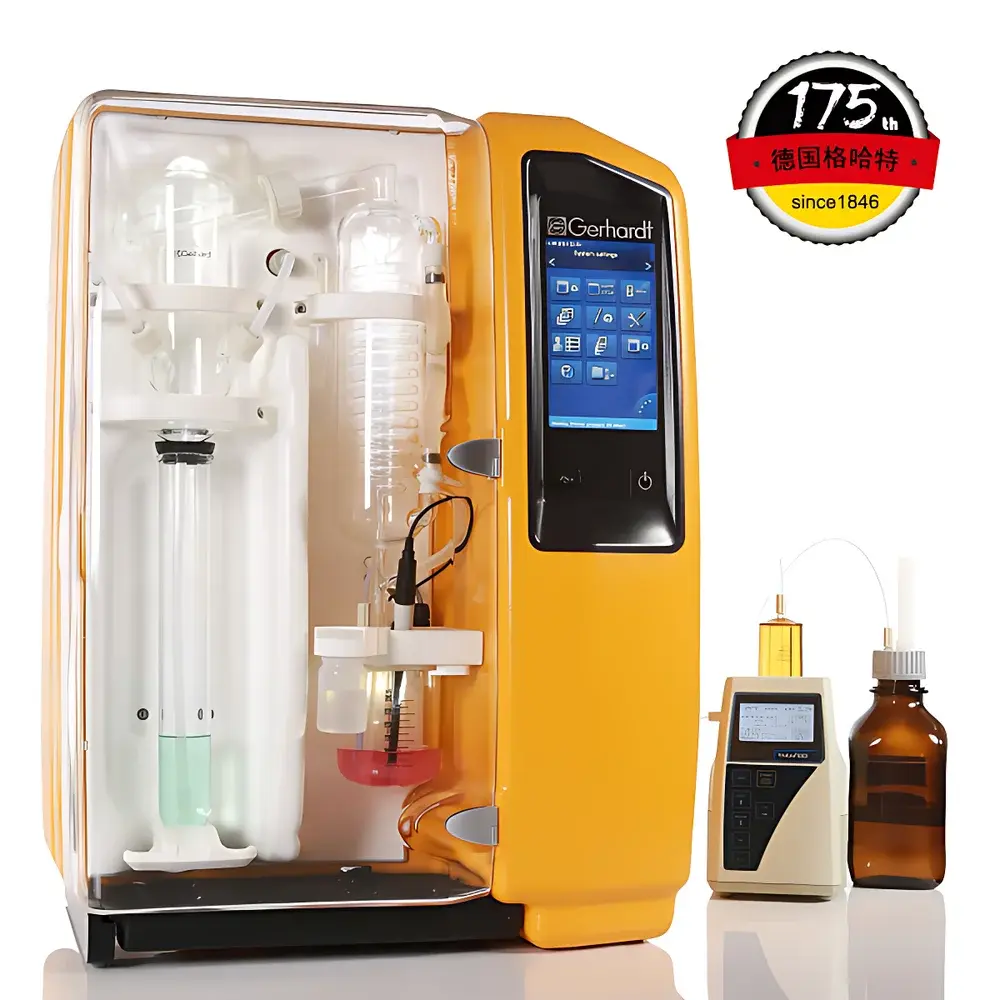
Gerhardt VAP450 Automatic Distillation Unit
| Brand | Gerhardt |
|---|---|
| Origin | Germany |
| Manufacturer | C. Gerhardt GmbH & Co. KG |
| Model | VAP450 |
| Instrument Type | Quartz Glass Distillation Apparatus |
| Heating Method | Electric |
| Cooling Method | External Circulating Chiller or Tap Water |
| Distillation Rate | 30 samples/hour |
| Heating Position | 1-place |
| Power Consumption | 2200 W |
| Voltage/Frequency | 230 V AC, 50/60 Hz |
| Dimensions (W×D×H) | 527 × 390 × 697 mm |
| Weight | 34 kg |
| Water Consumption | ~3 L/min |
| Typical Distillation Time | 3 min 30 s |
| Repeatability | ±1% |
| Detection Limit | 0.1 mg |
| Recovery Rate | >99.5% |
Overview
The Gerhardt VAP450 Automatic Distillation Unit is a precision-engineered, single-position quartz glass distillation system designed for high-reliability Kjeldahl and steam distillation applications in food, feed, environmental, and pharmaceutical laboratories. Based on the classical principle of steam distillation—where volatile analytes (e.g., ammonia liberated from digested samples) are quantitatively transferred via saturated steam into a receiving solution—the VAP450 delivers reproducible, trace-level separations under fully automated thermal control. Its robust quartz glass reaction chamber ensures chemical inertness, thermal stability up to 800 °C, and optical clarity for visual process monitoring. As a CE-marked instrument manufactured in Germany under EN ISO 9001:2000–certified quality management systems, the VAP450 reflects over 135 years of Gerhardt’s engineering heritage in thermal separation instrumentation.
Key Features
- Single-position electric heating module with precise temperature ramping and hold capability—optimized for consistent steam generation without thermal overshoot.
- Quartz glass distillation body resistant to strong acids, alkalis, and high-temperature condensates; eliminates borosilicate leaching and ensures long-term calibration stability.
- Flexible endpoint detection: programmable time-based termination (default 3 min 30 s), compatible with optional conductivity or pH sensor integration for adaptive endpoint recognition.
- Modular architecture supports field-upgradable configurations—from standalone distillation unit to integrated distillation–titration platform via external Gerhardt titrator (e.g., TitroLine 7700 or Titrino plus).
- Integrated safety interlocks: automatic steam valve cutoff upon lid opening, overtemperature shutdown, and low-water-flow alarm (when used with circulating chiller).
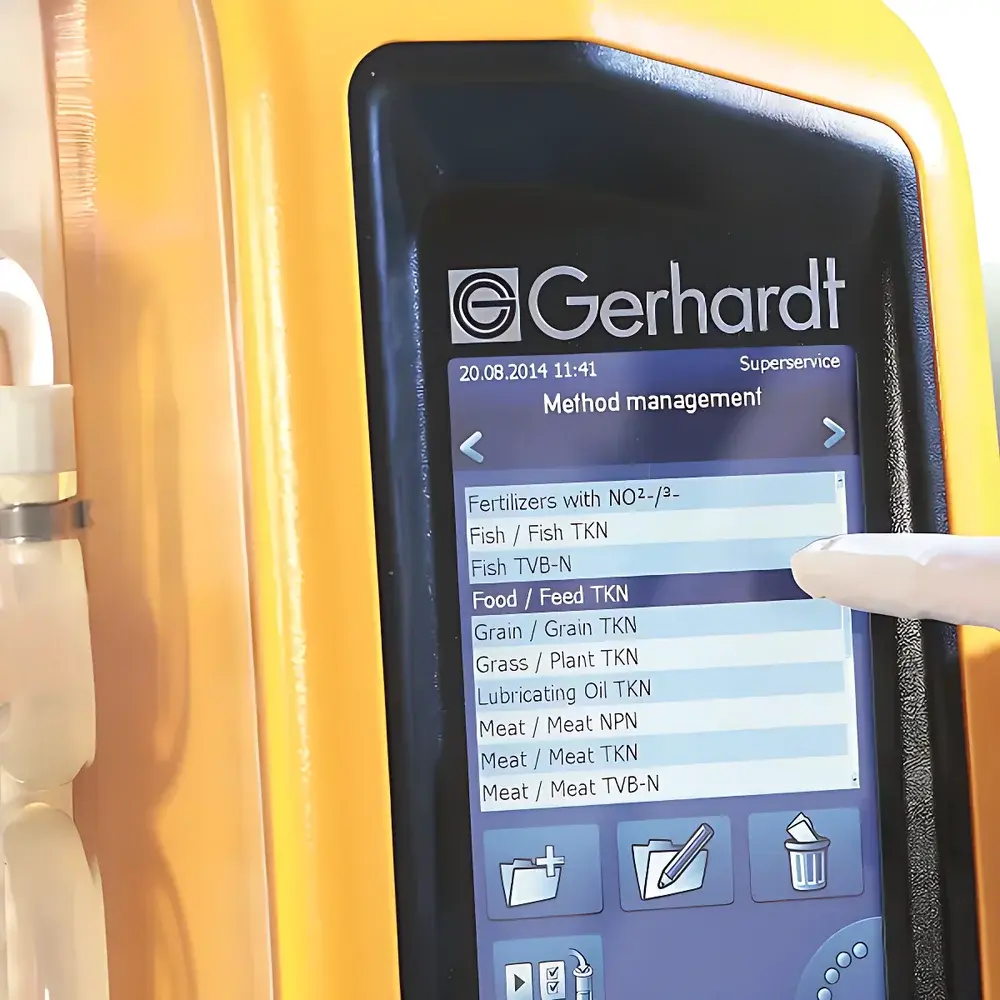
- Compliance-ready design: meets requirements for GLP environments, including audit-trail-capable operation logs (when paired with Gerhardt LabSoft software) and hardware-level parameter locking.
Sample Compatibility & Compliance
The VAP450 accommodates standard Kjeldahl digestion tubes (up to 400 mL), as well as custom sample vessels conforming to DIN 15020 and AOAC 981.10 specifications. It is validated for nitrogen determination per ISO 5983-1, ISO 8968-1, and AOAC 984.13, and supports method adaptation for cyanide, phenol, and volatile fatty acid analysis under EPA 410.1 and ASTM D129. All wetted parts comply with USP and EU Pharmacopoeia 2.2.44 material compatibility guidelines. The instrument’s mechanical and electrical design conforms to IEC 61010-1 for laboratory equipment safety.
Software & Data Management
When connected to Gerhardt LabSoft v5.x or higher, the VAP450 enables full method storage, user-access-level configuration, and electronic record generation compliant with FDA 21 CFR Part 11 (including digital signatures, change history, and electronic audit trails). Raw distillation timing, power draw profiles, and endpoint timestamps are logged at 1-second resolution. Data export supports CSV, PDF report templates, and direct LIMS integration via ASTM E1384-compliant HL7 messaging. No proprietary drivers are required—communication occurs over standard RS-232 or Ethernet TCP/IP.
Applications
- Routine total nitrogen and crude protein quantification in cereals, dairy, meat, and plant-based products.
- Regulatory testing for ammoniacal nitrogen in wastewater per ISO 5664-1 and EN 25663.
- Validation of digestion efficiency in method development workflows where distillate purity and carryover must be minimized.
- Reference laboratory use requiring traceable uncertainty budgets—supported by Gerhardt’s UKAS-accredited calibration certificates (available optionally).
- Education and training platforms: transparent quartz construction enables real-time observation of steam formation, condensation dynamics, and distillate collection kinetics.
FAQ
Can the VAP450 be operated without an external titrator?
Yes—the unit functions independently as a fully automated distillation module. Titration is optional and implemented externally via standardized interface protocols.
Is the quartz glass assembly replaceable as a field-service part?
Yes—quartz condenser, boiler, and receiver components are individually orderable with Gerhardt part numbers and installed without tools or alignment fixtures.
Does the VAP450 support multi-step distillation programs (e.g., variable steam flow rates)?
No—it executes fixed-parameter steam distillation cycles; advanced programmatic control requires integration with Gerhardt’s VAP500C model or third-party PLC interfacing.
What cooling water specifications are recommended for continuous operation?
Tap water supply must maintain ≥2 bar pressure and ≤25 °C inlet temperature; for chiller-coupled operation, a minimum flow rate of 3 L/min at ΔT ≤ 5 K is required to sustain rated throughput.
How is method validation documented for regulatory submissions?
Gerhardt provides IQ/OQ documentation templates aligned with ISO/IEC 17025 and GMP Annex 15, including blank test reports, repeatability studies (n=10), and recovery spike data sets for common matrices.



