
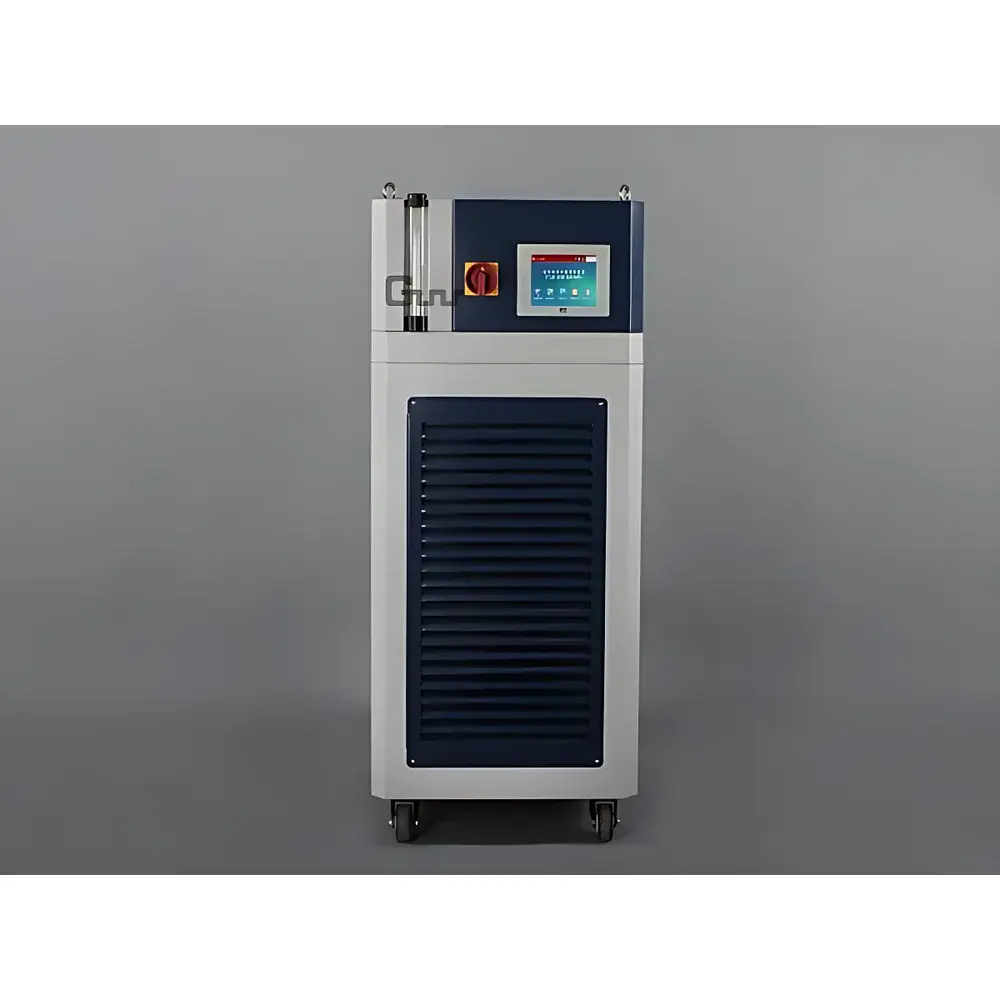
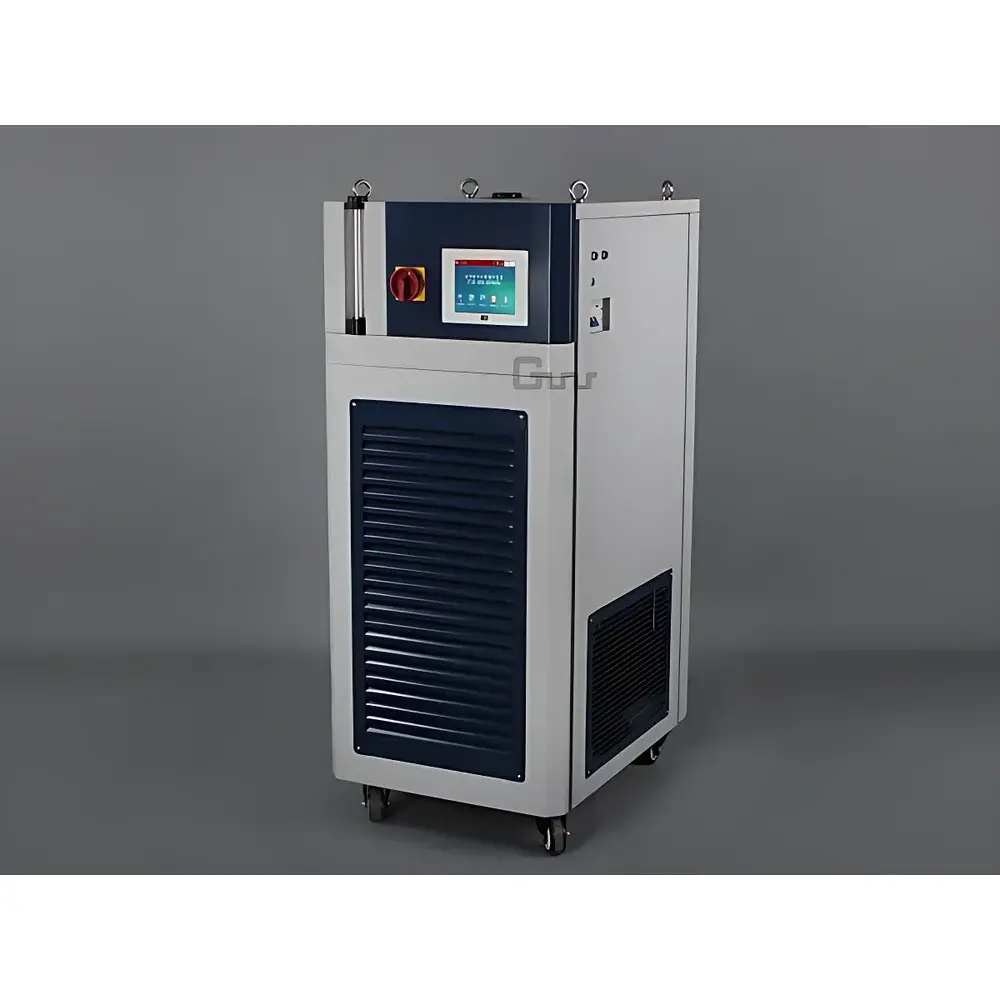
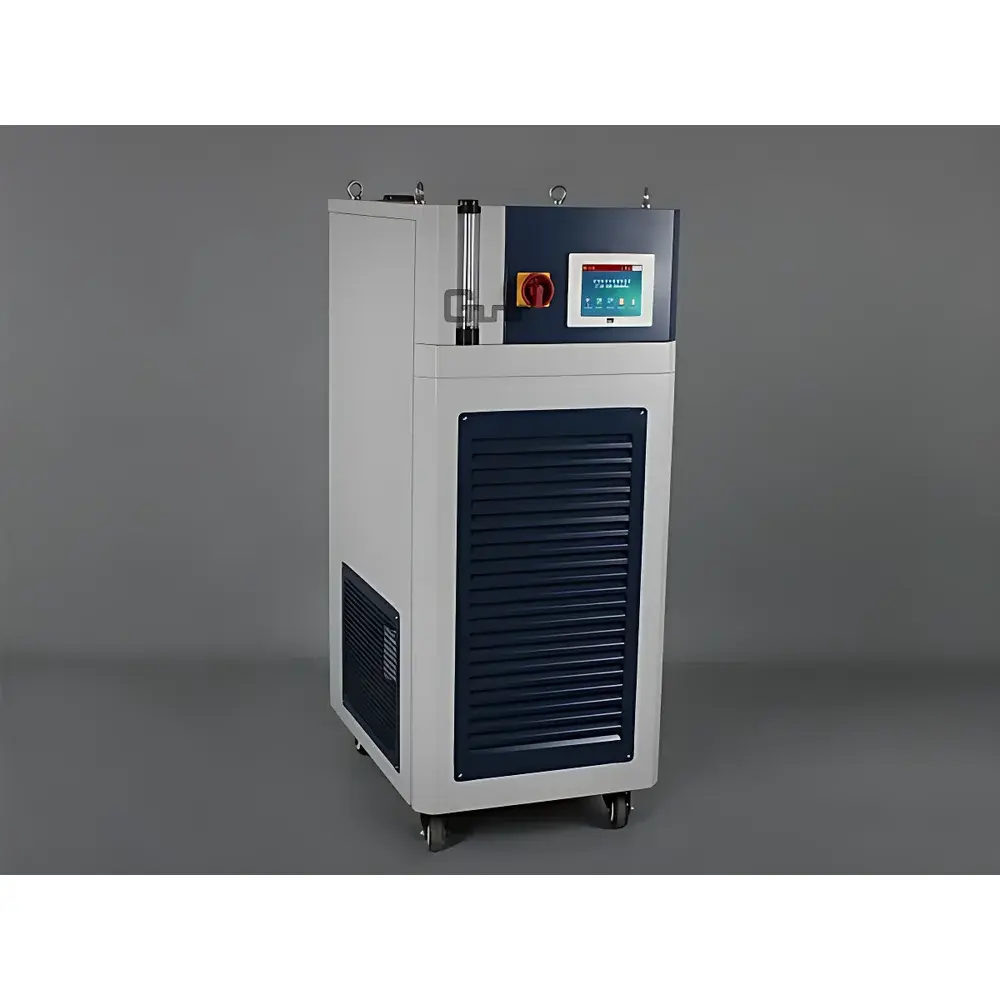
Great Wall ZT-50-200-80H Closed-Loop Cryogenic & High-Temperature Circulating Chiller
| Brand | The Great Wall |
|---|---|
| Origin | Henan, China |
| Manufacturer Type | OEM Manufacturer |
| Model | ZT-50-200-80H |
| Temperature Range | −80 °C to 200 °C |
| Temperature Stability | ±0.5 °C |
| Refrigerants | R404A / R23 |
| Total Power | 15 kW |
| Heating Power | 6 kW |
| Dual Compressors | 2 × 4.476 kW (Copeland/Tecumseh-grade hermetic piston) |
| Cooling Capacity | 8.2 kW at 200 °C, 5.0 kW at −40 °C, 1.0 kW at −78 °C |
| Pump Flow Rate | 30 L/min @ 3 bar |
| Reservoir Volume | 17 L |
| Display | 7″ TFT color touchscreen with MODBUS RTU (RS-485) |
| Compliance | JB/T 2379 (industrial electric heaters), CE-marked electrical architecture, IP54-rated control cabinet |
| Dimensions (W×D×H) | 885 × 1340 × 1580 mm |
| Weight | Approx. 320 kg |
Overview
The Great Wall ZT-50-200-80H is a fully sealed, dual-mode circulating chiller engineered for precise thermal management of external process loads—including jacketed reactors, calorimeters, spectroscopic cells, and material testing fixtures—across an exceptionally wide operational envelope of −80 °C to +200 °C. Unlike single-refrigerant systems constrained by thermodynamic limits, this unit employs a cascade refrigeration architecture with two independent compression stages: a high-stage circuit using R404A for pre-cooling and a low-stage circuit utilizing R23 to achieve sub−70 °C operation without cryogenic fluids or liquid nitrogen dependency. Its integrated heating system features flanged immersion-type electric heaters compliant with JB/T 2379, enabling seamless transition between cooling and heating modes while maintaining ±0.5 °C temperature stability under dynamic load conditions. Designed for continuous-duty laboratory and pilot-scale applications, the ZT-50-200-80H meets fundamental requirements for GLP-compliant thermal validation studies and supports traceable temperature control in regulated environments where audit-ready data integrity is essential.
Key Features
- Cascade refrigeration system with two hermetically sealed Tecumseh/Copeland-equivalent piston compressors (2 × 4.476 kW), delivering stable cooling down to −80 °C without mechanical or chemical cryogens.
- High-efficiency plate-type evaporator constructed from ASTM A240 S31603 stainless steel, rated for −160 °C to +200 °C service, with fouling-resistant geometry and <20% mass relative to shell-and-tube alternatives.
- Intelligent dual-mode control architecture: selectable “medium temperature” (heat transfer fluid) or “process temperature” (external load) regulation; supports both constant-setpoint and multi-segment programmable ramps (120 programs × 100 segments).
- Robust circulation subsystem: SUS304 fluid path including pump head, valves, and expansion tank with level-indicating float switch; integrated anti-siphon check logic prevents backflow during thermal transients.
- Comprehensive safety interlocks: high/low pressure cutouts, overcurrent protection, dry-run detection, overtemperature shutdown (dual-sensor redundancy), and compressor delay timers to prevent short-cycling.
- Industrial-grade human-machine interface: 7-inch resistive TFT touchscreen with real-time graphing of ramp profiles, event logging (timestamped alarms), and MODBUS RTU protocol support for SCADA integration and centralized fleet monitoring.
Sample Compatibility & Compliance
The ZT-50-200-80H circulates thermally stable, non-corrosive heat transfer media—including silicone oils, polyalphaolefins (PAOs), and specialized low-temperature glycol blends—within a fully closed loop. All wetted components (reservoir, piping, pump, and heat exchangers) are fabricated from ASTM A240 S30400 or S31603 stainless steel to ensure compatibility with chemically aggressive process streams and eliminate leachable metal contamination. The system operates within ambient conditions of 5–35 °C and ≤70% RH, and its electrical design conforms to IEC 61000-6-2/6-4 immunity/emission standards. While not inherently FDA 21 CFR Part 11–compliant, its audit-trail-capable HMI and MODBUS-enabled data export facilitate integration into validated workflows meeting ISO/IEC 17025, USP , and GMP Annex 11 requirements when deployed with qualified software infrastructure.
Software & Data Management
The embedded controller logs all operational parameters—including setpoint, actual medium temperature, compressor discharge pressure, pump current, and alarm history—with microsecond-resolution timestamps. Data exports via USB mass storage or RS-485 to third-party LIMS or MES platforms using standard MODBUS RTU register mapping (e.g., holding registers 40001–40120 for thermal profile, status flags, and fault codes). Programmable ramp sequences support complex thermal protocols required for polymer curing, catalyst activation, or accelerated aging tests. Optional firmware upgrades enable CSV-formatted trend reports compatible with JMP, MATLAB, or Python-based analysis pipelines. No cloud connectivity or remote access is enabled by default—ensuring full data sovereignty per institutional IT policies.
Applications
- Temperature-controlled synthesis in jacketed glass or stainless-steel reactors (e.g., Grignard reactions requiring −60 °C initiation followed by 120 °C reflux).
- Calibration and verification of differential scanning calorimeters (DSC), thermogravimetric analyzers (TGA), and dynamic mechanical analyzers (DMA).
- Stability testing of pharmaceutical formulations across ICH Q1A-recommended storage conditions (−20 °C, 25 °C/60% RH, 40 °C/75% RH simulated via external chamber coupling).
- Thermal cycling of composite materials, battery cells, and optoelectronic packages per MIL-STD-810G or JEDEC JESD22-A104 protocols.
- Preconditioning of reference standards for metrology labs performing ISO/IEC 17025-accredited thermal calibration services.
FAQ
What heat transfer fluids are recommended for operation at −80 °C?
Low-viscosity, low-pour-point silicone oils (e.g., DC-200 series) or specially formulated PAO-based synthetic fluids with pour points ≤−90 °C and thermal stability >200 °C. Ethylene glycol/water mixtures are prohibited below −20 °C due to freezing and viscosity-induced pump cavitation.
Can the unit maintain temperature stability while powering a 5-L reactor with high thermal mass?
Yes—its 8.2 kW cooling capacity at 200 °C and 30 L/min flow rate ensure sufficient thermal exchange margin for jacketed vessels up to 10 L volume under typical heat load conditions (≤1.5 kW/m² jacket area).
Is remote monitoring supported out-of-the-box?
No native Ethernet or Wi-Fi interface is included; however, MODBUS RTU over RS-485 enables integration with industrial gateways (e.g., Moxa EDS-G205A) for secure OPC UA or MQTT bridging into existing plant networks.
What maintenance intervals are specified for the cascade refrigeration system?
Compressor oil analysis every 3,000 operating hours; filter-drier replacement every 12 months or after any refrigerant breach; annual calibration of PT100 sensors per ISO/IEC 17025 traceable procedures.
Does the system comply with European CE directives?
The electrical control cabinet carries CE marking per EN 61000-6-2 (immunity) and EN 61000-6-4 (emissions); mechanical pressure components meet PED 2014/68/EU Category I requirements for non-hazardous fluid service.



