
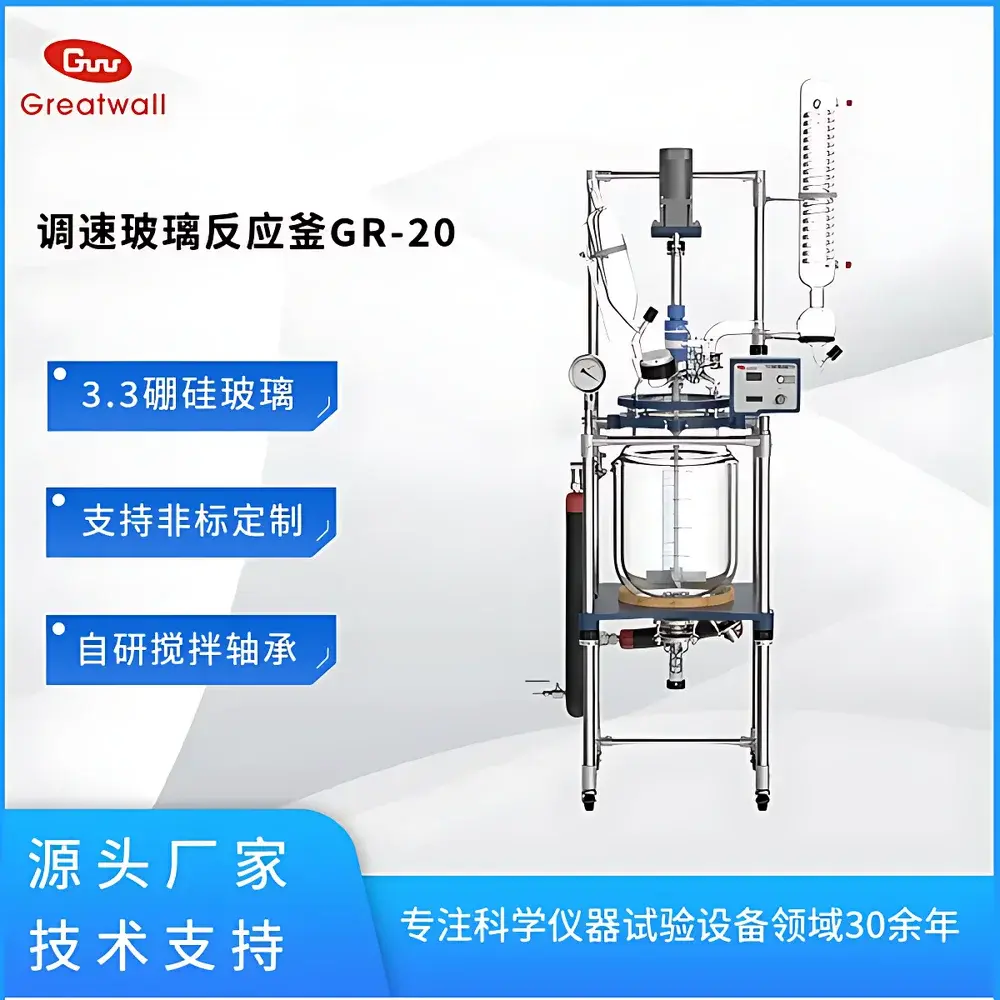
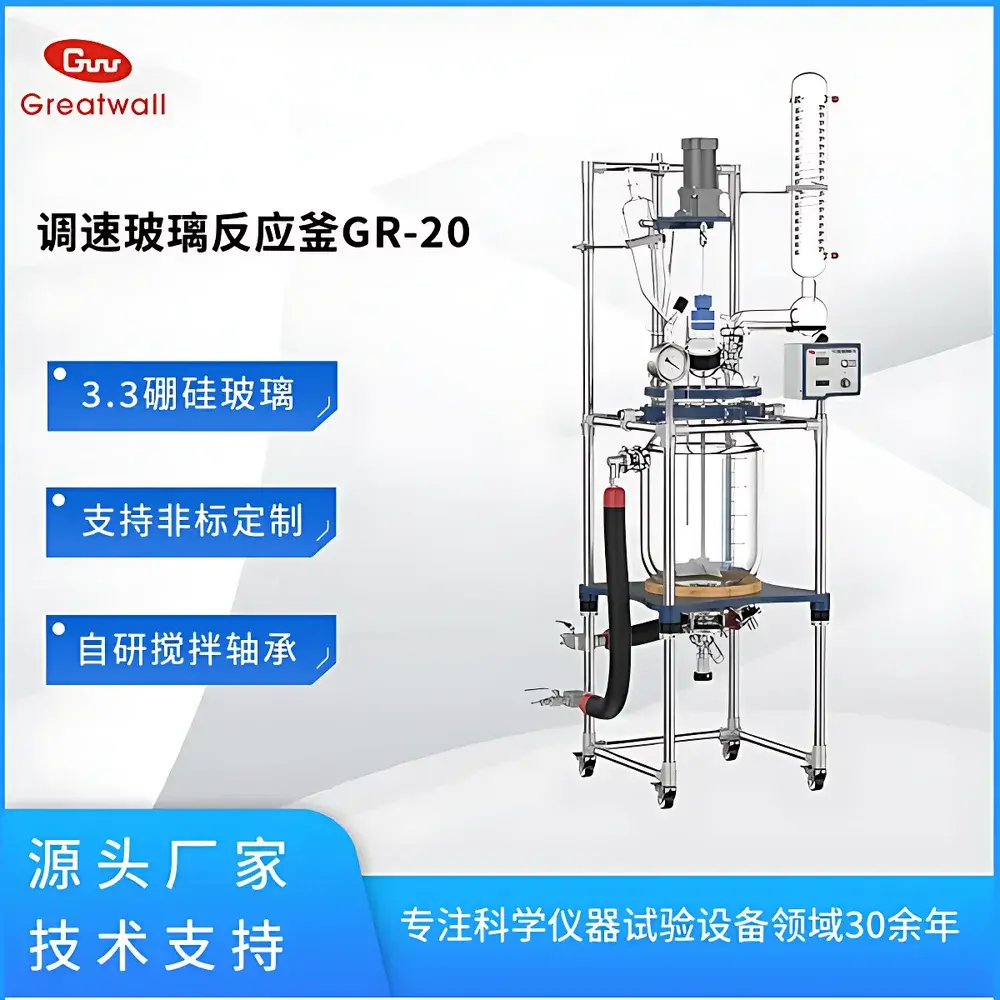
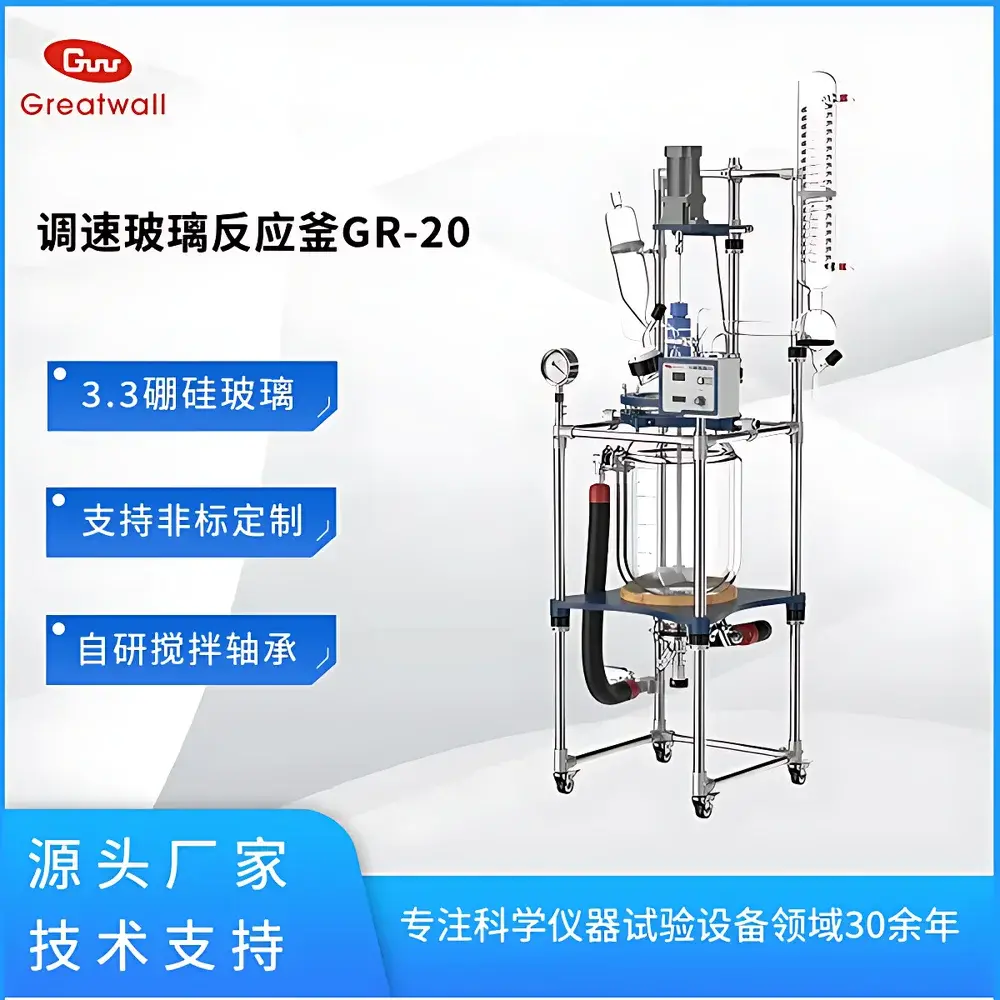
Great Wall GR-20 Dual-Jacketed Borosilicate Glass Reactor
| Brand | Great Wall |
|---|---|
| Origin | Henan, China |
| Manufacturer Type | Direct Manufacturer |
| Product Category | Domestic |
| Model | GR-20 |
| Capacity | 20 L |
| Vessel Material | 3.3 borosilicate glass |
| Operating Pressure Range | –0.1 MPa to atmospheric pressure |
| Temperature Range | –80 °C to +200 °C |
| Vacuum Performance | ≤ –0.095 MPa (absolute) |
| Sealing Components | PTFE stopcocks and discharge valve |
| Jacket Configuration | Dual-layer (inner heating/cooling jacket + outer vacuum-insulated jacket optional) |
| Application Class | Synthesis, distillation, concentration, reflux |
Overview
The Great Wall GR-20 Dual-Jacketed Borosilicate Glass Reactor is an engineered laboratory-scale reaction system designed for controlled chemical synthesis, solvent recovery, concentration, and temperature-sensitive reaction processes. It operates on the principle of double-wall thermal management: the inner jacket circulates temperature-controlled fluid (e.g., silicone oil, ethylene glycol/water, or cryogenic coolant) to precisely regulate reaction mass temperature, while the outer jacket—optionally evacuated—provides thermal insulation to minimize heat loss or gain and enhance energy efficiency. Constructed entirely from ASTM E438 Type I, Class A 3.3 borosilicate glass, the reactor exhibits exceptional resistance to thermal shock, chemical corrosion, and mechanical stress, enabling safe operation across a broad thermal envelope from –80 °C to +200 °C. Its transparent vessel allows real-time visual monitoring of phase behavior, mixing homogeneity, crystallization, and reaction progression—critical for process development under GLP-compliant research protocols.
Key Features
- Double-jacketed borosilicate glass vessel (3.3 grade) with standardized ISO/KF flange interfaces for modular integration with condensers, addition funnels, and vacuum manifolds
- PTFE-sealed stopcocks and bottom discharge valve ensuring inert, leak-tight fluid handling for air- and moisture-sensitive reagents
- Integrated vacuum-compatible design supporting sustained operation at ≤ –0.095 MPa absolute pressure—suitable for low-boiling-point solvent removal and reduced-pressure reactions
- Reinforced support frame with adjustable leveling feet and load-rated mounting points for stable operation during stirring, heating, or cooling cycles
- Standardized 20 L working volume optimized for scalability between benchtop screening and pilot-scale process validation
- Pre-installed insulated flexible tubing for external circulation loops, reducing mechanical strain on glass joints and minimizing risk of fracture during thermal cycling
- Modular customization options including integrated filtration sintered-glass frits, bottom-mounted collection trays for drip containment, and custom port configurations per ASTM D2622 or ISO 17025 method requirements
Sample Compatibility & Compliance
The GR-20 is compatible with a wide range of organic solvents (e.g., THF, toluene, DMF), aqueous solutions, and mildly aggressive reagents (e.g., dilute acids/bases up to pH 2–12). Its all-glass wetted path eliminates metal ion leaching—essential for catalysis studies, pharmaceutical intermediate synthesis, and battery electrolyte formulation. The reactor meets structural safety requirements outlined in ISO 14001 (environmental management) and supports traceability in regulated environments through documented calibration of temperature sensors and pressure transducers. While not certified for ASME Section VIII Div. 1 service, its –0.1 MPa to ambient pressure rating aligns with standard laboratory practice per OSHA 1910.1200 and EU CLP Regulation Annex VI handling guidelines.
Software & Data Management
As a manually operated, analog-integrated platform, the GR-20 does not include embedded digital control firmware. However, it is fully compatible with third-party PID controllers, data loggers (e.g., Omega iSeries, Keysight DAQ systems), and SCADA-ready temperature/pressure transmitters. Users may implement 21 CFR Part 11–compliant audit trails by connecting calibrated PT100 sensors and digital vacuum gauges to validated acquisition software. Optional accessories include RS-485-enabled circulation chillers and programmable hotplates with Ethernet output—enabling synchronized logging of jacket temperature, internal bath temperature, and vacuum level in timestamped CSV or TDMS formats.
Applications
- Multi-step organic synthesis under reflux or inert atmosphere (N₂/Ar purging via septum ports)
- Solvent-free or low-solvent condensation reactions requiring precise thermal ramping
- Distillation and fractional distillation of heat-labile compounds using vertical condenser assemblies
- Catalytic hydrogenation trials with H₂-compatible PTFE seals and pressure-rated sight glasses
- Crystallization kinetics studies with in-situ video recording through the transparent vessel wall
- Process analytical technology (PAT) integration for real-time NIR or Raman probe insertion via auxiliary ports
- Educational demonstration of reaction thermodynamics, phase equilibria, and mass transfer limitations
FAQ
What temperature control fluids are recommended for the inner jacket?
Silicone oil (–40 °C to +200 °C), 50/50 ethylene glycol/water (–30 °C to +120 °C), or specialized low-temperature heat transfer fluids (e.g., Dynalene HC-F) are commonly used—selection depends on required operating range and compatibility with external chiller/heater units.
Can the GR-20 be used under positive pressure?
No—the standard configuration is rated for vacuum and atmospheric pressure only. Positive pressure operation requires reinforced glass, certified pressure relief devices, and third-party pressure vessel certification; such modifications fall outside factory specifications.
Is the reactor suitable for ultrasonic-assisted synthesis?
Yes, when mounted on a vibration-isolated optical table and coupled with externally positioned ultrasonic transducers (e.g., Hielscher UP200St); direct immersion probes are not recommended due to potential glass fatigue.
How is cleaning and maintenance performed?
All glass components are autoclavable at 121 °C for 20 minutes. PTFE parts should be rinsed with IPA and air-dried; avoid abrasive cleaners. Annual inspection of ground-glass joints for scoring and seal integrity is advised per ISO/IEC 17025 clause 6.4.6.
Does Great Wall provide IQ/OQ documentation?
Factory-issued Installation Qualification (IQ) templates and Operational Qualification (OQ) test protocols are available upon request for GMP-aligned installations, including temperature uniformity mapping and vacuum decay testing procedures.



