
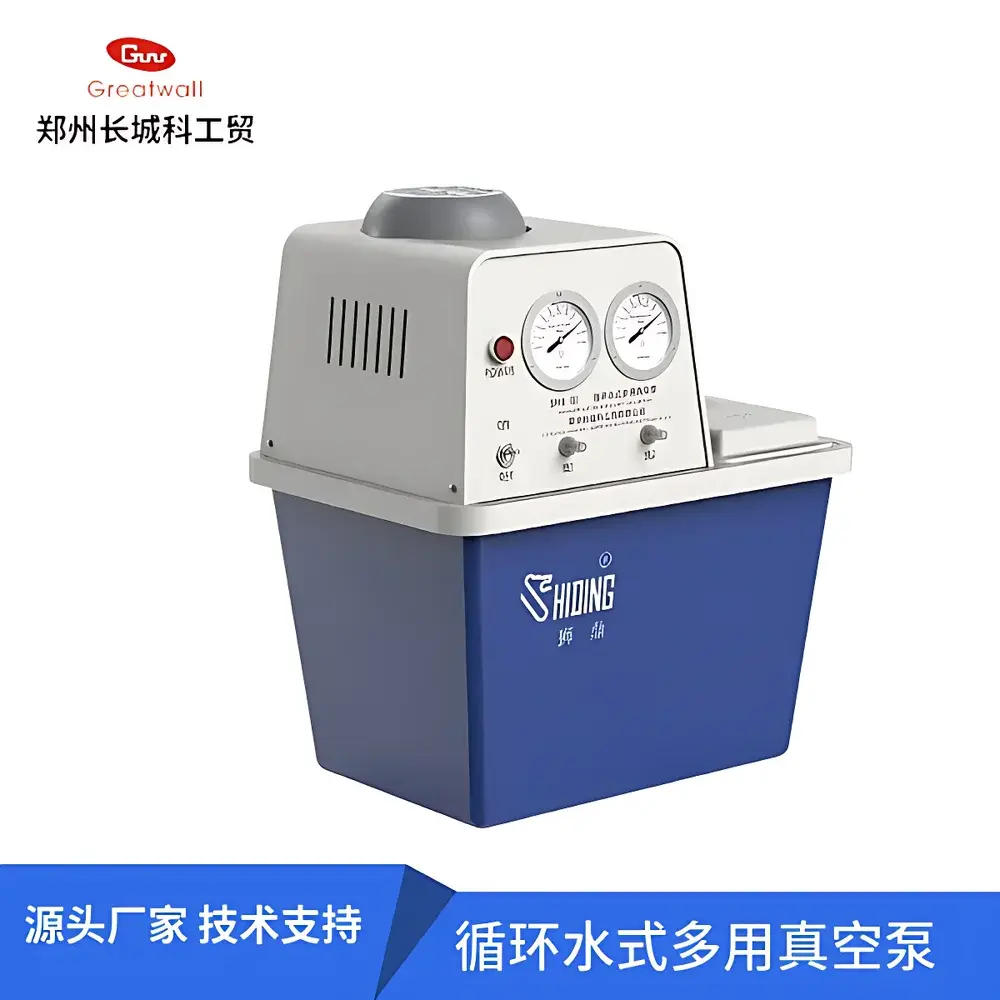
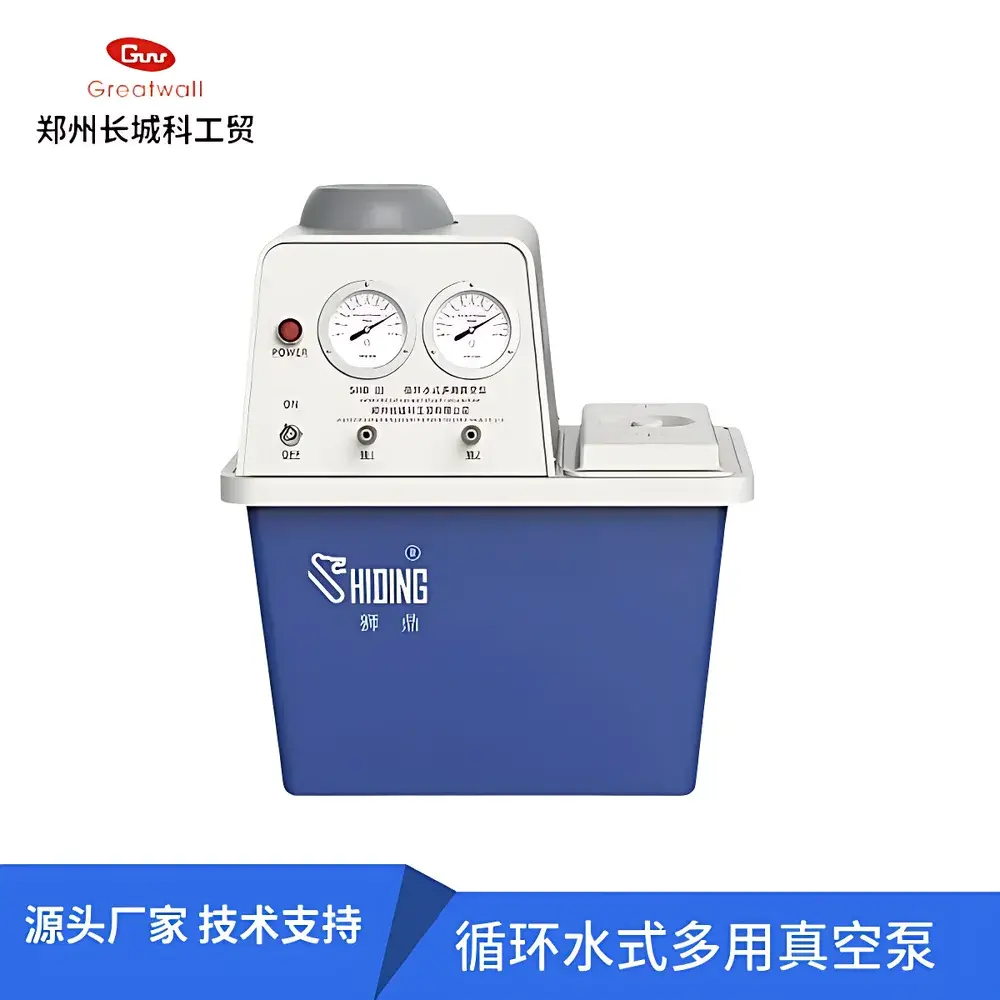
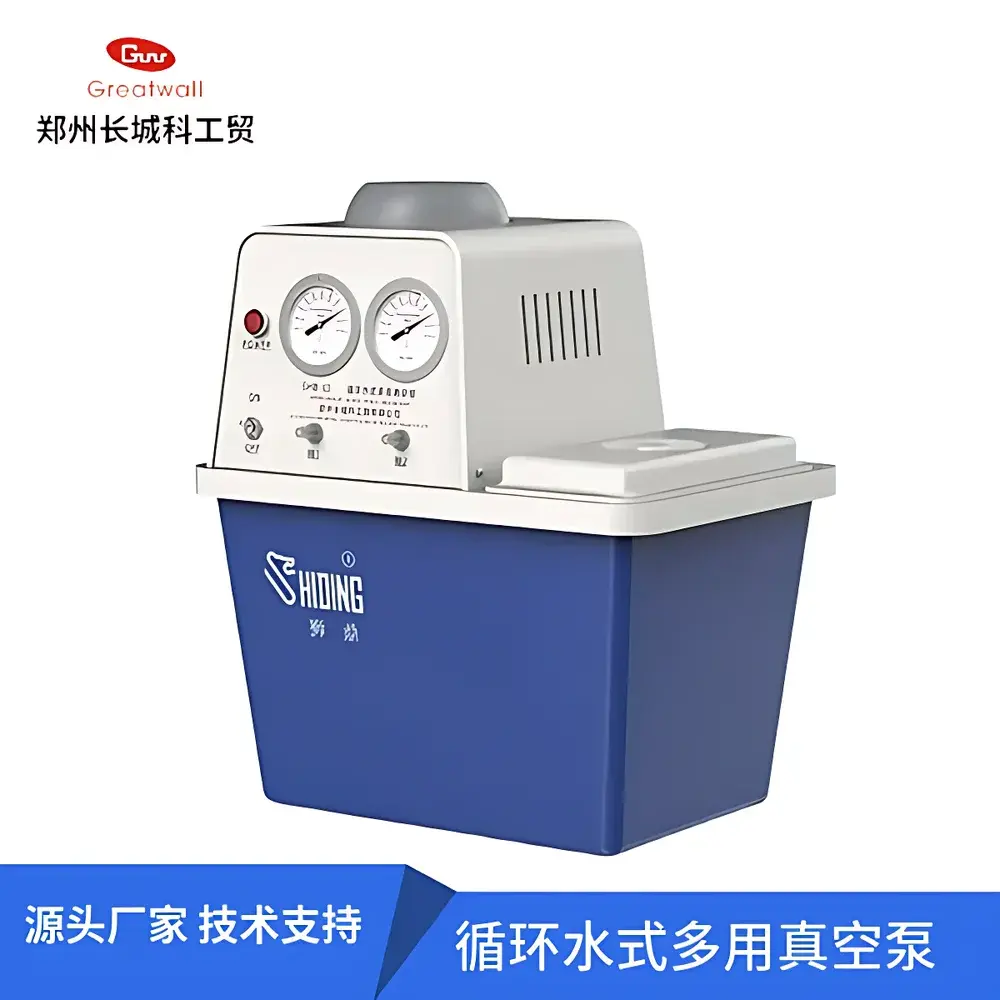
Great Wall SHB-III Circulating Water Vacuum Pump
| Brand | Great Wall |
|---|---|
| Origin | Henan, China |
| Manufacturer Type | Direct Manufacturer |
| Country of Origin | China |
| Model | SHB-III |
| Instrument Category | Circulating Water Vacuum Pump |
| Product Type | Oil-Free Vacuum Pump |
| Single-Head Pumping Rate | 10 L/min |
| Ultimate Vacuum | 0.098 MPa (20 mbar) |
| External Dimensions | 385 W × 280 D × 420 H mm |
| Weight | 9.5 kg |
| Motor Power | 180 W |
| Power Supply | 220–240 V, 50 Hz |
| Water Tank Capacity | 15 L |
| Operating Temperature Range | 5–35 °C |
| Max. Relative Humidity | ≤70% |
| IP Rating | IP20 |
Overview
The Great Wall SHB-III Circulating Water Vacuum Pump is an oil-free, water-sealed vacuum source engineered for reliable, low-maintenance operation in academic laboratories, R&D facilities, and pilot-scale chemical processing environments. It operates on the principle of water-ring vacuum generation: a rotating impeller eccentrically mounted within a partially water-filled pump casing creates a dynamic seal and volumetric displacement, enabling continuous evacuation of gas from connected apparatus. Unlike mechanical or diaphragm pumps, this design eliminates lubrication requirements and hydrocarbon contamination risk—making it especially suitable for solvent-sensitive applications such as rotary evaporation, vacuum distillation, filtration, and degassing of reaction mixtures. Its compact footprint and lightweight construction (9.5 kg) support benchtop integration and repositioning without dedicated mounting, while dual independent vacuum ports allow simultaneous operation of two instruments—or parallelized load balancing to extend service life and thermal stability.
Key Features
- Dual independent vacuum ports with individual pressure gauges—enabling discrete control, real-time monitoring, and flexible configuration (standalone or parallel use)
- Water-cooled, self-priming operation with 15 L integrated reservoir—minimizes heat buildup and ensures stable vacuum performance over extended duty cycles
- Corrosion-resistant wetted materials: standard configuration features 304 stainless steel pump body and impeller; optional variants include PP, PA, and PTFE-coated brass components for enhanced chemical compatibility
- Integrated fluid silencer—reduces turbulence-induced noise from gas-water interaction, achieving acoustic emissions below 62 dB(A) under typical operating conditions
- Energy-efficient 180 W induction motor with thermal overload protection—designed for continuous 24/7 operation within ambient temperatures of 5–35 °C
- IP20-rated enclosure—provides basic protection against solid ingress (≥12.5 mm) and non-drip moisture, compliant with general laboratory environmental safety expectations
Sample Compatibility & Compliance
The SHB-III is compatible with standard laboratory glassware interfaces (e.g., 10/15/19/24 standard taper joints) and commonly used vacuum accessories including Büchner funnels, cold traps, and manifold adapters. Its water-seal architecture inherently avoids oil backstreaming, eliminating sample cross-contamination in volatile organic compound (VOC) handling. While not certified to ISO 8573 or ASTM F2754 for compressed air purity, its oil-free operation meets fundamental GLP-aligned expectations for vacuum integrity in preparative chemistry workflows. The unit complies with IEC 61000-6-3 (EMI emission limits) and IEC 61000-6-2 (immunity to electrostatic discharge and fast transients), supporting stable integration into regulated lab networks where electromagnetic compatibility is required.
Software & Data Management
The SHB-III is a standalone analog instrument with no embedded microcontroller, firmware, or digital interface—intentionally designed for operational simplicity, long-term reliability, and minimal validation burden. Pressure is monitored via dual mechanical Bourdon-tube gauges calibrated to ±0.005 MPa accuracy, eliminating dependency on software calibration routines or cybersecurity protocols. This architecture supports straightforward qualification under FDA 21 CFR Part 11 Annex 11 and EU GMP Annex 11 frameworks, as no electronic records, audit trails, or user-access controls are generated. For labs requiring traceable vacuum documentation, external data loggers (e.g., calibrated pressure transducers with USB/RS-485 output) may be interfaced via standard vacuum line T-pieces without modification to the pump.
Applications
- Rotary evaporation of heat-sensitive compounds (e.g., natural product isolates, pharmaceutical intermediates)
- Vacuum-assisted filtration of crystalline precipitates or biological suspensions
- Short-path and fractional distillation under reduced pressure
- Evacuation of Schlenk lines during inert-atmosphere synthesis setup
- Gas-phase extraction and solvent removal in analytical sample preparation workflows
- Supporting chilled condenser systems in reflux or continuous extraction configurations
FAQ
Is the SHB-III suitable for use with aggressive solvents such as chlorinated hydrocarbons or strong acids?
Yes—when equipped with optional PP, PA, or PTFE-coated wetted parts (SHB-IIIA/S/G variants). Standard 304 stainless steel components resist mild organics and aqueous solutions but are not recommended for prolonged exposure to hydrochloric, nitric, or hydrofluoric acids.
Can the water reservoir be refilled during operation?
Yes—the transparent polypropylene tank includes a fill-level indicator and threaded cap permitting top-up without interrupting vacuum generation.
What maintenance intervals are recommended for continuous use?
Routine inspection every 500 hours: check water level, clean inlet strainer, verify gauge responsiveness, and inspect hose connections for microcracks or swelling. No scheduled lubrication or seal replacement is required.
Does the pump require a dedicated drainage system?
No—it operates as a closed-loop recirculating system; periodic water replacement (every 48–72 hours under heavy use) is sufficient to maintain cooling efficiency and prevent mineral scaling.
How does ambient temperature affect ultimate vacuum performance?
Ultimate vacuum degrades by approximately 0.001 MPa per 5 °C above 25 °C due to increased water vapor pressure; operation within the specified 5–35 °C range ensures consistent achievement of ≤0.098 MPa (20 mbar).



