
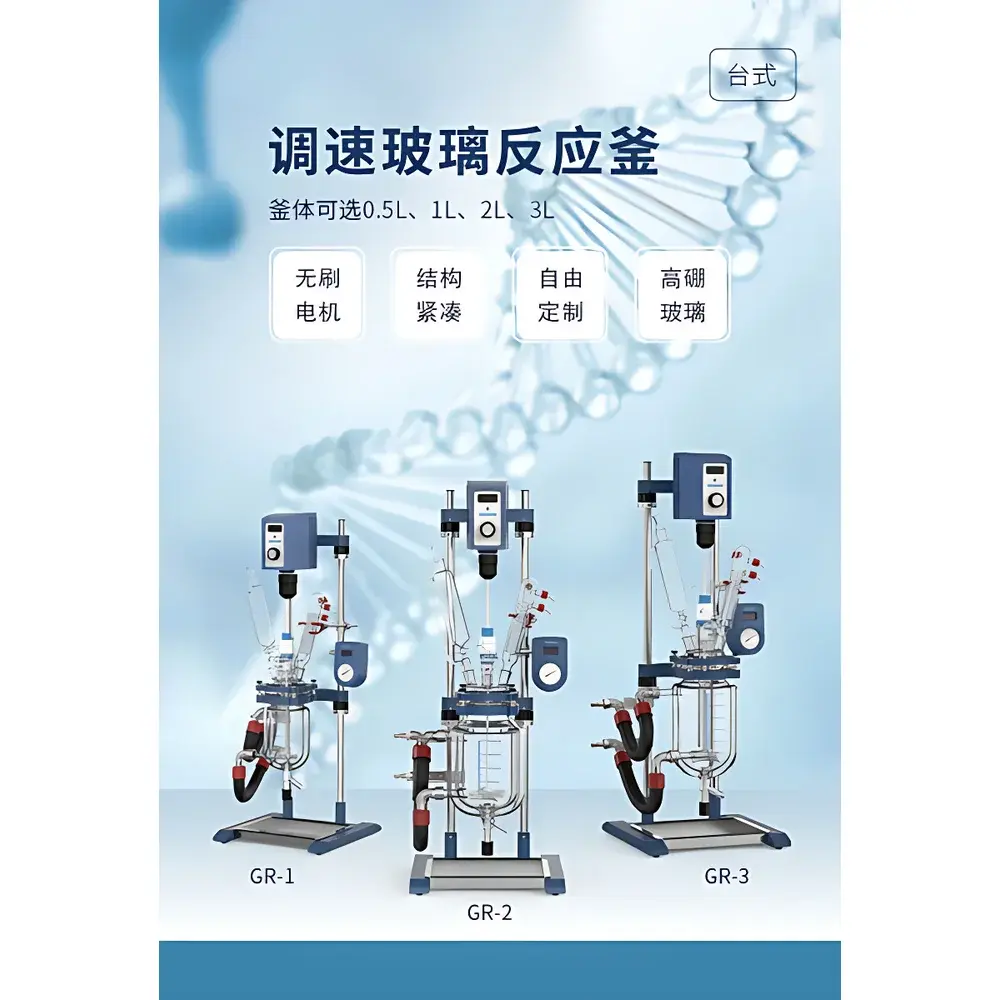
The Great Wall GR-1/2/3 Advanced Speed-Controlled Borosilicate Glass Reactor (1–3 L Capacity)
| Brand | The Great Wall |
|---|---|
| Origin | Henan, China |
| Manufacturer Type | Direct Manufacturer |
| Origin Category | Domestic |
| Model | GR-1 / GR-2 / GR-3 |
| Instrument Classification | Glass Reactor |
| Volume Range | 1 L, 2 L, 3 L (selectable) |
| Vessel Material | Borosilicate Glass 3.3 |
| Operating Pressure Range | –0.1 MPa to 0 MPa (vacuum to atmospheric) |
| Temperature Range | –80 °C to +200 °C |
| Jacketed Design | Dual-layer with stainless steel fluid ports |
| Stirring System | PTFE-coated SUS304 shaft, PTFE impeller, proprietary sealed bearing assembly |
| Frame | SUS304 structural frame + 6061-F aluminum panel with powder coating |
| Mobility | Locking casters with load-rated brakes |
| Compliance | Designed for GLP-compliant lab environments |
Overview
The Great Wall GR-Series Speed-Controlled Borosilicate Glass Reactors are engineered for precision-controlled chemical synthesis, solvent reflux, distillation, concentration, and extraction under vacuum or inert atmosphere. Built on the foundational principles of jacketed thermal management and mechanically sealed rotational agitation, these reactors operate via a dual-layer glass vessel architecture—where the outer jacket enables precise temperature regulation through external circulating fluid (e.g., silicone oil, ethylene glycol/water mixtures), while the inner vessel maintains full optical visibility and chemical inertness. The core measurement and control paradigm centers on maintaining reproducible reaction kinetics through stable temperature gradients, consistent shear profiles, and leak-tight vacuum integrity down to –0.1 MPa. Each unit is purpose-built for small-scale laboratory development (1–3 L working volume), supporting early-stage process optimization, catalyst screening, and API intermediate synthesis where material transparency, corrosion resistance, and thermal stability are non-negotiable.
Key Features
- Borosilicate glass 3.3 construction throughout all wetted components—including flask body, condenser, addition funnel, and thermometer sleeve—ensuring exceptional thermal shock resistance (ΔT ≥ 150 °C), low coefficient of thermal expansion (3.3 × 10⁻⁶/K), and high hydrolytic stability per ISO 719 HGB 1.
- Wide operational envelope: validated continuous use from –80 °C (with cryogenic circulator) to +200 °C (with high-temp oil bath), enabling both低温 lithiation protocols and high-boiling-point esterification reactions.
- Vacuum-compatible sealing system featuring a proprietary multi-lip PTFE-stainless steel mechanical seal, rated for sustained operation at –0.1 MPa without lubricant migration or vapor-phase leakage.
- Modular jacket interface with flexible stainless steel braided hoses and swivel fittings—eliminating torsional stress at inlet/outlet ports during thermal cycling or positional adjustment.
- Stirring assembly optimized for laminar-to-transitional flow regimes: PTFE-bladed impeller (chemically inert, low particle shedding) mounted on a double-sheathed SUS304 shaft (inner metal core + full PTFE overmold) for uniform torque transmission and zero metal-ion leaching.
- Structural frame fabricated from laser-cut 304 stainless steel uprights and anodized 6061-F aluminum horizontal panels with epoxy-polyester powder coating—resistant to common lab solvents and passivated against chloride-induced pitting.
Sample Compatibility & Compliance
These reactors accommodate heterogeneous and homogeneous reaction mixtures including organometallics, strong acids (e.g., concentrated H₂SO₄, HF-free etchants), halogenated solvents (CH₂Cl₂, chlorobenzene), and base-sensitive substrates (e.g., enolates, Grignard reagents). All glass joints conform to standard ISO 2955 taper specifications (e.g., 24/40, 29/32), ensuring interchangeability with condensers, drying tubes, and gas inlets from major global suppliers. The system supports integration with inert gas manifolds (N₂, Ar), digital vacuum controllers, and pressure transducers for closed-loop process monitoring. Documentation packages include factory calibration records, material traceability certificates (glass batch #, SS mill test reports), and design verification summaries aligned with ICH Q5A and FDA 21 CFR Part 11 data integrity expectations for audit-ready electronic lab notebooks (ELN).
Software & Data Management
While the GR-Series operates as a standalone analog-digital hybrid instrument (digital speed controller with LED feedback, analog temperature readout optional), it is fully compatible with third-party data acquisition systems via 0–10 V analog outputs for stir speed and optional PT100 input channels. Users may integrate reactor telemetry into LabArchives, Electronic Lab Notebook (ELN) platforms, or SCADA-grade historian systems using Modbus RTU over RS-485 (adapter available). All firmware logs timestamped event sequences—including motor start/stop, overtemperature alerts, and vacuum breach detection—with configurable retention policies compliant with GLP Annex 11 and ISO/IEC 17025 clause 7.7 requirements for record preservation.
Applications
- Batch-wise synthesis of fine chemicals and pharmaceutical intermediates under controlled exotherm management.
- Solvent recovery via rotary-assisted vacuum distillation with inline cold trap coupling.
- Photochemical reactions requiring UV-transparent vessels (borosilicate transmits >85% at 300 nm).
- Polymerization initiation studies (e.g., ring-opening, free-radical) with real-time viscosity trend capture via torque monitoring.
- Extraction protocol development for botanicals or natural products using Soxhlet-compatible reflux configurations.
- Electrochemical cell integration for electrocatalytic hydrogenation or CO₂ reduction studies.
FAQ
What is the maximum allowable vacuum level for continuous operation?
The GR-Series is rated for sustained operation at –0.1 MPa (10 mbar abs) when using the standard mechanical seal and properly torqued PTFE-coated ground-glass joints.
Can the reactor be used with hydrofluoric acid (HF)?
No. Although borosilicate glass 3.3 resists most mineral acids, it is not resistant to HF or fluoride-containing solutions above trace concentrations—use fused quartz alternatives for such applications.
Is the stirring motor explosion-proof?
Standard units are not ATEX or IECEx certified; however, intrinsically safe motor variants (Class I, Division 1) are available upon request with custom lead time.
Does the system support automated pH or dissolved oxygen feedback control?
Yes—via optional DIN-rail-mounted signal conditioners and 4–20 mA transmitter modules compatible with standard lab-grade probes (e.g., Hamilton, Mettler Toledo).
What documentation is provided for regulatory submissions?
Each shipment includes a Factory Acceptance Test (FAT) report, materials compliance statement (RoHS/REACH), and a User Requirement Specification (URS) alignment matrix referencing ISO 14644-1 cleanroom compatibility, ASME BPE surface finish standards, and GAMP5 category classification.



