
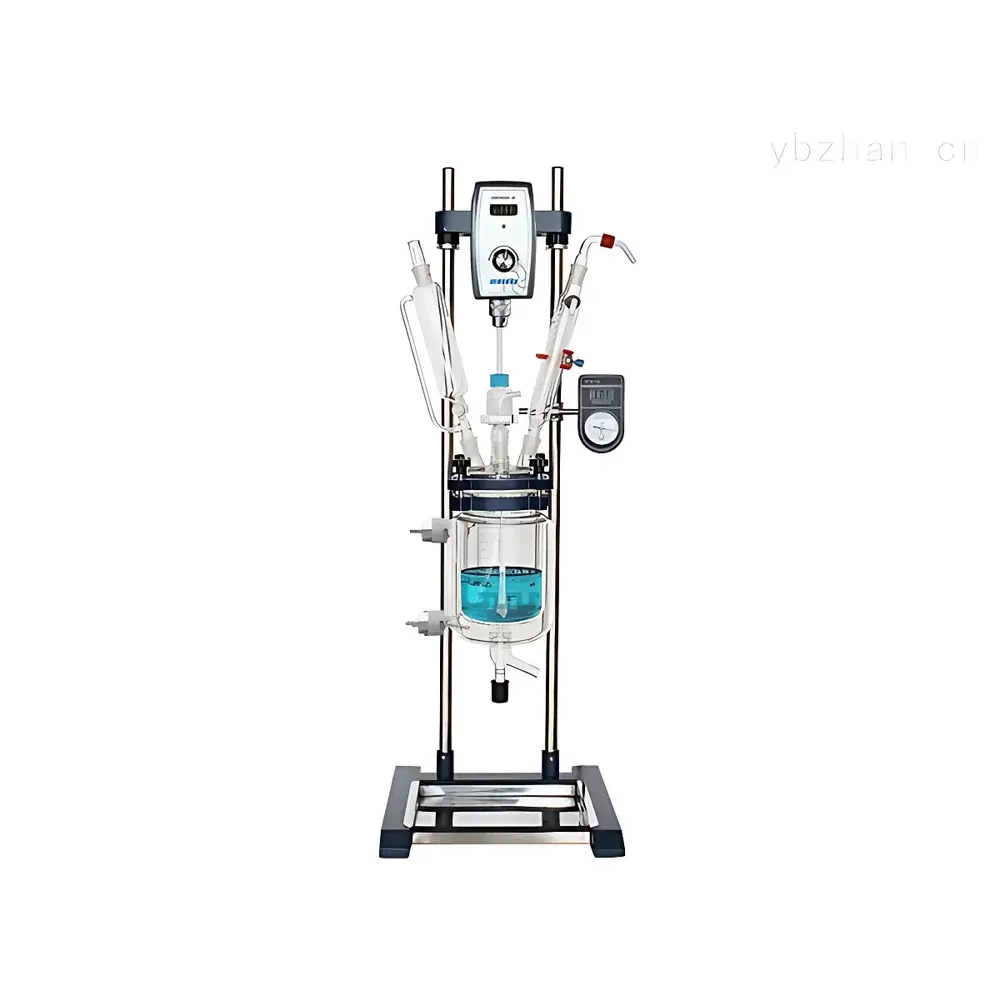
Great Wall GR-2 Small-Scale Glass Reactor
| Brand | Great Wall |
|---|---|
| Origin | Henan, China |
| Manufacturer Type | Direct Manufacturer |
| Country of Origin | China |
| Model | GR-2 |
| Price Range | USD 2,800–7,000 (FOB) |
| Usable Volume | 2 L |
| Construction Material | Borosilicate Glass 3.3 (DIN ISO 3585) |
| Operating Pressure Range | −0.1 MPa to 0 MPa (gauge) |
| Maximum Vacuum Level | 0.098 MPa (absolute) |
| Temperature Range | −80 °C to +200 °C |
| Sealing Components | PTFE/FKM stopcocks and discharge valves |
| O-rings | FEP-coated FKM elastomers |
| Integrated Gauges | Analog vacuum gauge + digital temperature display |
| Available Volumes | 1 L, 2 L, 3 L, 5 L |
Overview
The Great Wall GR-2 Small-Scale Glass Reactor is a precision-engineered laboratory reactor system designed for controlled synthesis, catalytic studies, crystallization, distillation, and solvent recovery under variable thermal and pressure conditions. Built entirely from high-purity borosilicate glass 3.3 (compliant with DIN ISO 3585), the GR-2 ensures exceptional thermal shock resistance, chemical inertness toward strong acids, bases, and organic solvents, and optical clarity for real-time visual monitoring of reaction progress. Its operational envelope spans −80 °C to +200 °C, enabled by compatible circulating chillers and heating mantles, while its pressure-rated design supports operation at atmospheric pressure or under stable vacuum down to 0.098 MPa (absolute), corresponding to a gauge pressure of −0.1 MPa. Unlike metal-jacketed reactors, the all-glass construction eliminates catalytic interference and metal leaching—critical for pharmaceutical intermediate synthesis, fine chemical development, and academic mechanistic studies where material purity and reproducibility are paramount.
Key Features
- Borosilicate glass 3.3 vessel (GR-2 model: 2 L nominal capacity, jacketed or non-jacketed configurations available)
- PTFE/FKM dual-material stopcocks and bottom discharge valves with zero dead-volume design for quantitative transfer
- FEP-coated FKM O-rings providing enhanced chemical resistance and compression set stability across the full operating temperature range
- Integrated analog vacuum gauge (0–−0.1 MPa scale) and digital PT100-based temperature display (±0.5 °C accuracy, 0.1 °C resolution)
- Standard NS29/32 and NS24/29 ground-glass joints (ISO 2768-mK tolerance) ensuring leak-tight assembly with interchangeable condensers, dropping funnels, and gas inlets
- Reinforced glass support frame with adjustable height and load-balanced clamping system for safe vertical orientation during reflux or distillation
Sample Compatibility & Compliance
The GR-2 is routinely deployed in GLP-compliant R&D laboratories for API route scouting, polymerization screening, and electrochemical precursor synthesis. Its inert surface prevents adsorption or catalytic side reactions common with stainless-steel reactors—making it especially suitable for lithium battery electrolyte formulation, Grignard reagent handling, and anhydrous organometallic chemistry. The reactor meets general requirements of ASTM E2877 (Standard Guide for Laboratory Reactor Safety) and aligns with ISO 17025 clause 6.4.2 regarding equipment suitability for intended use. While not certified to PED 2014/68/EU (as it operates exclusively below 0.5 bar gauge), its mechanical integrity is verified per EN 1591-1 flange calculation methodology for glass-to-glass joints under vacuum cycling. Documentation includes material certificates for glass (Schott BOROSILICATE 3.3), FKM elastomer lot traceability, and joint dimensional inspection reports.
Software & Data Management
The GR-2 is a standalone analog-digital hybrid instrument requiring no proprietary software for basic operation. However, its temperature output signal (4–20 mA or 0–10 V DC) and optional vacuum transducer (with 4–20 mA output) are compatible with third-party data acquisition systems—including LabVIEW, DeltaV, or Siemens Desigo CCMS—enabling time-stamped logging, alarm thresholds, and integration into centralized lab informatics platforms. For regulated environments, users may configure external controllers with audit-trail-capable firmware compliant with FDA 21 CFR Part 11 when paired with electronic signatures and role-based access control.
Applications
- Low-temperature lithiation and cryogenic enolate formation (−78 °C using dry ice/acetone baths)
- Vacuum-assisted solvent removal and fractional distillation of heat-sensitive natural extracts
- Heterogeneous catalysis under inert atmosphere (N₂/Ar purged via Schlenk line adapter)
- Photochemical reactions using UV-transparent quartz jackets (optional upgrade)
- Scale-down validation of pilot-scale batch processes prior to GMP manufacturing
- Teaching laboratory demonstrations of phase equilibria, Raoult’s law, and reaction kinetics
FAQ
What is the maximum allowable working temperature for continuous operation?
Continuous operation is rated up to +200 °C; intermittent exposure to 220 °C is permissible for ≤15 minutes provided thermal gradients remain below 50 °C/min.
Can the GR-2 be used for hydrogenation reactions?
Yes—with appropriate pressure-rated glass accessories (e.g., HPLC-rated autoclave caps, reinforced sight glasses) and certified gas-tight fittings; standard configuration supports only vacuum and ambient pressure.
Is the vacuum gauge calibrated and traceable to NIST standards?
The analog vacuum gauge is factory-calibrated against a reference capacitance manometer; calibration certificate (traceable to NIM, China) is supplied with each unit.
How is cleaning and residue verification performed for multi-use applications?
The fully disassemblable design allows ultrasonic cleaning in acetone/methanol; residual solvent verification may be conducted via GC-FID or FTIR-ATR of swabbed joint surfaces.
Does Great Wall provide IQ/OQ documentation packages?
Yes—upon request, a configurable qualification protocol (aligned with ASTM E2500 and Annex 15) including installation checks, operational boundary testing, and temperature/vacuum uniformity mapping is available.



