
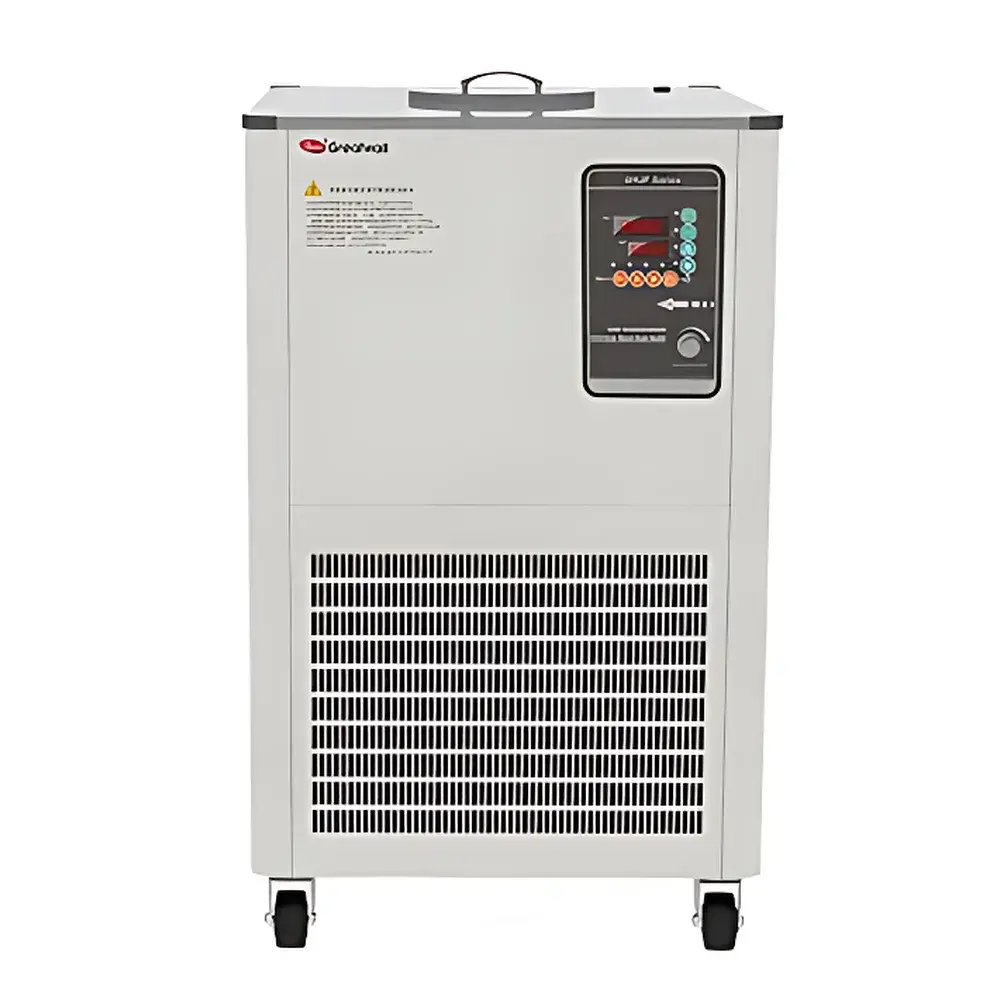
Great Wall DHJF-1210 Low-Temperature Constant-Temperature Stirred Bath
| Brand | The Great Wall |
|---|---|
| Origin | Henan, China |
| Manufacturer Type | Original Equipment Manufacturer (OEM) |
| Country of Origin | China |
| Model | DHJF-1210 |
| Pricing | Upon Request |
Overview
The Great Wall DHJF-1210 Low-Temperature Constant-Temperature Stirred Bath is an engineered thermal management system designed for precise temperature control and homogeneous mixing in demanding low-temperature laboratory applications. It operates on a single-stage compression cascade refrigeration principle—enhanced by serially coupled heat exchangers—to achieve stable operation across a wide cryogenic range from −120 °C to −60 °C. Unlike conventional single-stage systems limited by thermodynamic constraints, the DHJF-1210 employs a proprietary serial condensation architecture that enables multi-stage cooling performance using one hermetic reciprocating compressor. This design eliminates intermediate refrigerant staging while maintaining structural integrity through all-welded copper tubing joints and minimizes failure points. The bath integrates a submerged coil-type evaporator directly within the 304 stainless steel reservoir, ensuring mechanical resilience during phase transitions of heat transfer media—including scenarios where the coolant may partially freeze. Temperature regulation is executed via a microprocessor-based digital controller with 0.1 °C resolution and real-time feedback compensation.
Key Features
- Hermetically sealed Tecumseh-type reciprocating compressor offering high volumetric efficiency, low acoustic emission (<62 dB(A)), and extended service life under continuous cryogenic load.
- Air-cooled condenser with oxygen-free high-conductivity (OFHC) copper spiral tubing—optimized for convective heat dissipation and resistance to oxidation in ambient environments up to 35 °C.
- Serial-coupled heat exchanger array utilizing single-compressor-driven partial condensation, enabling −120 °C operation without liquid nitrogen or secondary refrigerants.
- Submerged helical evaporator constructed from seamless 316L stainless steel tubing, fully immersed in the reservoir and mechanically isolated from ice expansion forces.
- Digital PID controller with dual-sensor input (bath sensor + external probe option), programmable ramp/soak profiles, and auto-tuning functionality.
- Integrated magnetic stirrer (50 W, 100–1000 rpm) with adjustable torque and non-contact coupling—designed to maintain uniform suspension of catalysts, nanoparticles, or viscous reaction mixtures at sub-zero temperatures.
- Comprehensive safety architecture including compressor delay protection (3-min restart lockout), overcurrent cutoff (IEC 61000-4-5 compliant), and dual independent thermal cutouts (T1: 120 °C; T2: 150 °C).
Sample Compatibility & Compliance
The DHJF-1210 accommodates standard laboratory glassware up to 3 L capacity (e.g., three-neck flasks, jacketed reactors, and Schlenk tubes) via its Φ210 mm opening and Φ250 × 250 mm cylindrical reservoir. Its 304 stainless steel tank meets ASTM A240 requirements for corrosion resistance in chloride-containing coolants (e.g., ethanol/methanol/water blends or specialized low-temperature heat transfer fluids). The unit conforms to IEC 61010-1:2010 for electrical safety in laboratory equipment and incorporates grounding continuity verification per EN 61326-1 for electromagnetic compatibility. While not certified for Class I Div 1 hazardous locations, it supports GLP-compliant workflows when paired with validated external data loggers and audit-trail-enabled software interfaces.
Software & Data Management
The DHJF-1210 operates as a standalone instrument with embedded firmware supporting RS-485 Modbus RTU communication (optional USB-to-RS485 adapter required). It exports time-stamped temperature/stirring data at user-defined intervals (1–600 s) to external SCADA or LIMS platforms. When integrated with Great Wall’s optional WinBath Pro v3.2 software (Windows 10/11 compatible), users gain access to real-time graphical trending, alarm event logging with timestamped cause codes, and CSV export compliant with FDA 21 CFR Part 11 Annex 11 requirements—including electronic signatures, audit trails, and data integrity validation reports. All firmware updates are digitally signed and verified prior to installation.
Applications
- Cryogenic synthesis of organometallic compounds requiring strict thermal control below −80 °C (e.g., n-BuLi-mediated lithiations, Grignard additions).
- Low-temperature polymerization kinetics studies where viscosity changes must be monitored in situ under shear.
- Calibration of infrared detectors, bolometers, and superconducting quantum interference devices (SQUIDs) across extended cold plate ranges.
- Stability testing of pharmaceutical intermediates per ICH Q1A(R2) guidelines at accelerated sub-ambient conditions.
- Material science investigations involving phase transition analysis of shape-memory alloys or ferrofluids under controlled convection.
- Environmental simulation chambers for evaluating sealant performance and elastomer brittleness per ASTM D746 and ISO 974.
FAQ
What refrigerant blend is used in the DHJF-1210?
The system uses a proprietary zeotropic mixture of R23/R13/R14, selected for optimal pressure-temperature characteristics across the −120 °C to −60 °C range and zero ozone depletion potential (ODP = 0).
Can the unit operate continuously at −120 °C?
Yes—continuous operation at −120 °C is supported for up to 72 hours under nominal load (≤60% of max refrigeration capacity), provided ambient conditions remain within 5–35 °C and relative humidity ≤70%.
Is external chilling water required for condenser cooling?
No—the air-cooled condenser operates autonomously; no chilled water loop or facility cooling infrastructure is needed.
Does the magnetic stirrer function reliably below −80 °C?
Yes—the stirrer motor and coupling are rated for continuous operation down to −100 °C; torque delivery remains linear across the full 100–1000 rpm range.
What maintenance intervals are recommended?
Compressor oil inspection every 2000 operating hours; condenser coil cleaning every 6 months in dusty environments; annual calibration of temperature sensors traceable to NIST standards.
Related Products



